

2.6 Some More Remarks on Rubber Reinforcement
39
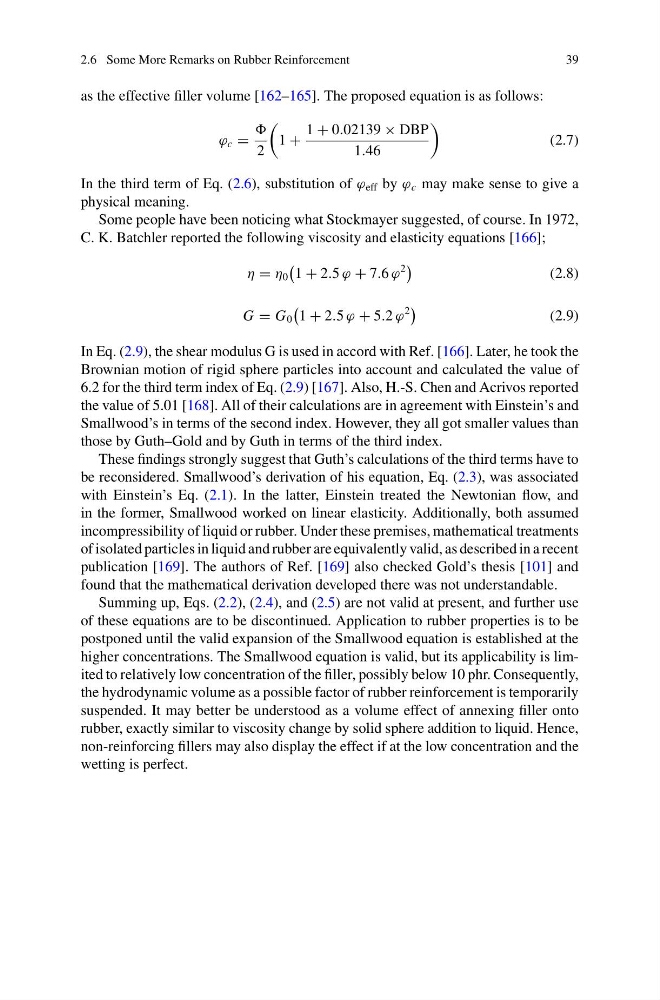
as the effective filler volume [162–165]. The proposed equation is as follows:
ϕ c =
2
1 +
1 + 0.02139 × DBP
1.46
(2.7)
In the third term of Eq. (2.6), substitution of ϕ eff by ϕ c may make sense to give a
physical meaning.
Some people have been noticing what Stockmayer suggested, of course. In 1972,
C. K. Batchler reported the following viscosity and elasticity equations [166];
η = η 0
1 + 2.5 ϕ + 7.6 ϕ
2
(2.8)
G = G 0
1 + 2.5 ϕ + 5.2 ϕ
2
(2.9)
In Eq. (2.9), the shear modulus G is used in accord with Ref. [166]. Later, he took the
Brownian motion of rigid sphere particles into account and calculated the value of
6.2 for the third term index of Eq. (2.9) [167]. Also, H.-S. Chen and Acrivos reported
the value of 5.01 [168]. All of their calculations are in agreement with Einstein’s and
Smallwood’s in terms of the second index. However, they all got smaller values than
those by Guth–Gold and by Guth in terms of the third index.
These findings strongly suggest that Guth’s calculations of the third terms have to
be reconsidered. Smallwood’s derivation of his equation, Eq. (2.3), was associated
with Einstein’s Eq. (2.1). In the latter, Einstein treated the Newtonian flow, and
in the former, Smallwood worked on linear elasticity. Additionally, both assumed
incompressibility of liquid or rubber. Under these premises, mathematical treatments
of isolated particles in liquid and rubber are equivalently valid, as described in a recent
publication [169]. The authors of Ref. [169] also checked Gold’s thesis [101] and
found that the mathematical derivation developed there was not understandable.
Summing up, Eqs. (2.2), (2.4), and (2.5) are not valid at present, and further use
of these equations are to be discontinued. Application to rubber properties is to be
postponed until the valid expansion of the Smallwood equation is established at the
higher concentrations. The Smallwood equation is valid, but its applicability is limited to relatively low concentration of the filler, possibly below 10 phr. Consequently,
the hydrodynamic volume as a possible factor of rubber reinforcement is temporarily
suspended. It may better be understood as a volume effect of annexing filler onto
rubber, exactly similar to viscosity change by solid sphere addition to liquid. Hence,
non-reinforcing fillers may also display the effect if at the low concentration and the
wetting is perfect.
39
as the effective filler volume [162–165]. The proposed equation is as follows:
ϕ c =
2
1 +
1 + 0.02139 × DBP
1.46
(2.7)
In the third term of Eq. (2.6), substitution of ϕ eff by ϕ c may make sense to give a
physical meaning.
Some people have been noticing what Stockmayer suggested, of course. In 1972,
C. K. Batchler reported the following viscosity and elasticity equations [166];
η = η 0
1 + 2.5 ϕ + 7.6 ϕ
2
(2.8)
G = G 0
1 + 2.5 ϕ + 5.2 ϕ
2
(2.9)
In Eq. (2.9), the shear modulus G is used in accord with Ref. [166]. Later, he took the
Brownian motion of rigid sphere particles into account and calculated the value of
6.2 for the third term index of Eq. (2.9) [167]. Also, H.-S. Chen and Acrivos reported
the value of 5.01 [168]. All of their calculations are in agreement with Einstein’s and
Smallwood’s in terms of the second index. However, they all got smaller values than
those by Guth–Gold and by Guth in terms of the third index.
These findings strongly suggest that Guth’s calculations of the third terms have to
be reconsidered. Smallwood’s derivation of his equation, Eq. (2.3), was associated
with Einstein’s Eq. (2.1). In the latter, Einstein treated the Newtonian flow, and
in the former, Smallwood worked on linear elasticity. Additionally, both assumed
incompressibility of liquid or rubber. Under these premises, mathematical treatments
of isolated particles in liquid and rubber are equivalently valid, as described in a recent
publication [169]. The authors of Ref. [169] also checked Gold’s thesis [101] and
found that the mathematical derivation developed there was not understandable.
Summing up, Eqs. (2.2), (2.4), and (2.5) are not valid at present, and further use
of these equations are to be discontinued. Application to rubber properties is to be
postponed until the valid expansion of the Smallwood equation is established at the
higher concentrations. The Smallwood equation is valid, but its applicability is limited to relatively low concentration of the filler, possibly below 10 phr. Consequently,
the hydrodynamic volume as a possible factor of rubber reinforcement is temporarily
suspended. It may better be understood as a volume effect of annexing filler onto
rubber, exactly similar to viscosity change by solid sphere addition to liquid. Hence,
non-reinforcing fillers may also display the effect if at the low concentration and the
wetting is perfect.