

2.5 Reinforcing Factors of Particulate Nanofiller
35
research projects on filler networking at the end of twentieth century or at the beginning of the new century. Our group was one of them. We used Fig. 2.7 as the starting
hypothesis on that occasion, which was modified in accordance with the context and
used in our publications [12, 133–136].
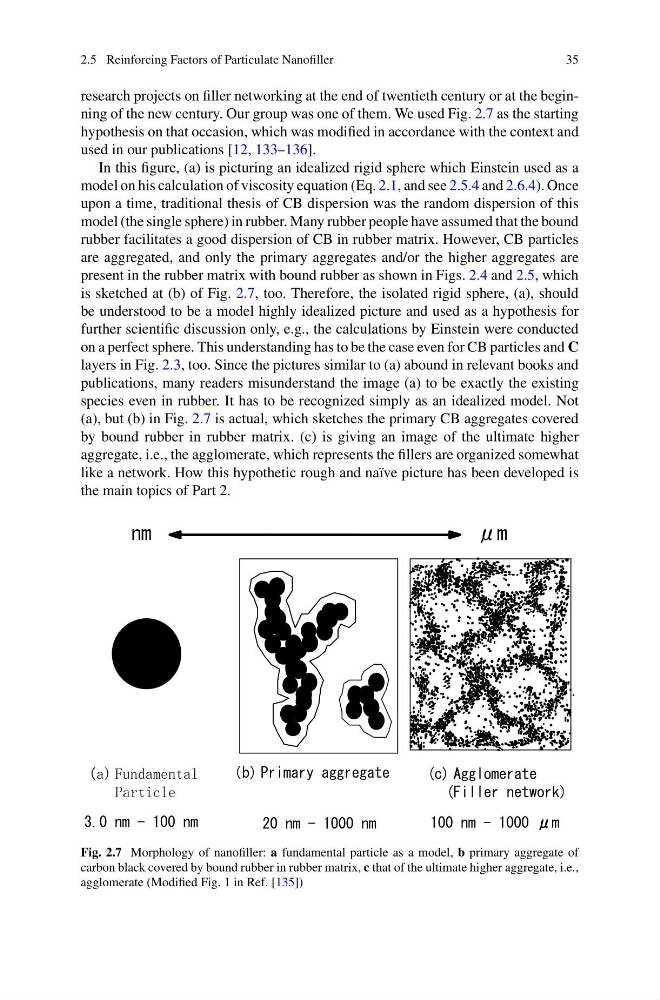
In this figure, (a) is picturing an idealized rigid sphere which Einstein used as a
model on his calculation of viscosity equation (Eq. 2.1, and see 2.5.4 and 2.6.4). Once
upon a time, traditional thesis of CB dispersion was the random dispersion of this
model (the single sphere) in rubber. Many rubber people have assumed that the bound
rubber facilitates a good dispersion of CB in rubber matrix. However, CB particles
are aggregated, and only the primary aggregates and/or the higher aggregates are
present in the rubber matrix with bound rubber as shown in Figs. 2.4 and 2.5, which
is sketched at (b) of Fig. 2.7, too. Therefore, the isolated rigid sphere, (a), should
be understood to be a model highly idealized picture and used as a hypothesis for
further scientific discussion only, e.g., the calculations by Einstein were conducted
on a perfect sphere. This understanding has to be the case even for CB particles and C
layers in Fig. 2.3, too. Since the pictures similar to (a) abound in relevant books and
publications, many readers misunderstand the image (a) to be exactly the existing
species even in rubber. It has to be recognized simply as an idealized model. Not
(a), but (b) in Fig. 2.7 is actual, which sketches the primary CB aggregates covered
by bound rubber in rubber matrix. (c) is giving an image of the ultimate higher
aggregate, i.e., the agglomerate, which represents the fillers are organized somewhat
like a network. How this hypothetic rough and naïve picture has been developed is
the main topics of Part 2.
Fig. 2.7 Morphology of nanofiller: a fundamental particle as a model, b primary aggregate of
carbon black covered by bound rubber in rubber matrix, c that of the ultimate higher aggregate, i.e.,
agglomerate (Modified Fig. 1 in Ref. [135])
35
research projects on filler networking at the end of twentieth century or at the beginning of the new century. Our group was one of them. We used Fig. 2.7 as the starting
hypothesis on that occasion, which was modified in accordance with the context and
used in our publications [12, 133–136].
In this figure, (a) is picturing an idealized rigid sphere which Einstein used as a
model on his calculation of viscosity equation (Eq. 2.1, and see 2.5.4 and 2.6.4). Once
upon a time, traditional thesis of CB dispersion was the random dispersion of this
model (the single sphere) in rubber. Many rubber people have assumed that the bound
rubber facilitates a good dispersion of CB in rubber matrix. However, CB particles
are aggregated, and only the primary aggregates and/or the higher aggregates are
present in the rubber matrix with bound rubber as shown in Figs. 2.4 and 2.5, which
is sketched at (b) of Fig. 2.7, too. Therefore, the isolated rigid sphere, (a), should
be understood to be a model highly idealized picture and used as a hypothesis for
further scientific discussion only, e.g., the calculations by Einstein were conducted
on a perfect sphere. This understanding has to be the case even for CB particles and C
layers in Fig. 2.3, too. Since the pictures similar to (a) abound in relevant books and
publications, many readers misunderstand the image (a) to be exactly the existing
species even in rubber. It has to be recognized simply as an idealized model. Not
(a), but (b) in Fig. 2.7 is actual, which sketches the primary CB aggregates covered
by bound rubber in rubber matrix. (c) is giving an image of the ultimate higher
aggregate, i.e., the agglomerate, which represents the fillers are organized somewhat
like a network. How this hypothetic rough and naïve picture has been developed is
the main topics of Part 2.
Fig. 2.7 Morphology of nanofiller: a fundamental particle as a model, b primary aggregate of
carbon black covered by bound rubber in rubber matrix, c that of the ultimate higher aggregate, i.e.,
agglomerate (Modified Fig. 1 in Ref. [135])