

26
2 Filler and Rubber Reinforcement
and lower mobility was found than those in the matrix (continuous) phase [79, 80].
Hence, the expression ‘immobilized layer’ has been proposed, and both bound rubber and immobilized layer have been interchangeably used. The latter suggests lower
mobility of bound rubber in terms of the micro-Brownian motion of rubber chains.
It is notable that ‘immobilized’ does not necessarily mean no micro-Brown motion
at all.
Reference [5] edited by Kraus, has played an active role for the spread of the
bound rubber concept among rubber people worldwide. Chapter 1 by Bueche [81],
3 by Payne, 4 by Kraus, and 12 by M. L. Studebaker of the book are still worthy of
careful reading in order to know the nature of bound rubber. J. Furukawa reported a
figure showing the cross-linked rubber as the bound rubber [82]. Also, there appeared
a paper showing bound rubber as cross-linked state [83]. Their explanations were
partially compatible with what Bueche had written in Chap. 1.
However, the most influential study so far specifically on bound rubber is
K. Fujimoto’s heterogeneous structural model of the rubber vulcanizate [79,
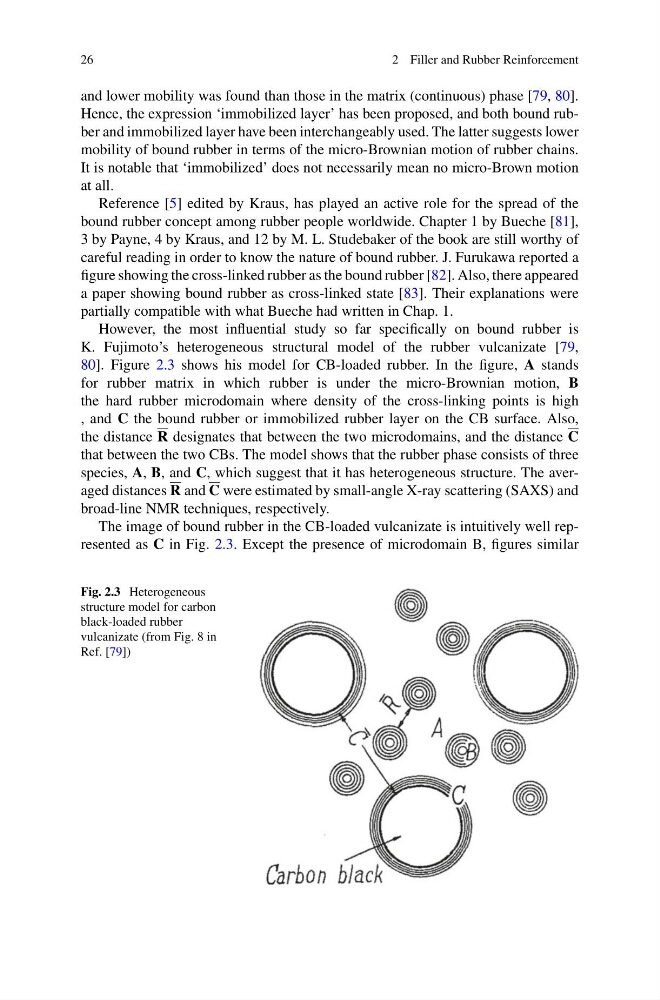
80]. Figure 2.3 shows his model for CB-loaded rubber. In the figure, A stands
for rubber matrix in which rubber is under the micro-Brownian motion, B
the hard rubber microdomain where density of the cross-linking points is high
, and C the bound rubber or immobilized rubber layer on the CB surface. Also,
the distance R designates that between the two microdomains, and the distance C
that between the two CBs. The model shows that the rubber phase consists of three
species, A, B, and C, which suggest that it has heterogeneous structure. The averaged distances R and C were estimated by small-angle X-ray scattering (SAXS) and
broad-line NMR techniques, respectively.
The image of bound rubber in the CB-loaded vulcanizate is intuitively well represented as C in Fig. 2.3. Except the presence of microdomain B, figures similar
Fig. 2.3 Heterogeneous
structure model for carbon
black-loaded rubber
vulcanizate (from Fig. 8 in
Ref. [79])
2 Filler and Rubber Reinforcement
and lower mobility was found than those in the matrix (continuous) phase [79, 80].
Hence, the expression ‘immobilized layer’ has been proposed, and both bound rubber and immobilized layer have been interchangeably used. The latter suggests lower
mobility of bound rubber in terms of the micro-Brownian motion of rubber chains.
It is notable that ‘immobilized’ does not necessarily mean no micro-Brown motion
at all.
Reference [5] edited by Kraus, has played an active role for the spread of the
bound rubber concept among rubber people worldwide. Chapter 1 by Bueche [81],
3 by Payne, 4 by Kraus, and 12 by M. L. Studebaker of the book are still worthy of
careful reading in order to know the nature of bound rubber. J. Furukawa reported a
figure showing the cross-linked rubber as the bound rubber [82]. Also, there appeared
a paper showing bound rubber as cross-linked state [83]. Their explanations were
partially compatible with what Bueche had written in Chap. 1.
However, the most influential study so far specifically on bound rubber is
K. Fujimoto’s heterogeneous structural model of the rubber vulcanizate [79,
80]. Figure 2.3 shows his model for CB-loaded rubber. In the figure, A stands
for rubber matrix in which rubber is under the micro-Brownian motion, B
the hard rubber microdomain where density of the cross-linking points is high
, and C the bound rubber or immobilized rubber layer on the CB surface. Also,
the distance R designates that between the two microdomains, and the distance C
that between the two CBs. The model shows that the rubber phase consists of three
species, A, B, and C, which suggest that it has heterogeneous structure. The averaged distances R and C were estimated by small-angle X-ray scattering (SAXS) and
broad-line NMR techniques, respectively.
The image of bound rubber in the CB-loaded vulcanizate is intuitively well represented as C in Fig. 2.3. Except the presence of microdomain B, figures similar
Fig. 2.3 Heterogeneous
structure model for carbon
black-loaded rubber
vulcanizate (from Fig. 8 in
Ref. [79])