

16
2 Filler and Rubber Reinforcement
At the cross-linking step, the presence of filler at a high temperature (cross-linking
temperature, usually between 130 and 220 °C) may lead to some chemical reactions
of curing agents with filler surface. The reacted filler surface may influence to the
filler dispersion in the cross-linked rubber. Further studies on the mechanochemical
reactions are absolutely necessary for the exact elucidation of them all during rubber
processing, particularly during mechanical mixing.
The majority of rubber samples displayed in this book is prepared by using the socalled standard formulations and is subjected to the ordinary mixing and cross-linking
conditions. On these samples, the present authors reasonably assume the influence
of the processing conditions on the reinforcement effect is at least minimized and
not to annul the presented discussions. Thus, the results described here are of use
for placing the rubber mixing on scientific basis, which helps rubber processing
engineers to make a progress in their technically finding the way to discontinue their
total dependence on the trial-and-error method in treating rubber compounds.
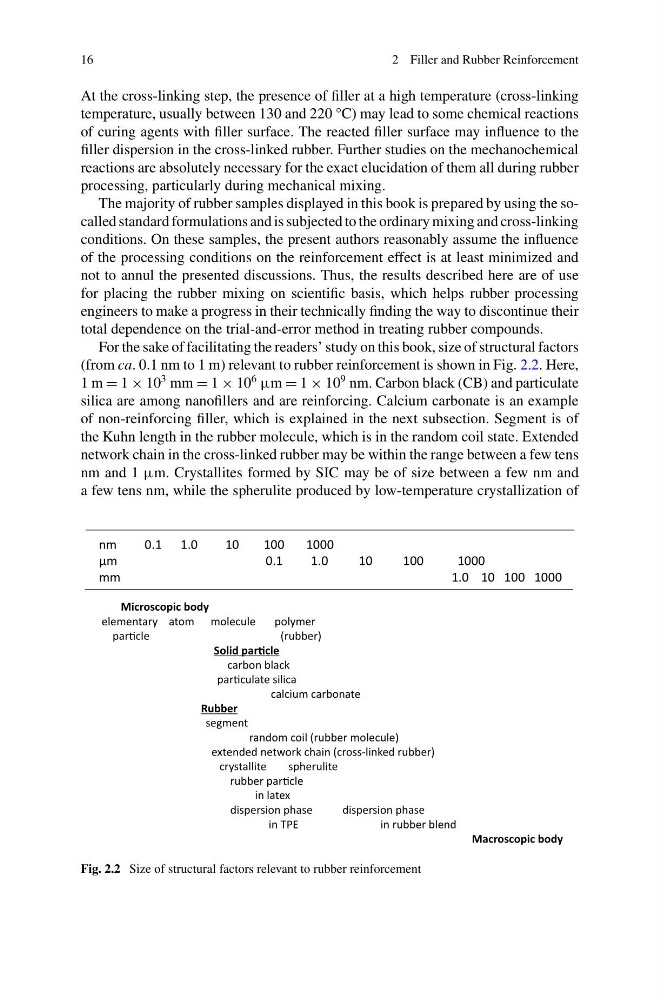
For the sake of facilitating the readers’ study on this book, size of structural factors
(from ca. 0.1 nm to 1 m) relevant to rubber reinforcement is shown in Fig. 2.2. Here,
1 m = 1 × 10
3 mm = 1 × 10
6
µm = 1 × 10
9 nm. Carbon black (CB) and particulate
silica are among nanofillers and are reinforcing. Calcium carbonate is an example
of non-reinforcing filler, which is explained in the next subsection. Segment is of
the Kuhn length in the rubber molecule, which is in the random coil state. Extended
network chain in the cross-linked rubber may be within the range between a few tens
nm and 1 µm. Crystallites formed by SIC may be of size between a few nm and
a few tens nm, while the spherulite produced by low-temperature crystallization of
nm
0.1 1.0
10
100
1000
μm
0.1
1.0
10
100
1000
mm
1.0 10 100 1000
Microscopic body
elementary atom molecule
polymer
parƟcle
(rubber)
Solid parƟcle
carbon black
parƟculate silica
calcium carbonate
Rubber
segment
random coil (rubber molecule)
extended network chain (cross-linked rubber)
crystallite
spherulite
rubber parƟcle
in latex
dispersion phase
dispersion phase
in TPE
in rubber blend
Macroscopic body
Fig. 2.2 Size of structural factors relevant to rubber reinforcement
2 Filler and Rubber Reinforcement
At the cross-linking step, the presence of filler at a high temperature (cross-linking
temperature, usually between 130 and 220 °C) may lead to some chemical reactions
of curing agents with filler surface. The reacted filler surface may influence to the
filler dispersion in the cross-linked rubber. Further studies on the mechanochemical
reactions are absolutely necessary for the exact elucidation of them all during rubber
processing, particularly during mechanical mixing.
The majority of rubber samples displayed in this book is prepared by using the socalled standard formulations and is subjected to the ordinary mixing and cross-linking
conditions. On these samples, the present authors reasonably assume the influence
of the processing conditions on the reinforcement effect is at least minimized and
not to annul the presented discussions. Thus, the results described here are of use
for placing the rubber mixing on scientific basis, which helps rubber processing
engineers to make a progress in their technically finding the way to discontinue their
total dependence on the trial-and-error method in treating rubber compounds.
For the sake of facilitating the readers’ study on this book, size of structural factors
(from ca. 0.1 nm to 1 m) relevant to rubber reinforcement is shown in Fig. 2.2. Here,
1 m = 1 × 10
3 mm = 1 × 10
6
µm = 1 × 10
9 nm. Carbon black (CB) and particulate
silica are among nanofillers and are reinforcing. Calcium carbonate is an example
of non-reinforcing filler, which is explained in the next subsection. Segment is of
the Kuhn length in the rubber molecule, which is in the random coil state. Extended
network chain in the cross-linked rubber may be within the range between a few tens
nm and 1 µm. Crystallites formed by SIC may be of size between a few nm and
a few tens nm, while the spherulite produced by low-temperature crystallization of
nm
0.1 1.0
10
100
1000
μm
0.1
1.0
10
100
1000
mm
1.0 10 100 1000
Microscopic body
elementary atom molecule
polymer
parƟcle
(rubber)
Solid parƟcle
carbon black
parƟculate silica
calcium carbonate
Rubber
segment
random coil (rubber molecule)
extended network chain (cross-linked rubber)
crystallite
spherulite
rubber parƟcle
in latex
dispersion phase
dispersion phase
in TPE
in rubber blend
Macroscopic body
Fig. 2.2 Size of structural factors relevant to rubber reinforcement