

14
2 Filler and Rubber Reinforcement
it makes sense, but we do not call it filler in this book. In this connection, we will
explain ‘non-reinforcing filler’ afresh in the next subsection.
In the case of natural rubber (NR) or some synthetic crystallizable rubbers, selfreinforcement effect is observed without compounding any reinforcing fillers. This
effect has been typically recognized in cross-linked NRs, which is due to straininduced crystallization (SIC). SIC was reported very early [13], whose mechanism
is only recently proposed to be template crystallization [12, 14, 15]. SIC of NR is
observed only at a higher strain, approximately at the elongation ratio of more than
4.0, and is a reversible process in terms of stretching and contraction. The resultant
oriented crystallites, which are formed at place, function as self-reinforcing filler
generated in situ. Details of SIC and template crystallization are to be described in
Chap. 8.
Thermoplastic elastomer (TPE) is also known to be self-reinforcing. TPE is thermoplastic due to its microphase separated structure between the hard segments and
the soft segments. The microdomains of the hard segments afford both cross-linking
and reinforcing effects in the soft-segment matrix [12, 16]. Self-reinforcements are
unique and interesting and offering much different features from the reinforcement
by compounding a nanofiller. However, Ref. [16] has given a detailed account for
TPE, and the details of self-reinforcement effect in NR are only recently elucidated.
In this book, only the latter is intensively treated in Chap. 8.
For establishing the reinforcement effect on rubber, we have to pay attention
to the influence of rubber processing [6, 8–12] onto the reinforcement beforehand.
After adopting an appropriate compounding recipe, processing of rubber begins. The
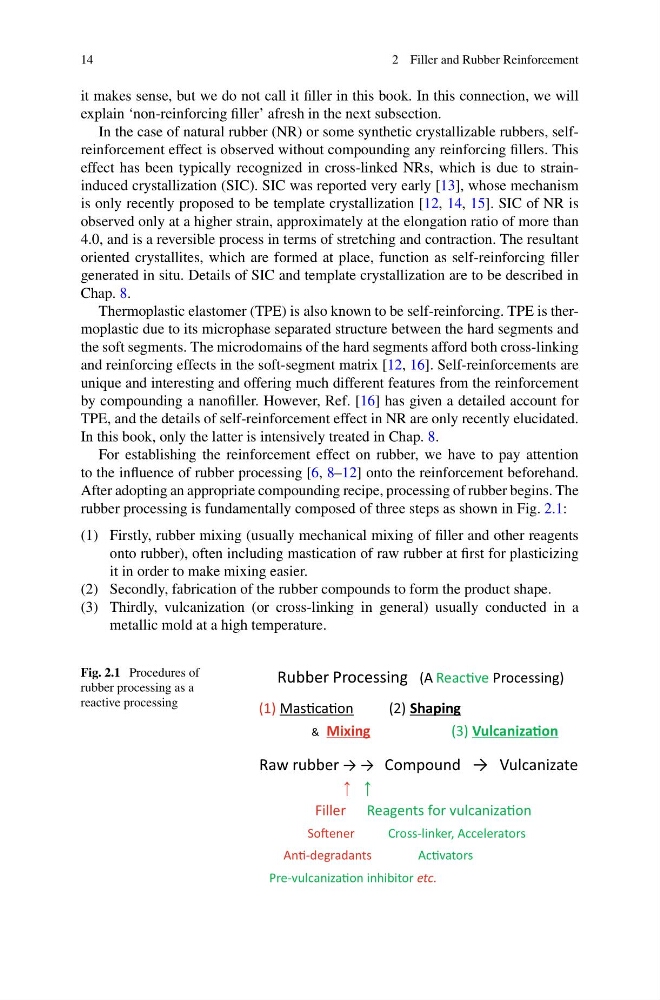
rubber processing is fundamentally composed of three steps as shown in Fig. 2.1:
(1) Firstly, rubber mixing (usually mechanical mixing of filler and other reagents
onto rubber), often including mastication of raw rubber at first for plasticizing
it in order to make mixing easier.
(2) Secondly, fabrication of the rubber compounds to form the product shape.
(3) Thirdly, vulcanization (or cross-linking in general) usually conducted in a
metallic mold at a high temperature.
Fig. 2.1 Procedures of
rubber processing as a
reactive processing
Rubber Processing (A ReacƟve Processing)
(1) MasƟcaƟon
(2) Shaping
& Mixing
(3) VulcanizaƟon
Raw rubber → → Compound → Vulcanizate
↑ ↑
Filler Reagents for vulcanizaƟon
SoŌener
Cross-linker, Accelerators
AnƟ-degradants
AcƟvators
Pre-vulcanizaƟon inhibitor etc.
2 Filler and Rubber Reinforcement
it makes sense, but we do not call it filler in this book. In this connection, we will
explain ‘non-reinforcing filler’ afresh in the next subsection.
In the case of natural rubber (NR) or some synthetic crystallizable rubbers, selfreinforcement effect is observed without compounding any reinforcing fillers. This
effect has been typically recognized in cross-linked NRs, which is due to straininduced crystallization (SIC). SIC was reported very early [13], whose mechanism
is only recently proposed to be template crystallization [12, 14, 15]. SIC of NR is
observed only at a higher strain, approximately at the elongation ratio of more than
4.0, and is a reversible process in terms of stretching and contraction. The resultant
oriented crystallites, which are formed at place, function as self-reinforcing filler
generated in situ. Details of SIC and template crystallization are to be described in
Chap. 8.
Thermoplastic elastomer (TPE) is also known to be self-reinforcing. TPE is thermoplastic due to its microphase separated structure between the hard segments and
the soft segments. The microdomains of the hard segments afford both cross-linking
and reinforcing effects in the soft-segment matrix [12, 16]. Self-reinforcements are
unique and interesting and offering much different features from the reinforcement
by compounding a nanofiller. However, Ref. [16] has given a detailed account for
TPE, and the details of self-reinforcement effect in NR are only recently elucidated.
In this book, only the latter is intensively treated in Chap. 8.
For establishing the reinforcement effect on rubber, we have to pay attention
to the influence of rubber processing [6, 8–12] onto the reinforcement beforehand.
After adopting an appropriate compounding recipe, processing of rubber begins. The
rubber processing is fundamentally composed of three steps as shown in Fig. 2.1:
(1) Firstly, rubber mixing (usually mechanical mixing of filler and other reagents
onto rubber), often including mastication of raw rubber at first for plasticizing
it in order to make mixing easier.
(2) Secondly, fabrication of the rubber compounds to form the product shape.
(3) Thirdly, vulcanization (or cross-linking in general) usually conducted in a
metallic mold at a high temperature.
Fig. 2.1 Procedures of
rubber processing as a
reactive processing
Rubber Processing (A ReacƟve Processing)
(1) MasƟcaƟon
(2) Shaping
& Mixing
(3) VulcanizaƟon
Raw rubber → → Compound → Vulcanizate
↑ ↑
Filler Reagents for vulcanizaƟon
SoŌener
Cross-linker, Accelerators
AnƟ-degradants
AcƟvators
Pre-vulcanizaƟon inhibitor etc.