

9.3 Soft Nanocomposites in the Twenty-First Century
183
studies on self-reinforcement (template crystallization behaviors) of the two NRs
and evaluation of their tensile behaviors are progressing to increase the potential of
their large-scale production [80–84].
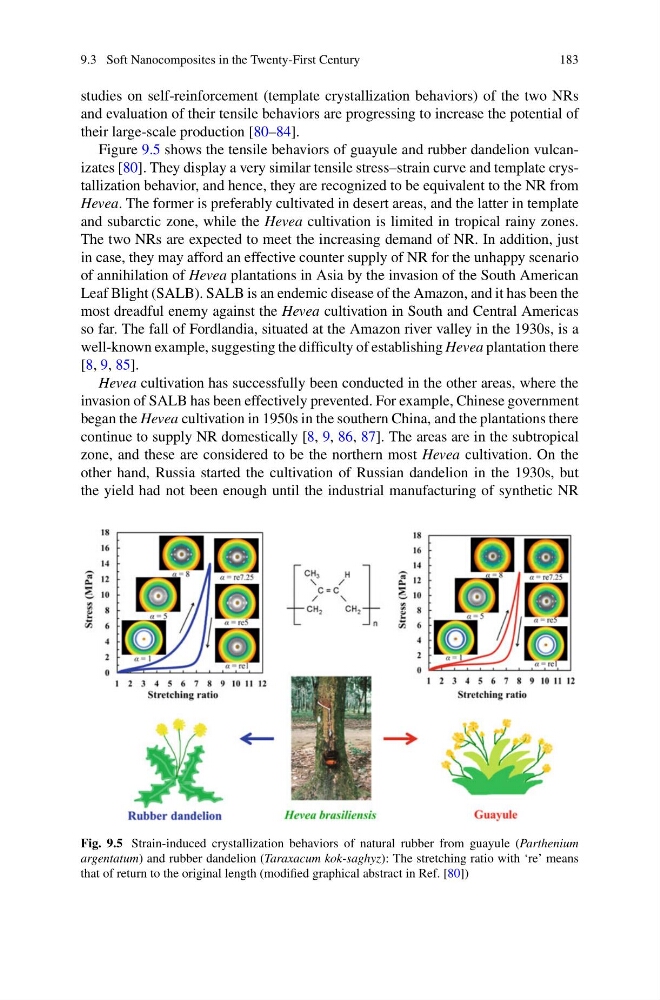
Figure 9.5 shows the tensile behaviors of guayule and rubber dandelion vulcanizates [80]. They display a very similar tensile stress–strain curve and template crystallization behavior, and hence, they are recognized to be equivalent to the NR from
Hevea. The former is preferably cultivated in desert areas, and the latter in template
and subarctic zone, while the Hevea cultivation is limited in tropical rainy zones.
The two NRs are expected to meet the increasing demand of NR. In addition, just
in case, they may afford an effective counter supply of NR for the unhappy scenario
of annihilation of Hevea plantations in Asia by the invasion of the South American
Leaf Blight (SALB). SALB is an endemic disease of the Amazon, and it has been the
most dreadful enemy against the Hevea cultivation in South and Central Americas
so far. The fall of Fordlandia, situated at the Amazon river valley in the 1930s, is a
well-known example, suggesting the difficulty of establishing Hevea plantation there
[8, 9, 85].
Hevea cultivation has successfully been conducted in the other areas, where the
invasion of SALB has been effectively prevented. For example, Chinese government
began the Hevea cultivation in 1950s in the southern China, and the plantations there
continue to supply NR domestically [8, 9, 86, 87]. The areas are in the subtropical
zone, and these are considered to be the northern most Hevea cultivation. On the
other hand, Russia started the cultivation of Russian dandelion in the 1930s, but
the yield had not been enough until the industrial manufacturing of synthetic NR
Fig. 9.5 Strain-induced crystallization behaviors of natural rubber from guayule (Parthenium
argentatum) and rubber dandelion (Taraxacum kok-saghyz): The stretching ratio with ‘re’ means
that of return to the original length (modified graphical abstract in Ref. [80])
183
studies on self-reinforcement (template crystallization behaviors) of the two NRs
and evaluation of their tensile behaviors are progressing to increase the potential of
their large-scale production [80–84].
Figure 9.5 shows the tensile behaviors of guayule and rubber dandelion vulcanizates [80]. They display a very similar tensile stress–strain curve and template crystallization behavior, and hence, they are recognized to be equivalent to the NR from
Hevea. The former is preferably cultivated in desert areas, and the latter in template
and subarctic zone, while the Hevea cultivation is limited in tropical rainy zones.
The two NRs are expected to meet the increasing demand of NR. In addition, just
in case, they may afford an effective counter supply of NR for the unhappy scenario
of annihilation of Hevea plantations in Asia by the invasion of the South American
Leaf Blight (SALB). SALB is an endemic disease of the Amazon, and it has been the
most dreadful enemy against the Hevea cultivation in South and Central Americas
so far. The fall of Fordlandia, situated at the Amazon river valley in the 1930s, is a
well-known example, suggesting the difficulty of establishing Hevea plantation there
[8, 9, 85].
Hevea cultivation has successfully been conducted in the other areas, where the
invasion of SALB has been effectively prevented. For example, Chinese government
began the Hevea cultivation in 1950s in the southern China, and the plantations there
continue to supply NR domestically [8, 9, 86, 87]. The areas are in the subtropical
zone, and these are considered to be the northern most Hevea cultivation. On the
other hand, Russia started the cultivation of Russian dandelion in the 1930s, but
the yield had not been enough until the industrial manufacturing of synthetic NR
Fig. 9.5 Strain-induced crystallization behaviors of natural rubber from guayule (Parthenium
argentatum) and rubber dandelion (Taraxacum kok-saghyz): The stretching ratio with ‘re’ means
that of return to the original length (modified graphical abstract in Ref. [80])