

9.2 Soft Materials in the Twenty-First Century
177
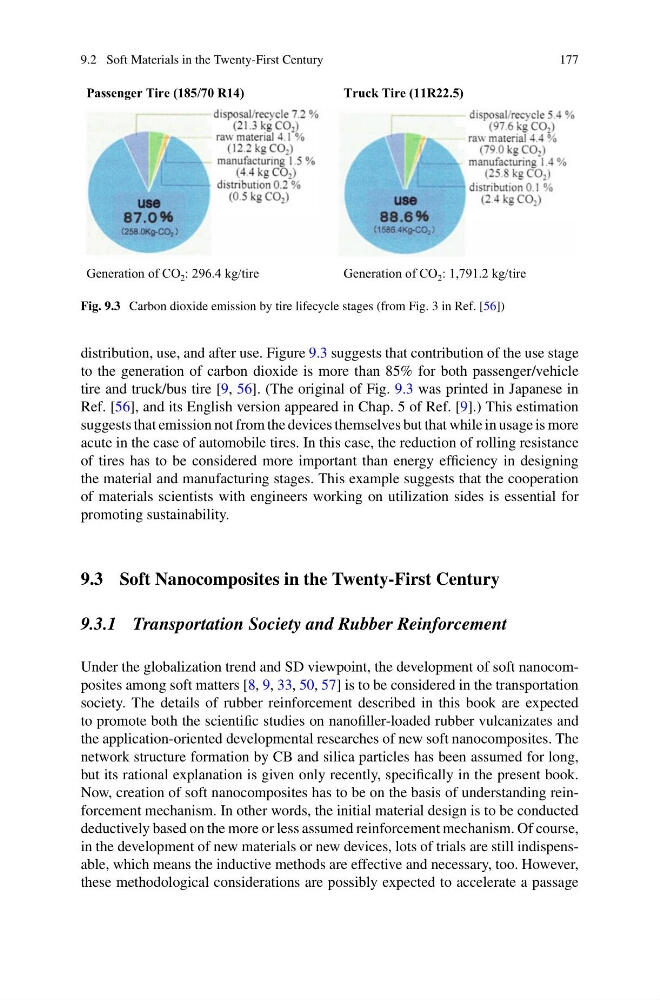
Passenger Tire (185/70 R14)
Truck Tire (11R22.5)
Generation of CO 2 : 296.4 kg/tire
Generation of CO 2 : 1,791.2 kg/tire
Fig. 9.3 Carbon dioxide emission by tire lifecycle stages (from Fig. 3 in Ref. [56])
distribution, use, and after use. Figure 9.3 suggests that contribution of the use stage
to the generation of carbon dioxide is more than 85% for both passenger/vehicle
tire and truck/bus tire [9, 56]. (The original of Fig. 9.3 was printed in Japanese in
Ref. [56], and its English version appeared in Chap. 5 of Ref. [9].) This estimation
suggests that emission not from the devices themselves but that while in usage is more
acute in the case of automobile tires. In this case, the reduction of rolling resistance
of tires has to be considered more important than energy efficiency in designing
the material and manufacturing stages. This example suggests that the cooperation
of materials scientists with engineers working on utilization sides is essential for
promoting sustainability.
9.3 Soft Nanocomposites in the Twenty-First Century
9.3.1 Transportation Society and Rubber Reinforcement
Under the globalization trend and SD viewpoint, the development of soft nanocomposites among soft matters [8, 9, 33, 50, 57] is to be considered in the transportation
society. The details of rubber reinforcement described in this book are expected
to promote both the scientific studies on nanofiller-loaded rubber vulcanizates and
the application-oriented developmental researches of new soft nanocomposites. The
network structure formation by CB and silica particles has been assumed for long,
but its rational explanation is given only recently, specifically in the present book.
Now, creation of soft nanocomposites has to be on the basis of understanding reinforcement mechanism. In other words, the initial material design is to be conducted
deductively based on the more or less assumed reinforcement mechanism. Of course,
in the development of new materials or new devices, lots of trials are still indispensable, which means the inductive methods are effective and necessary, too. However,
these methodological considerations are possibly expected to accelerate a passage
177
Passenger Tire (185/70 R14)
Truck Tire (11R22.5)
Generation of CO 2 : 296.4 kg/tire
Generation of CO 2 : 1,791.2 kg/tire
Fig. 9.3 Carbon dioxide emission by tire lifecycle stages (from Fig. 3 in Ref. [56])
distribution, use, and after use. Figure 9.3 suggests that contribution of the use stage
to the generation of carbon dioxide is more than 85% for both passenger/vehicle
tire and truck/bus tire [9, 56]. (The original of Fig. 9.3 was printed in Japanese in
Ref. [56], and its English version appeared in Chap. 5 of Ref. [9].) This estimation
suggests that emission not from the devices themselves but that while in usage is more
acute in the case of automobile tires. In this case, the reduction of rolling resistance
of tires has to be considered more important than energy efficiency in designing
the material and manufacturing stages. This example suggests that the cooperation
of materials scientists with engineers working on utilization sides is essential for
promoting sustainability.
9.3 Soft Nanocomposites in the Twenty-First Century
9.3.1 Transportation Society and Rubber Reinforcement
Under the globalization trend and SD viewpoint, the development of soft nanocomposites among soft matters [8, 9, 33, 50, 57] is to be considered in the transportation
society. The details of rubber reinforcement described in this book are expected
to promote both the scientific studies on nanofiller-loaded rubber vulcanizates and
the application-oriented developmental researches of new soft nanocomposites. The
network structure formation by CB and silica particles has been assumed for long,
but its rational explanation is given only recently, specifically in the present book.
Now, creation of soft nanocomposites has to be on the basis of understanding reinforcement mechanism. In other words, the initial material design is to be conducted
deductively based on the more or less assumed reinforcement mechanism. Of course,
in the development of new materials or new devices, lots of trials are still indispensable, which means the inductive methods are effective and necessary, too. However,
these methodological considerations are possibly expected to accelerate a passage