

9.1 Globalization and Sustainable Development: Historical …
173
still under way, by which the conspicuous aspect of the contemporary society under
globalization is characterized.
Alarmingly, one of the popular routes of a potentially illegal migration to the USA
from the Middle East is currently as follows [24]: First fly to Quito in Ecuador, and
take various land and waterway to Mexico by walking, swimming, carting, canoeing,
trucking, bussing, or railroading (dependent on the immigrants’ affordability, of
course), followed by the final crossing of the border on foot, if fortunate enough.
Almost all transportation means, both modern and ancient, are mobilized to transport
the immigrants, and the World Bank has reported that the income from this off-thebooks money is so big to be neglected in some business activities [24].
Among so many means of transportation, the importance of automobiles, trucks,
and aircraft is to be emphasized, particularly during the transition period from the
late twentieth and early twenty-first centuries. Railroads are the most convenient for
mass transportation. However, they have to move on the iron rails, which are much
less ubiquitous, while automobiles and trucks are navigable on omnipresent roads. In
modern and contemporary society, this freedom has enabled the bombshell spread of
automobiles all over the world. However, we have to note that the same freedom often
brings about traffic accidents, to result in many casualties among the pedestrians as
well as the passengers and the drivers [8, 9, 25–27]. Including the intimidating traffic
accidents, serious problems on the transportation are now urgent issues for SD of us
to be dissolved in this century [8, 9, 28, 29].
The present authors have discussed these issues under the assumption of the transportation society will continue to the end of this century, and the information society
would become dominant in the twenty-second century [8, 9]. The results of the
questionnaire already noted, however, suggest that the transportation society may
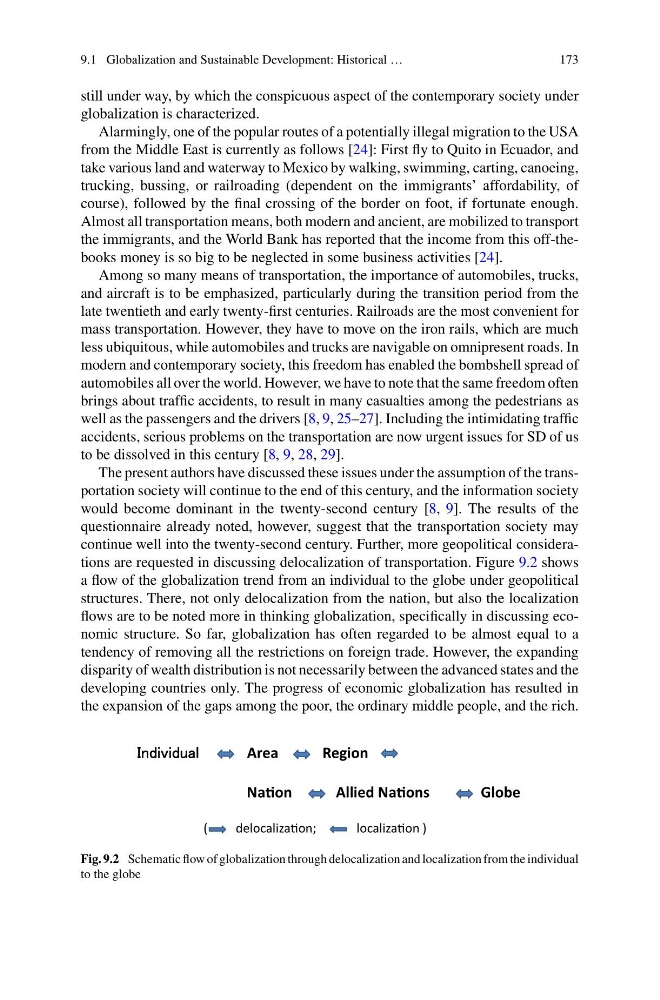
continue well into the twenty-second century. Further, more geopolitical considerations are requested in discussing delocalization of transportation. Figure 9.2 shows
a flow of the globalization trend from an individual to the globe under geopolitical
structures. There, not only delocalization from the nation, but also the localization
flows are to be noted more in thinking globalization, specifically in discussing economic structure. So far, globalization has often regarded to be almost equal to a
tendency of removing all the restrictions on foreign trade. However, the expanding
disparity of wealth distribution is not necessarily between the advanced states and the
developing countries only. The progress of economic globalization has resulted in
the expansion of the gaps among the poor, the ordinary middle people, and the rich.
Area
Region
NaƟon
Allied NaƟons
Globe
(
delocalizaƟon;
localizaƟon )
Fig. 9.2 Schematic flow of globalization through delocalization and localization from the individual
to the globe
173
still under way, by which the conspicuous aspect of the contemporary society under
globalization is characterized.
Alarmingly, one of the popular routes of a potentially illegal migration to the USA
from the Middle East is currently as follows [24]: First fly to Quito in Ecuador, and
take various land and waterway to Mexico by walking, swimming, carting, canoeing,
trucking, bussing, or railroading (dependent on the immigrants’ affordability, of
course), followed by the final crossing of the border on foot, if fortunate enough.
Almost all transportation means, both modern and ancient, are mobilized to transport
the immigrants, and the World Bank has reported that the income from this off-thebooks money is so big to be neglected in some business activities [24].
Among so many means of transportation, the importance of automobiles, trucks,
and aircraft is to be emphasized, particularly during the transition period from the
late twentieth and early twenty-first centuries. Railroads are the most convenient for
mass transportation. However, they have to move on the iron rails, which are much
less ubiquitous, while automobiles and trucks are navigable on omnipresent roads. In
modern and contemporary society, this freedom has enabled the bombshell spread of
automobiles all over the world. However, we have to note that the same freedom often
brings about traffic accidents, to result in many casualties among the pedestrians as
well as the passengers and the drivers [8, 9, 25–27]. Including the intimidating traffic
accidents, serious problems on the transportation are now urgent issues for SD of us
to be dissolved in this century [8, 9, 28, 29].
The present authors have discussed these issues under the assumption of the transportation society will continue to the end of this century, and the information society
would become dominant in the twenty-second century [8, 9]. The results of the
questionnaire already noted, however, suggest that the transportation society may
continue well into the twenty-second century. Further, more geopolitical considerations are requested in discussing delocalization of transportation. Figure 9.2 shows
a flow of the globalization trend from an individual to the globe under geopolitical
structures. There, not only delocalization from the nation, but also the localization
flows are to be noted more in thinking globalization, specifically in discussing economic structure. So far, globalization has often regarded to be almost equal to a
tendency of removing all the restrictions on foreign trade. However, the expanding
disparity of wealth distribution is not necessarily between the advanced states and the
developing countries only. The progress of economic globalization has resulted in
the expansion of the gaps among the poor, the ordinary middle people, and the rich.
Area
Region
NaƟon
Allied NaƟons
Globe
(
delocalizaƟon;
localizaƟon )
Fig. 9.2 Schematic flow of globalization through delocalization and localization from the individual
to the globe