

9.1 Globalization and Sustainable Development: Historical …
169
it was walking around just for survival, followed by a series of migration of a group
of people. On the other hand, SD is a very modern concept [10], the birth of which
was possibly the Club of Rome report disseminated in 1972 [11], and SD is the most
important issue for our development on the earth in this century [8–10, 12]. Hence,
SD is rationally recognized to represent the most recent stage of the globalization
trend, in the long history of human beings.
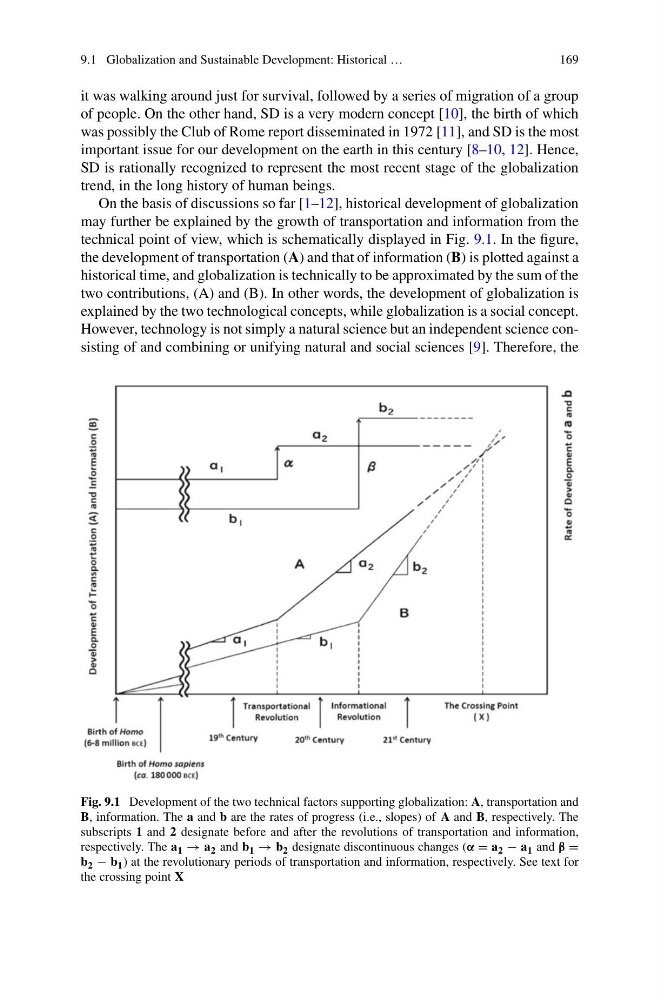
On the basis of discussions so far [1–12], historical development of globalization
may further be explained by the growth of transportation and information from the
technical point of view, which is schematically displayed in Fig. 9.1. In the figure,
the development of transportation (A) and that of information (B) is plotted against a
historical time, and globalization is technically to be approximated by the sum of the
two contributions, (A) and (B). In other words, the development of globalization is
explained by the two technological concepts, while globalization is a social concept.
However, technology is not simply a natural science but an independent science consisting of and combining or unifying natural and social sciences [9]. Therefore, the
Fig. 9.1 Development of the two technical factors supporting globalization: A, transportation and
B, information. The a and b are the rates of progress (i.e., slopes) of A and B, respectively. The
subscripts 1 and 2 designate before and after the revolutions of transportation and information,
respectively. The a 1 → a 2 and b 1 → b 2 designate discontinuous changes (α = a 2 − a 1 and β =
b 2 − b 1 ) at the revolutionary periods of transportation and information, respectively. See text for
the crossing point X
169
it was walking around just for survival, followed by a series of migration of a group
of people. On the other hand, SD is a very modern concept [10], the birth of which
was possibly the Club of Rome report disseminated in 1972 [11], and SD is the most
important issue for our development on the earth in this century [8–10, 12]. Hence,
SD is rationally recognized to represent the most recent stage of the globalization
trend, in the long history of human beings.
On the basis of discussions so far [1–12], historical development of globalization
may further be explained by the growth of transportation and information from the
technical point of view, which is schematically displayed in Fig. 9.1. In the figure,
the development of transportation (A) and that of information (B) is plotted against a
historical time, and globalization is technically to be approximated by the sum of the
two contributions, (A) and (B). In other words, the development of globalization is
explained by the two technological concepts, while globalization is a social concept.
However, technology is not simply a natural science but an independent science consisting of and combining or unifying natural and social sciences [9]. Therefore, the
Fig. 9.1 Development of the two technical factors supporting globalization: A, transportation and
B, information. The a and b are the rates of progress (i.e., slopes) of A and B, respectively. The
subscripts 1 and 2 designate before and after the revolutions of transportation and information,
respectively. The a 1 → a 2 and b 1 → b 2 designate discontinuous changes (α = a 2 − a 1 and β =
b 2 − b 1 ) at the revolutionary periods of transportation and information, respectively. See text for
the crossing point X