

152
8 Self-Reinforcement in Natural Rubber (NR): Template Crystallization
The effect of CB compounding was observed in NR, too, but the CB mixing is more
enhancing the stress, not so much increase of T B . Namely, CB compounding in
SBR is fundamentally for the higher tensile strength, but for NR, it is simply one
of the results. The high performance of CB compounded NR in various applications
suggests lots of betterment of NR products by mixing with CB in terms of frictionrelated performance, for an example.
The difference in hysteresis behavior shown in Fig. 8.7 is to be discussed next. The
SBR gum vulcanizate displays much smaller loss than NR. However, compounding
of CB has afforded much larger loss, comparable to or even a little larger than NR’s.
According to Payne et al., hysteresis loss (H B ) and the energy necessary for rupture
of the system (U B ) are in an empirical relationship [86] as follows:
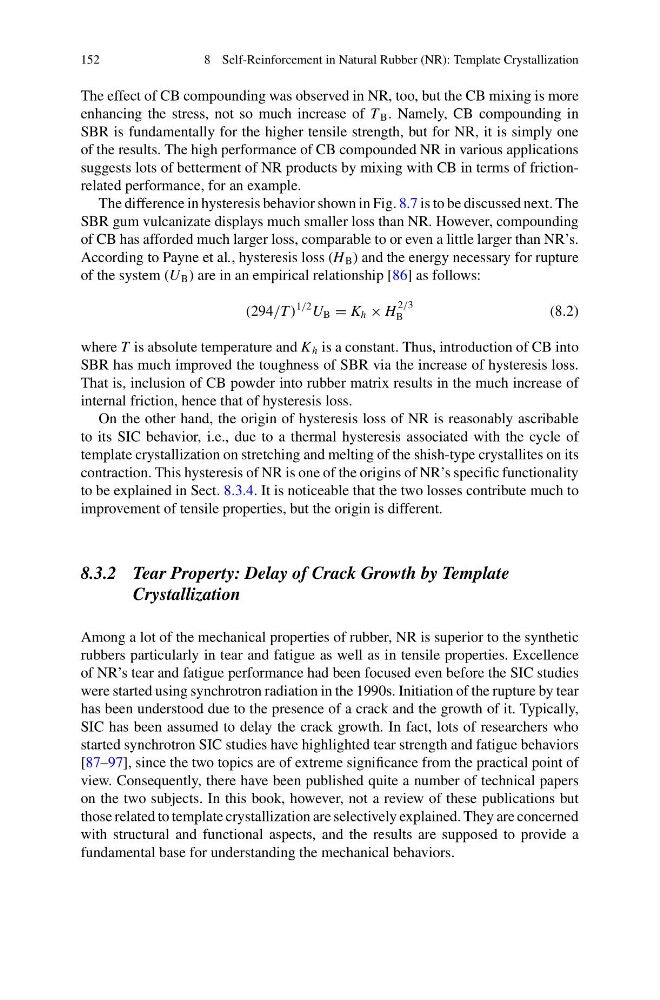
(294/T )
1/2 U B = K h × H
2/3
B
(8.2)
where T is absolute temperature and K h is a constant. Thus, introduction of CB into
SBR has much improved the toughness of SBR via the increase of hysteresis loss.
That is, inclusion of CB powder into rubber matrix results in the much increase of
internal friction, hence that of hysteresis loss.
On the other hand, the origin of hysteresis loss of NR is reasonably ascribable
to its SIC behavior, i.e., due to a thermal hysteresis associated with the cycle of
template crystallization on stretching and melting of the shish-type crystallites on its
contraction. This hysteresis of NR is one of the origins of NR’s specific functionality
to be explained in Sect. 8.3.4. It is noticeable that the two losses contribute much to
improvement of tensile properties, but the origin is different.
8.3.2 Tear Property: Delay of Crack Growth by Template
Crystallization
Among a lot of the mechanical properties of rubber, NR is superior to the synthetic
rubbers particularly in tear and fatigue as well as in tensile properties. Excellence
of NR’s tear and fatigue performance had been focused even before the SIC studies
were started using synchrotron radiation in the 1990s. Initiation of the rupture by tear
has been understood due to the presence of a crack and the growth of it. Typically,
SIC has been assumed to delay the crack growth. In fact, lots of researchers who
started synchrotron SIC studies have highlighted tear strength and fatigue behaviors
[87–97], since the two topics are of extreme significance from the practical point of
view. Consequently, there have been published quite a number of technical papers
on the two subjects. In this book, however, not a review of these publications but
those related to template crystallization are selectively explained. They are concerned
with structural and functional aspects, and the results are supposed to provide a
fundamental base for understanding the mechanical behaviors.
8 Self-Reinforcement in Natural Rubber (NR): Template Crystallization
The effect of CB compounding was observed in NR, too, but the CB mixing is more
enhancing the stress, not so much increase of T B . Namely, CB compounding in
SBR is fundamentally for the higher tensile strength, but for NR, it is simply one
of the results. The high performance of CB compounded NR in various applications
suggests lots of betterment of NR products by mixing with CB in terms of frictionrelated performance, for an example.
The difference in hysteresis behavior shown in Fig. 8.7 is to be discussed next. The
SBR gum vulcanizate displays much smaller loss than NR. However, compounding
of CB has afforded much larger loss, comparable to or even a little larger than NR’s.
According to Payne et al., hysteresis loss (H B ) and the energy necessary for rupture
of the system (U B ) are in an empirical relationship [86] as follows:
(294/T )
1/2 U B = K h × H
2/3
B
(8.2)
where T is absolute temperature and K h is a constant. Thus, introduction of CB into
SBR has much improved the toughness of SBR via the increase of hysteresis loss.
That is, inclusion of CB powder into rubber matrix results in the much increase of
internal friction, hence that of hysteresis loss.
On the other hand, the origin of hysteresis loss of NR is reasonably ascribable
to its SIC behavior, i.e., due to a thermal hysteresis associated with the cycle of
template crystallization on stretching and melting of the shish-type crystallites on its
contraction. This hysteresis of NR is one of the origins of NR’s specific functionality
to be explained in Sect. 8.3.4. It is noticeable that the two losses contribute much to
improvement of tensile properties, but the origin is different.
8.3.2 Tear Property: Delay of Crack Growth by Template
Crystallization
Among a lot of the mechanical properties of rubber, NR is superior to the synthetic
rubbers particularly in tear and fatigue as well as in tensile properties. Excellence
of NR’s tear and fatigue performance had been focused even before the SIC studies
were started using synchrotron radiation in the 1990s. Initiation of the rupture by tear
has been understood due to the presence of a crack and the growth of it. Typically,
SIC has been assumed to delay the crack growth. In fact, lots of researchers who
started synchrotron SIC studies have highlighted tear strength and fatigue behaviors
[87–97], since the two topics are of extreme significance from the practical point of
view. Consequently, there have been published quite a number of technical papers
on the two subjects. In this book, however, not a review of these publications but
those related to template crystallization are selectively explained. They are concerned
with structural and functional aspects, and the results are supposed to provide a
fundamental base for understanding the mechanical behaviors.