

8.2 Template Crystallization: Dynamic Mechanism …
141
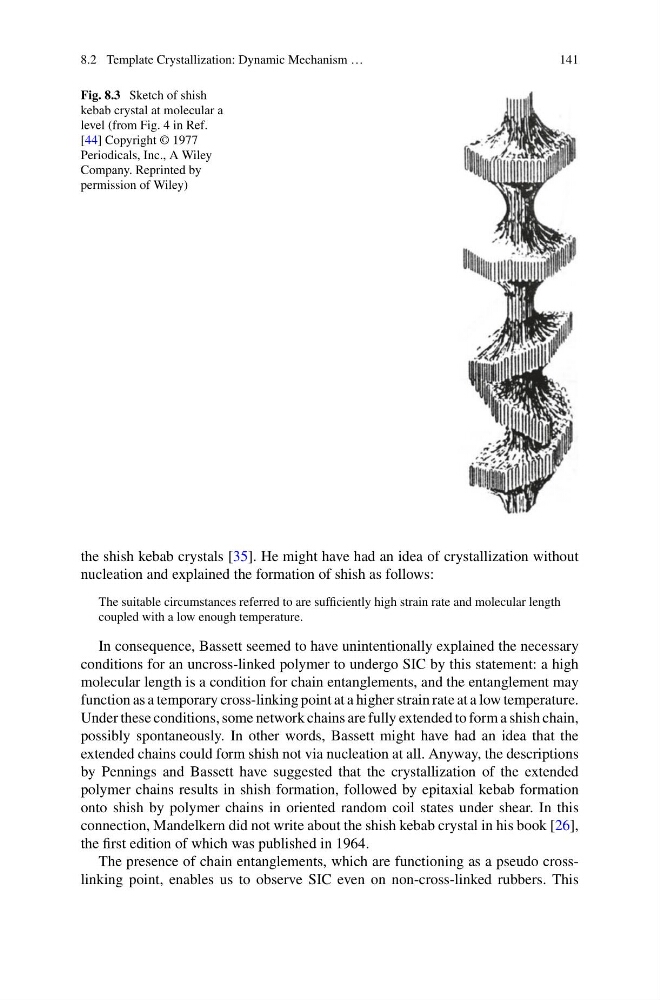
Fig. 8.3 Sketch of shish
kebab crystal at molecular a
level (from Fig. 4 in Ref.
[44] Copyright © 1977
Periodicals, Inc., A Wiley
Company. Reprinted by
permission of Wiley)
the shish kebab crystals [35]. He might have had an idea of crystallization without
nucleation and explained the formation of shish as follows:
The suitable circumstances referred to are sufficiently high strain rate and molecular length
coupled with a low enough temperature.
In consequence, Bassett seemed to have unintentionally explained the necessary
conditions for an uncross-linked polymer to undergo SIC by this statement: a high
molecular length is a condition for chain entanglements, and the entanglement may
function as a temporary cross-linking point at a higher strain rate at a low temperature.
Under these conditions, some network chains are fully extended to form a shish chain,
possibly spontaneously. In other words, Bassett might have had an idea that the
extended chains could form shish not via nucleation at all. Anyway, the descriptions
by Pennings and Bassett have suggested that the crystallization of the extended
polymer chains results in shish formation, followed by epitaxial kebab formation
onto shish by polymer chains in oriented random coil states under shear. In this
connection, Mandelkern did not write about the shish kebab crystal in his book [26],
the first edition of which was published in 1964.
The presence of chain entanglements, which are functioning as a pseudo crosslinking point, enables us to observe SIC even on non-cross-linked rubbers. This
141
Fig. 8.3 Sketch of shish
kebab crystal at molecular a
level (from Fig. 4 in Ref.
[44] Copyright © 1977
Periodicals, Inc., A Wiley
Company. Reprinted by
permission of Wiley)
the shish kebab crystals [35]. He might have had an idea of crystallization without
nucleation and explained the formation of shish as follows:
The suitable circumstances referred to are sufficiently high strain rate and molecular length
coupled with a low enough temperature.
In consequence, Bassett seemed to have unintentionally explained the necessary
conditions for an uncross-linked polymer to undergo SIC by this statement: a high
molecular length is a condition for chain entanglements, and the entanglement may
function as a temporary cross-linking point at a higher strain rate at a low temperature.
Under these conditions, some network chains are fully extended to form a shish chain,
possibly spontaneously. In other words, Bassett might have had an idea that the
extended chains could form shish not via nucleation at all. Anyway, the descriptions
by Pennings and Bassett have suggested that the crystallization of the extended
polymer chains results in shish formation, followed by epitaxial kebab formation
onto shish by polymer chains in oriented random coil states under shear. In this
connection, Mandelkern did not write about the shish kebab crystal in his book [26],
the first edition of which was published in 1964.
The presence of chain entanglements, which are functioning as a pseudo crosslinking point, enables us to observe SIC even on non-cross-linked rubbers. This