

8.1 Low-Temperature Crystallization of NR
139
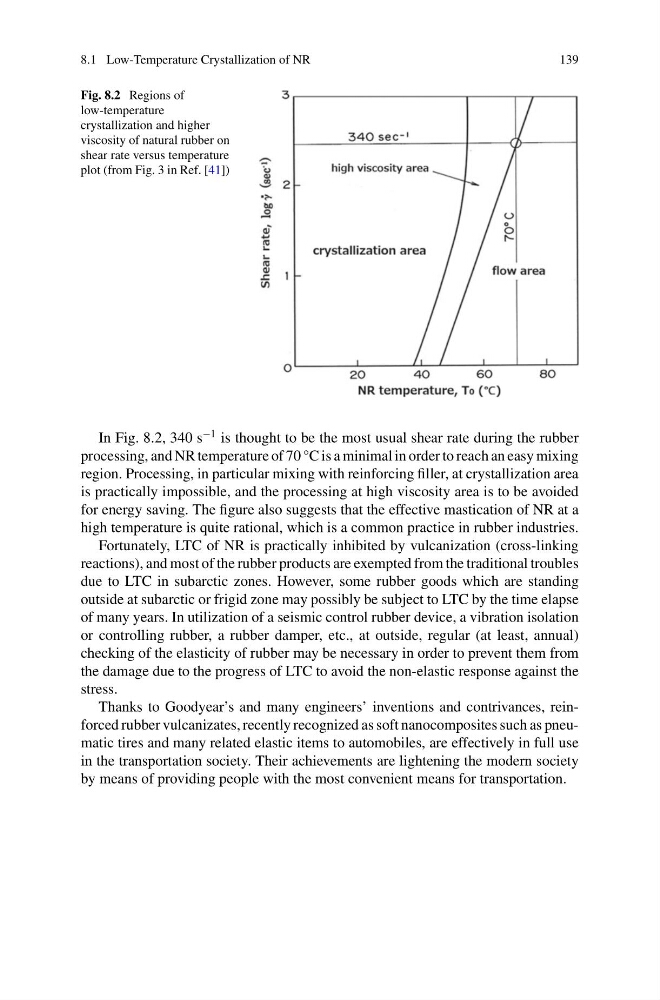
Fig. 8.2 Regions of
low-temperature
crystallization and higher
viscosity of natural rubber on
shear rate versus temperature
plot (from Fig. 3 in Ref. [41])
In Fig. 8.2, 340 s
−1 is thought to be the most usual shear rate during the rubber
processing, and NR temperature of 70 °C is a minimal in order to reach an easy mixing
region. Processing, in particular mixing with reinforcing filler, at crystallization area
is practically impossible, and the processing at high viscosity area is to be avoided
for energy saving. The figure also suggests that the effective mastication of NR at a
high temperature is quite rational, which is a common practice in rubber industries.
Fortunately, LTC of NR is practically inhibited by vulcanization (cross-linking
reactions), and most of the rubber products are exempted from the traditional troubles
due to LTC in subarctic zones. However, some rubber goods which are standing
outside at subarctic or frigid zone may possibly be subject to LTC by the time elapse
of many years. In utilization of a seismic control rubber device, a vibration isolation
or controlling rubber, a rubber damper, etc., at outside, regular (at least, annual)
checking of the elasticity of rubber may be necessary in order to prevent them from
the damage due to the progress of LTC to avoid the non-elastic response against the
stress.
Thanks to Goodyear’s and many engineers’ inventions and contrivances, reinforced rubber vulcanizates, recently recognized as soft nanocomposites such as pneumatic tires and many related elastic items to automobiles, are effectively in full use
in the transportation society. Their achievements are lightening the modern society
by means of providing people with the most convenient means for transportation.
139
Fig. 8.2 Regions of
low-temperature
crystallization and higher
viscosity of natural rubber on
shear rate versus temperature
plot (from Fig. 3 in Ref. [41])
In Fig. 8.2, 340 s
−1 is thought to be the most usual shear rate during the rubber
processing, and NR temperature of 70 °C is a minimal in order to reach an easy mixing
region. Processing, in particular mixing with reinforcing filler, at crystallization area
is practically impossible, and the processing at high viscosity area is to be avoided
for energy saving. The figure also suggests that the effective mastication of NR at a
high temperature is quite rational, which is a common practice in rubber industries.
Fortunately, LTC of NR is practically inhibited by vulcanization (cross-linking
reactions), and most of the rubber products are exempted from the traditional troubles
due to LTC in subarctic zones. However, some rubber goods which are standing
outside at subarctic or frigid zone may possibly be subject to LTC by the time elapse
of many years. In utilization of a seismic control rubber device, a vibration isolation
or controlling rubber, a rubber damper, etc., at outside, regular (at least, annual)
checking of the elasticity of rubber may be necessary in order to prevent them from
the damage due to the progress of LTC to avoid the non-elastic response against the
stress.
Thanks to Goodyear’s and many engineers’ inventions and contrivances, reinforced rubber vulcanizates, recently recognized as soft nanocomposites such as pneumatic tires and many related elastic items to automobiles, are effectively in full use
in the transportation society. Their achievements are lightening the modern society
by means of providing people with the most convenient means for transportation.