

8.1 Low-Temperature Crystallization of NR
137
Once frequently used phrase ‘Crystallization of NR’ has been equal to LTC of NR
until quite recent time (see Prefatory Remark). In accordance with the naming of
SIC, LTC might have been named temperature-induced crystallization (TIC). However, crystallization of NR had been recognized very early (though not recognized
exactly as crystallization at first, but as a kind of change often observed in winter),
which was assumed the cause of difficulty in the utilization of NR as a material of use
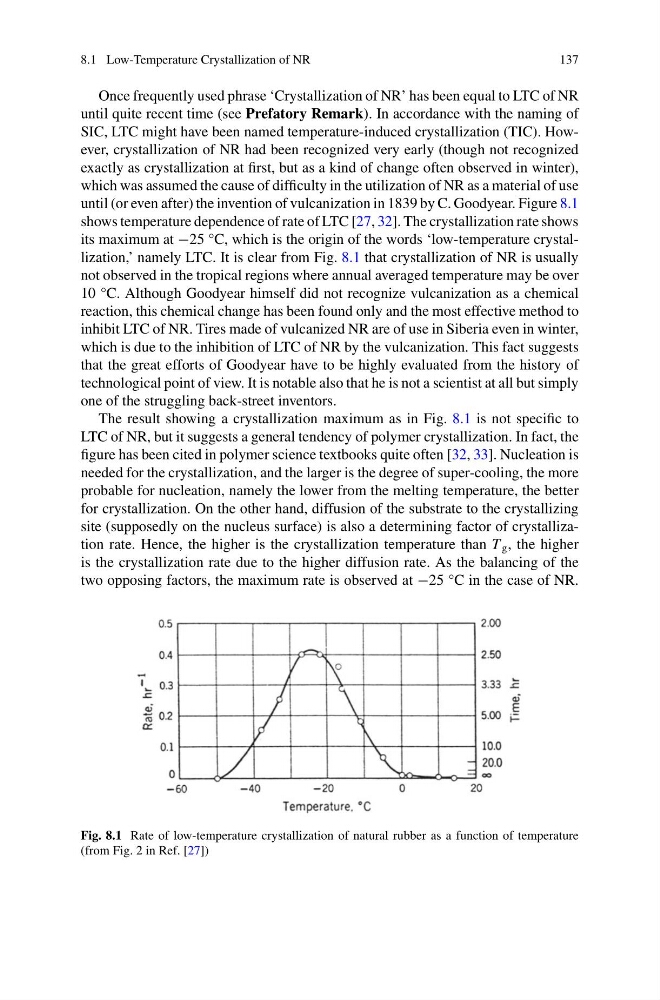
until (or even after) the invention of vulcanization in 1839 by C. Goodyear. Figure 8.1
shows temperature dependence of rate of LTC [27, 32]. The crystallization rate shows
its maximum at −25 °C, which is the origin of the words ‘low-temperature crystallization,’ namely LTC. It is clear from Fig. 8.1 that crystallization of NR is usually
not observed in the tropical regions where annual averaged temperature may be over
10 °C. Although Goodyear himself did not recognize vulcanization as a chemical
reaction, this chemical change has been found only and the most effective method to
inhibit LTC of NR. Tires made of vulcanized NR are of use in Siberia even in winter,
which is due to the inhibition of LTC of NR by the vulcanization. This fact suggests
that the great efforts of Goodyear have to be highly evaluated from the history of
technological point of view. It is notable also that he is not a scientist at all but simply
one of the struggling back-street inventors.
The result showing a crystallization maximum as in Fig. 8.1 is not specific to
LTC of NR, but it suggests a general tendency of polymer crystallization. In fact, the
figure has been cited in polymer science textbooks quite often [32, 33]. Nucleation is
needed for the crystallization, and the larger is the degree of super-cooling, the more
probable for nucleation, namely the lower from the melting temperature, the better
for crystallization. On the other hand, diffusion of the substrate to the crystallizing
site (supposedly on the nucleus surface) is also a determining factor of crystallization rate. Hence, the higher is the crystallization temperature than T g , the higher
is the crystallization rate due to the higher diffusion rate. As the balancing of the
two opposing factors, the maximum rate is observed at −25 °C in the case of NR.
Fig. 8.1 Rate of low-temperature crystallization of natural rubber as a function of temperature
(from Fig. 2 in Ref. [27])
137
Once frequently used phrase ‘Crystallization of NR’ has been equal to LTC of NR
until quite recent time (see Prefatory Remark). In accordance with the naming of
SIC, LTC might have been named temperature-induced crystallization (TIC). However, crystallization of NR had been recognized very early (though not recognized
exactly as crystallization at first, but as a kind of change often observed in winter),
which was assumed the cause of difficulty in the utilization of NR as a material of use
until (or even after) the invention of vulcanization in 1839 by C. Goodyear. Figure 8.1
shows temperature dependence of rate of LTC [27, 32]. The crystallization rate shows
its maximum at −25 °C, which is the origin of the words ‘low-temperature crystallization,’ namely LTC. It is clear from Fig. 8.1 that crystallization of NR is usually
not observed in the tropical regions where annual averaged temperature may be over
10 °C. Although Goodyear himself did not recognize vulcanization as a chemical
reaction, this chemical change has been found only and the most effective method to
inhibit LTC of NR. Tires made of vulcanized NR are of use in Siberia even in winter,
which is due to the inhibition of LTC of NR by the vulcanization. This fact suggests
that the great efforts of Goodyear have to be highly evaluated from the history of
technological point of view. It is notable also that he is not a scientist at all but simply
one of the struggling back-street inventors.
The result showing a crystallization maximum as in Fig. 8.1 is not specific to
LTC of NR, but it suggests a general tendency of polymer crystallization. In fact, the
figure has been cited in polymer science textbooks quite often [32, 33]. Nucleation is
needed for the crystallization, and the larger is the degree of super-cooling, the more
probable for nucleation, namely the lower from the melting temperature, the better
for crystallization. On the other hand, diffusion of the substrate to the crystallizing
site (supposedly on the nucleus surface) is also a determining factor of crystallization rate. Hence, the higher is the crystallization temperature than T g , the higher
is the crystallization rate due to the higher diffusion rate. As the balancing of the
two opposing factors, the maximum rate is observed at −25 °C in the case of NR.
Fig. 8.1 Rate of low-temperature crystallization of natural rubber as a function of temperature
(from Fig. 2 in Ref. [27])