

7.2 Mixing of Lignin into Rubber by a Soft Processing
127
Kohjiya and Ikeda disclosed a new soft process for a lignin/NR biocomposite
using waste lignin in 2009 [42]. Utilization of an aqueous alkaline lignin solution
and NR latex as the starting materials was not new, but they did not coagulate the
solution state mixture in this study. After the mixing of the two liquids without
coagulation of NR latex, curing reagents were further introduced to the liquid for
cross-linking NR in the latex, and the solvent (mainly water) was evaporated to form
a lignin/cross-linked NR biocomposite in a film form. These a series of procedure is
the soft processing. The employed curing reagents are listed in Table 7.1 [43], which
have been used in cross-linking of NR in the latex for basic studies at a laboratory
scale.
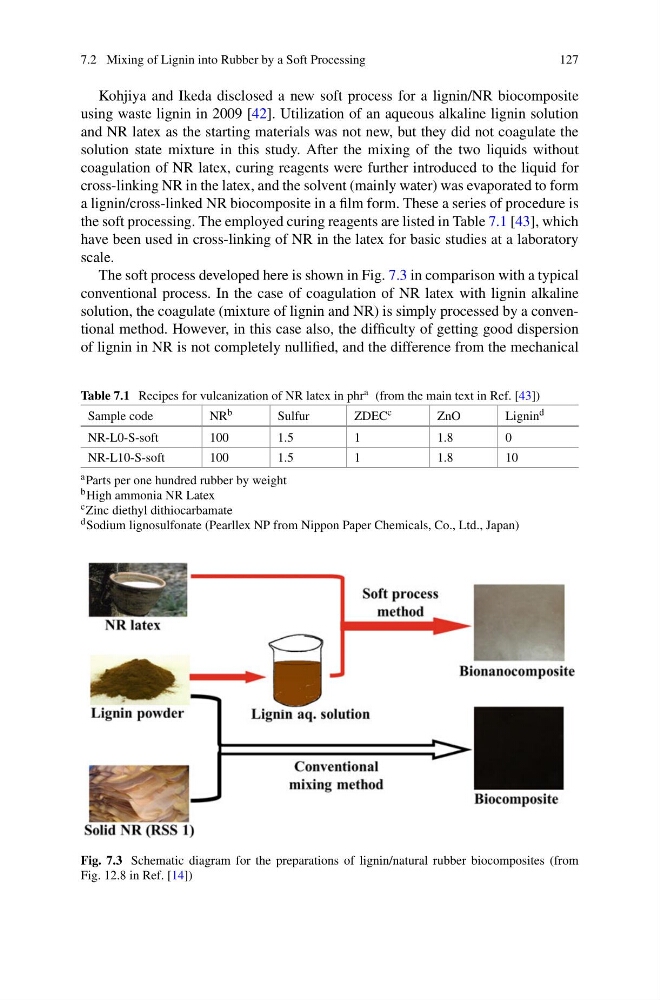
The soft process developed here is shown in Fig. 7.3 in comparison with a typical
conventional process. In the case of coagulation of NR latex with lignin alkaline
solution, the coagulate (mixture of lignin and NR) is simply processed by a conventional method. However, in this case also, the difficulty of getting good dispersion
of lignin in NR is not completely nullified, and the difference from the mechanical
Table 7.1 Recipes for vulcanization of NR latex in phr a (from the main text in Ref. [43])
Sample code
NR b
Sulfur
ZDEC c
ZnO
Lignin d
NR-L0-S-soft
100
1.5
1
1.8
0
NR-L10-S-soft
100
1.5
1
1.8
10
a Parts per one hundred rubber by weight
b High ammonia NR Latex
c Zinc diethyl dithiocarbamate
d Sodium lignosulfonate (Pearllex NP from Nippon Paper Chemicals, Co., Ltd., Japan)
Fig. 7.3 Schematic diagram for the preparations of lignin/natural rubber biocomposites (from
Fig. 12.8 in Ref. [14])
127
Kohjiya and Ikeda disclosed a new soft process for a lignin/NR biocomposite
using waste lignin in 2009 [42]. Utilization of an aqueous alkaline lignin solution
and NR latex as the starting materials was not new, but they did not coagulate the
solution state mixture in this study. After the mixing of the two liquids without
coagulation of NR latex, curing reagents were further introduced to the liquid for
cross-linking NR in the latex, and the solvent (mainly water) was evaporated to form
a lignin/cross-linked NR biocomposite in a film form. These a series of procedure is
the soft processing. The employed curing reagents are listed in Table 7.1 [43], which
have been used in cross-linking of NR in the latex for basic studies at a laboratory
scale.
The soft process developed here is shown in Fig. 7.3 in comparison with a typical
conventional process. In the case of coagulation of NR latex with lignin alkaline
solution, the coagulate (mixture of lignin and NR) is simply processed by a conventional method. However, in this case also, the difficulty of getting good dispersion
of lignin in NR is not completely nullified, and the difference from the mechanical
Table 7.1 Recipes for vulcanization of NR latex in phr a (from the main text in Ref. [43])
Sample code
NR b
Sulfur
ZDEC c
ZnO
Lignin d
NR-L0-S-soft
100
1.5
1
1.8
0
NR-L10-S-soft
100
1.5
1
1.8
10
a Parts per one hundred rubber by weight
b High ammonia NR Latex
c Zinc diethyl dithiocarbamate
d Sodium lignosulfonate (Pearllex NP from Nippon Paper Chemicals, Co., Ltd., Japan)
Fig. 7.3 Schematic diagram for the preparations of lignin/natural rubber biocomposites (from
Fig. 12.8 in Ref. [14])