

6.1 Use of Particulate Silica for High-Performance Rubber
109
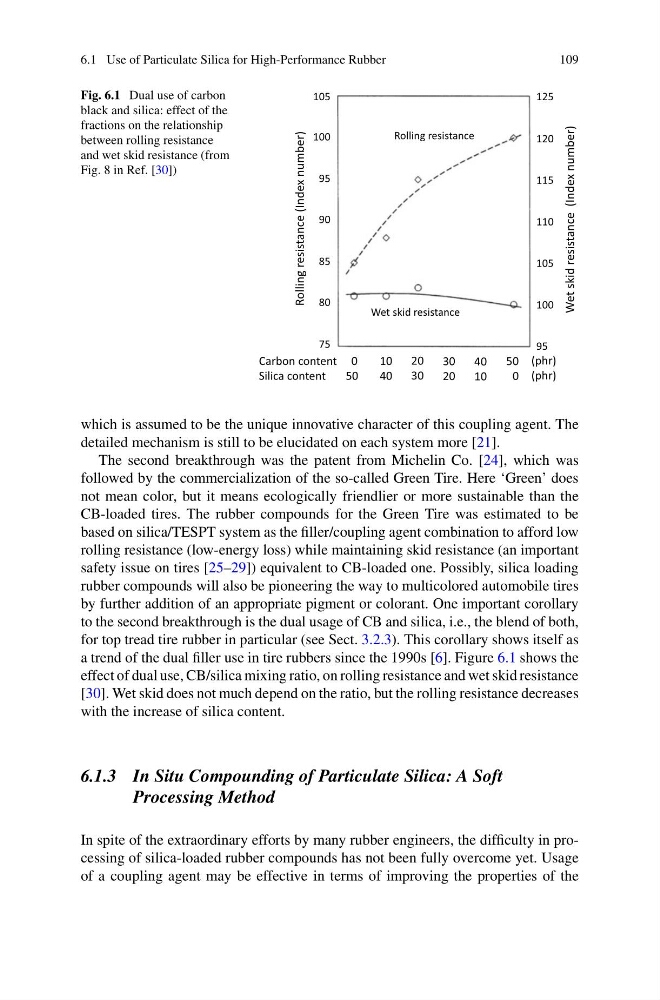
Fig. 6.1 Dual use of carbon
black and silica: effect of the
fractions on the relationship
between rolling resistance
and wet skid resistance (from
Fig. 8 in Ref. [30])
Rolling resistance (Index number)
Rolling resistance
Wet skid resistance
(Index number)
Wet skid resistance
105
100
95
90
85
80
75
105
125
120
100
115
110
95
Carbon content 0
Silica content
50
10
40
20
30
30
20
50
0
40
10
(phr)
(phr)
which is assumed to be the unique innovative character of this coupling agent. The
detailed mechanism is still to be elucidated on each system more [21].
The second breakthrough was the patent from Michelin Co. [24], which was
followed by the commercialization of the so-called Green Tire. Here ‘Green’ does
not mean color, but it means ecologically friendlier or more sustainable than the
CB-loaded tires. The rubber compounds for the Green Tire was estimated to be
based on silica/TESPT system as the filler/coupling agent combination to afford low
rolling resistance (low-energy loss) while maintaining skid resistance (an important
safety issue on tires [25–29]) equivalent to CB-loaded one. Possibly, silica loading
rubber compounds will also be pioneering the way to multicolored automobile tires
by further addition of an appropriate pigment or colorant. One important corollary
to the second breakthrough is the dual usage of CB and silica, i.e., the blend of both,
for top tread tire rubber in particular (see Sect. 3.2.3). This corollary shows itself as
a trend of the dual filler use in tire rubbers since the 1990s [6]. Figure 6.1 shows the
effect of dual use, CB/silica mixing ratio, on rolling resistance and wet skid resistance
[30]. Wet skid does not much depend on the ratio, but the rolling resistance decreases
with the increase of silica content.
6.1.3 In Situ Compounding of Particulate Silica: A Soft
Processing Method
In spite of the extraordinary efforts by many rubber engineers, the difficulty in processing of silica-loaded rubber compounds has not been fully overcome yet. Usage
of a coupling agent may be effective in terms of improving the properties of the
109
Fig. 6.1 Dual use of carbon
black and silica: effect of the
fractions on the relationship
between rolling resistance
and wet skid resistance (from
Fig. 8 in Ref. [30])
Rolling resistance (Index number)
Rolling resistance
Wet skid resistance
(Index number)
Wet skid resistance
105
100
95
90
85
80
75
105
125
120
100
115
110
95
Carbon content 0
Silica content
50
10
40
20
30
30
20
50
0
40
10
(phr)
(phr)
which is assumed to be the unique innovative character of this coupling agent. The
detailed mechanism is still to be elucidated on each system more [21].
The second breakthrough was the patent from Michelin Co. [24], which was
followed by the commercialization of the so-called Green Tire. Here ‘Green’ does
not mean color, but it means ecologically friendlier or more sustainable than the
CB-loaded tires. The rubber compounds for the Green Tire was estimated to be
based on silica/TESPT system as the filler/coupling agent combination to afford low
rolling resistance (low-energy loss) while maintaining skid resistance (an important
safety issue on tires [25–29]) equivalent to CB-loaded one. Possibly, silica loading
rubber compounds will also be pioneering the way to multicolored automobile tires
by further addition of an appropriate pigment or colorant. One important corollary
to the second breakthrough is the dual usage of CB and silica, i.e., the blend of both,
for top tread tire rubber in particular (see Sect. 3.2.3). This corollary shows itself as
a trend of the dual filler use in tire rubbers since the 1990s [6]. Figure 6.1 shows the
effect of dual use, CB/silica mixing ratio, on rolling resistance and wet skid resistance
[30]. Wet skid does not much depend on the ratio, but the rolling resistance decreases
with the increase of silica content.
6.1.3 In Situ Compounding of Particulate Silica: A Soft
Processing Method
In spite of the extraordinary efforts by many rubber engineers, the difficulty in processing of silica-loaded rubber compounds has not been fully overcome yet. Usage
of a coupling agent may be effective in terms of improving the properties of the