

96
5 Reinforcing Mechanism of Rubber by Nanofiller
CB or silica/NR or IR as described in the previous subsection, and further, studies
have to be done for clarifying the differences.
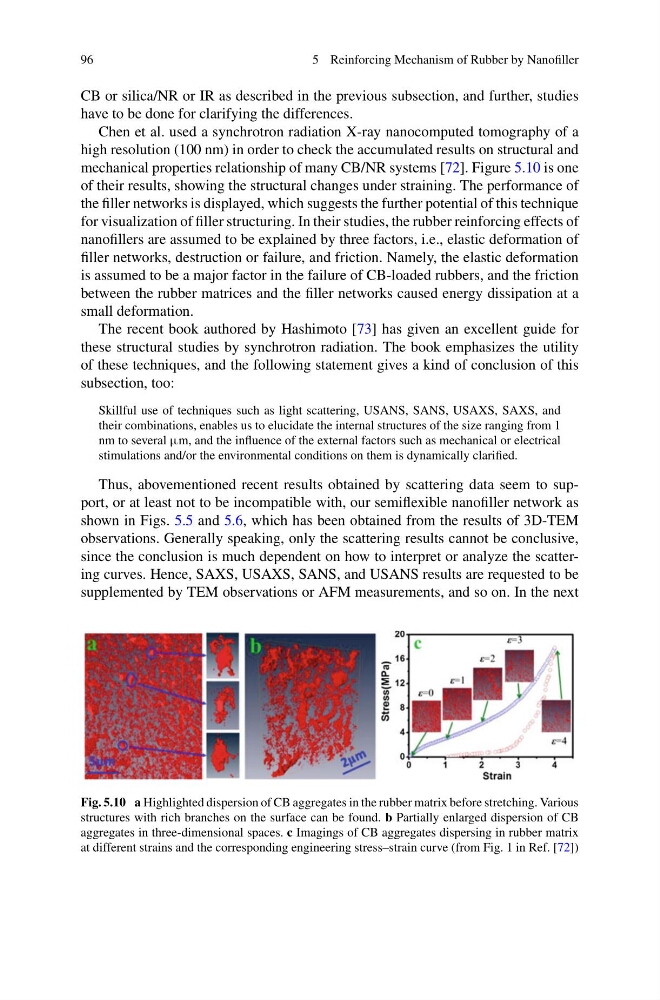
Chen et al. used a synchrotron radiation X-ray nanocomputed tomography of a
high resolution (100 nm) in order to check the accumulated results on structural and
mechanical properties relationship of many CB/NR systems [72]. Figure 5.10 is one
of their results, showing the structural changes under straining. The performance of
the filler networks is displayed, which suggests the further potential of this technique
for visualization of filler structuring. In their studies, the rubber reinforcing effects of
nanofillers are assumed to be explained by three factors, i.e., elastic deformation of
filler networks, destruction or failure, and friction. Namely, the elastic deformation
is assumed to be a major factor in the failure of CB-loaded rubbers, and the friction
between the rubber matrices and the filler networks caused energy dissipation at a
small deformation.
The recent book authored by Hashimoto [73] has given an excellent guide for
these structural studies by synchrotron radiation. The book emphasizes the utility
of these techniques, and the following statement gives a kind of conclusion of this
subsection, too:
Skillful use of techniques such as light scattering, USANS, SANS, USAXS, SAXS, and
their combinations, enables us to elucidate the internal structures of the size ranging from 1
nm to several µm, and the influence of the external factors such as mechanical or electrical
stimulations and/or the environmental conditions on them is dynamically clarified.
Thus, abovementioned recent results obtained by scattering data seem to support, or at least not to be incompatible with, our semiflexible nanofiller network as
shown in Figs. 5.5 and 5.6, which has been obtained from the results of 3D-TEM
observations. Generally speaking, only the scattering results cannot be conclusive,
since the conclusion is much dependent on how to interpret or analyze the scattering curves. Hence, SAXS, USAXS, SANS, and USANS results are requested to be
supplemented by TEM observations or AFM measurements, and so on. In the next
Fig. 5.10 a Highlighted dispersion of CB aggregates in the rubber matrix before stretching. Various
structures with rich branches on the surface can be found. b Partially enlarged dispersion of CB
aggregates in three-dimensional spaces. c Imagings of CB aggregates dispersing in rubber matrix
at different strains and the corresponding engineering stress–strain curve (from Fig. 1 in Ref. [72])
5 Reinforcing Mechanism of Rubber by Nanofiller
CB or silica/NR or IR as described in the previous subsection, and further, studies
have to be done for clarifying the differences.
Chen et al. used a synchrotron radiation X-ray nanocomputed tomography of a
high resolution (100 nm) in order to check the accumulated results on structural and
mechanical properties relationship of many CB/NR systems [72]. Figure 5.10 is one
of their results, showing the structural changes under straining. The performance of
the filler networks is displayed, which suggests the further potential of this technique
for visualization of filler structuring. In their studies, the rubber reinforcing effects of
nanofillers are assumed to be explained by three factors, i.e., elastic deformation of
filler networks, destruction or failure, and friction. Namely, the elastic deformation
is assumed to be a major factor in the failure of CB-loaded rubbers, and the friction
between the rubber matrices and the filler networks caused energy dissipation at a
small deformation.
The recent book authored by Hashimoto [73] has given an excellent guide for
these structural studies by synchrotron radiation. The book emphasizes the utility
of these techniques, and the following statement gives a kind of conclusion of this
subsection, too:
Skillful use of techniques such as light scattering, USANS, SANS, USAXS, SAXS, and
their combinations, enables us to elucidate the internal structures of the size ranging from 1
nm to several µm, and the influence of the external factors such as mechanical or electrical
stimulations and/or the environmental conditions on them is dynamically clarified.
Thus, abovementioned recent results obtained by scattering data seem to support, or at least not to be incompatible with, our semiflexible nanofiller network as
shown in Figs. 5.5 and 5.6, which has been obtained from the results of 3D-TEM
observations. Generally speaking, only the scattering results cannot be conclusive,
since the conclusion is much dependent on how to interpret or analyze the scattering curves. Hence, SAXS, USAXS, SANS, and USANS results are requested to be
supplemented by TEM observations or AFM measurements, and so on. In the next
Fig. 5.10 a Highlighted dispersion of CB aggregates in the rubber matrix before stretching. Various
structures with rich branches on the surface can be found. b Partially enlarged dispersion of CB
aggregates in three-dimensional spaces. c Imagings of CB aggregates dispersing in rubber matrix
at different strains and the corresponding engineering stress–strain curve (from Fig. 1 in Ref. [72])