

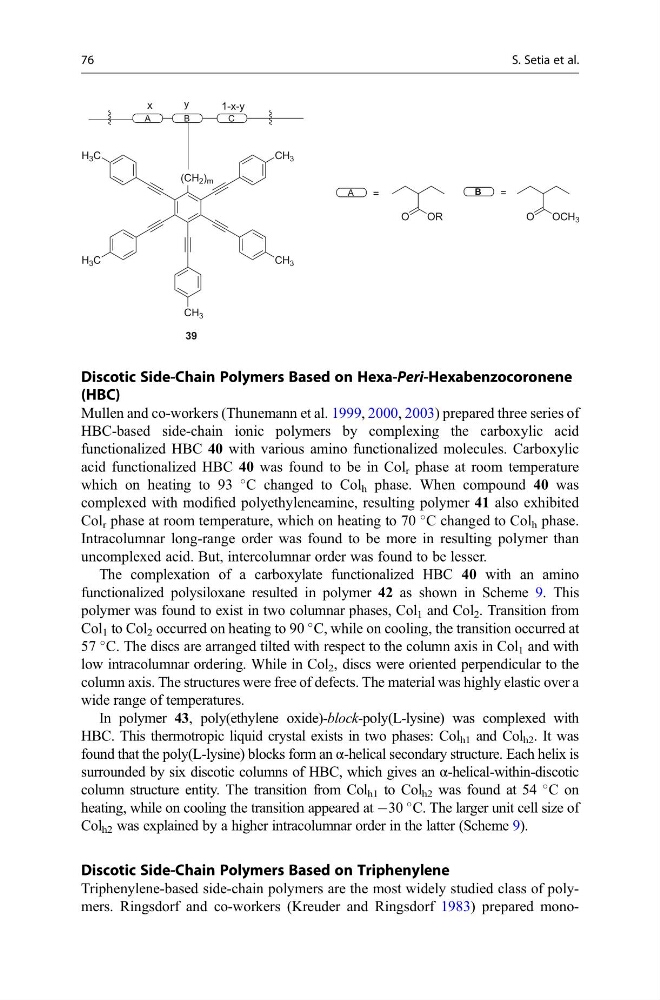
Discotic Side-Chain Polymers Based on Hexa-Peri-Hexabenzocoronene
(HBC)
Mullen and co-workers (Thunemann et al. 1999, 2000, 2003) prepared three series of
HBC-based side-chain ionic polymers by complexing the carboxylic acid
functionalized HBC 40 with various amino functionalized molecules. Carboxylic
acid functionalized HBC 40 was found to be in Col r phase at room temperature
which on heating to 93
C changed to Col h phase. When compound 40 was
complexed with modified polyethyleneamine, resulting polymer 41 also exhibited
Col r phase at room temperature, which on heating to 70
C changed to Col h phase.
Intracolumnar long-range order was found to be more in resulting polymer than
uncomplexed acid. But, intercolumnar order was found to be lesser.
The complexation of a carboxylate functionalized HBC 40 with an amino
functionalized polysiloxane resulted in polymer 42 as shown in Scheme 9. This
polymer was found to exist in two columnar phases, Col 1 and Col 2 . Transition from
Col 1 to Col 2 occurred on heating to 90
C, while on cooling, the transition occurred at
57
C. The discs are arranged tilted with respect to the column axis in Col 1 and with
low intracolumnar ordering. While in Col 2 , discs were oriented perpendicular to the
column axis. The structures were free of defects. The material was highly elastic over a
wide range of temperatures.
In polymer 43, poly(ethylene oxide)-block-poly(L-lysine) was complexed with
HBC. This thermotropic liquid crystal exists in two phases: Col h1 and Col h2 . It was
found that the poly(L-lysine) blocks form an α-helical secondary structure. Each helix is
surrounded by six discotic columns of HBC, which gives an α-helical-within-discotic
column structure entity. The transition from Col h1 to Col h2 was found at 54
C on
heating, while on cooling the transition appeared at À30
C. The larger unit cell size of
Col h2 was explained by a higher intracolumnar order in the latter (Scheme 9).
Discotic Side-Chain Polymers Based on Triphenylene
Triphenylene-based side-chain polymers are the most widely studied class of polymers. Ringsdorf and co-workers (Kreuder and Ringsdorf 1983) prepared mono(CH 2 ) m
H 3 C
CH 3
CH 3
CH 3
H 3 C
x
y
1-x-y
A
=
OR
O
B
=
OCH 3
O
39
A
B
C
76
S. Setia et al.
(HBC)
Mullen and co-workers (Thunemann et al. 1999, 2000, 2003) prepared three series of
HBC-based side-chain ionic polymers by complexing the carboxylic acid
functionalized HBC 40 with various amino functionalized molecules. Carboxylic
acid functionalized HBC 40 was found to be in Col r phase at room temperature
which on heating to 93
C changed to Col h phase. When compound 40 was
complexed with modified polyethyleneamine, resulting polymer 41 also exhibited
Col r phase at room temperature, which on heating to 70
C changed to Col h phase.
Intracolumnar long-range order was found to be more in resulting polymer than
uncomplexed acid. But, intercolumnar order was found to be lesser.
The complexation of a carboxylate functionalized HBC 40 with an amino
functionalized polysiloxane resulted in polymer 42 as shown in Scheme 9. This
polymer was found to exist in two columnar phases, Col 1 and Col 2 . Transition from
Col 1 to Col 2 occurred on heating to 90
C, while on cooling, the transition occurred at
57
C. The discs are arranged tilted with respect to the column axis in Col 1 and with
low intracolumnar ordering. While in Col 2 , discs were oriented perpendicular to the
column axis. The structures were free of defects. The material was highly elastic over a
wide range of temperatures.
In polymer 43, poly(ethylene oxide)-block-poly(L-lysine) was complexed with
HBC. This thermotropic liquid crystal exists in two phases: Col h1 and Col h2 . It was
found that the poly(L-lysine) blocks form an α-helical secondary structure. Each helix is
surrounded by six discotic columns of HBC, which gives an α-helical-within-discotic
column structure entity. The transition from Col h1 to Col h2 was found at 54
C on
heating, while on cooling the transition appeared at À30
C. The larger unit cell size of
Col h2 was explained by a higher intracolumnar order in the latter (Scheme 9).
Discotic Side-Chain Polymers Based on Triphenylene
Triphenylene-based side-chain polymers are the most widely studied class of polymers. Ringsdorf and co-workers (Kreuder and Ringsdorf 1983) prepared mono(CH 2 ) m
H 3 C
CH 3
CH 3
CH 3
H 3 C
x
y
1-x-y
A
=
OR
O
B
=
OCH 3
O
39
A
B
C
76
S. Setia et al.