

Polymerization process involves the heating of dihydroxy-functionalized discotic
metallomesogens for bulk condensation at about 200
C in the presence of catalysts such as FeCl 3 , ZnCl 2 , AlCl 3 , CdCl 2 , CaCl 2 etc. for approximate 7 h.
Catalysts can be avoided by replacing the hydroxyl groups with better leaving
groups such as trifluoroacetate. The polymerization can also be carried out at lower
temperature (about 100
C) by taking a dichloro monomer and halogenophilic
condensation agents such as AgSO 3 CF 3 , TlSO 3 CF 3 , [Cu(CH 3 CN) 4 ]SO 3 CF 3 , etc.
(Sauer 1993; Sauer and Wegner 1991; Schouten et al. 1992; Sielcken et al. 1990;
Sirlin et al. 1987, 1988a, b; Orthmann and Wegner 1986; Caseri et al. 1988; Dulog
et al. 1993).
The X-ray diffraction studies revealed the existence of columnar mesophases
in these polymers. In differential scanning calorimetry (DSC) studies, it was
found that the polymer with short lateral side chains didn’t exhibit any phase
transition up to the decomposition temperature. Whereas polymer with medium
lateral side chains showed only melting transitions below 100
C. The long sidechain derivatives showed isotropic transition at high temperature under polarizing microscope without decomposing; however, this transition was absent in
DSC thermograms.
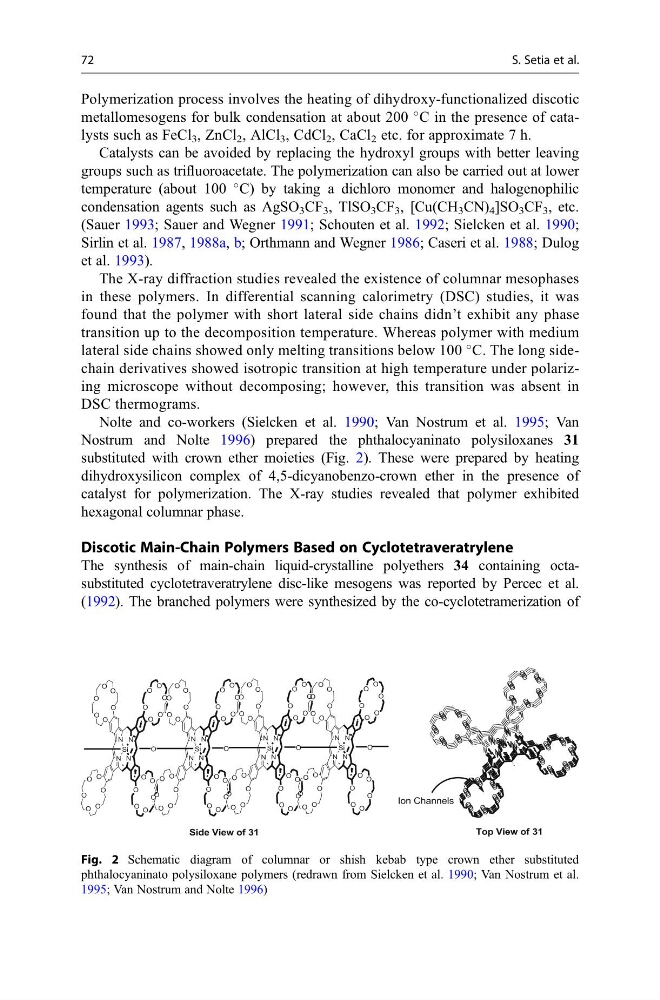
Nolte and co-workers (Sielcken et al. 1990; Van Nostrum et al. 1995; Van
Nostrum and Nolte 1996) prepared the phthalocyaninato polysiloxanes 31
substituted with crown ether moieties (Fig. 2). These were prepared by heating
dihydroxysilicon complex of 4,5-dicyanobenzo-crown ether in the presence of
catalyst for polymerization. The X-ray studies revealed that polymer exhibited
hexagonal columnar phase.
Discotic Main-Chain Polymers Based on Cyclotetraveratrylene
The synthesis of main-chain liquid-crystalline polyethers 34 containing octasubstituted cyclotetraveratrylene disc-like mesogens was reported by Percec et al.
(1992). The branched polymers were synthesized by the co-cyclotetramerization of
Fig. 2 Schematic diagram of columnar or shish kebab type crown ether substituted
phthalocyaninato polysiloxane polymers (redrawn from Sielcken et al. 1990; Van Nostrum et al.
1995; Van Nostrum and Nolte 1996)
72
S. Setia et al.
metallomesogens for bulk condensation at about 200
C in the presence of catalysts such as FeCl 3 , ZnCl 2 , AlCl 3 , CdCl 2 , CaCl 2 etc. for approximate 7 h.
Catalysts can be avoided by replacing the hydroxyl groups with better leaving
groups such as trifluoroacetate. The polymerization can also be carried out at lower
temperature (about 100
C) by taking a dichloro monomer and halogenophilic
condensation agents such as AgSO 3 CF 3 , TlSO 3 CF 3 , [Cu(CH 3 CN) 4 ]SO 3 CF 3 , etc.
(Sauer 1993; Sauer and Wegner 1991; Schouten et al. 1992; Sielcken et al. 1990;
Sirlin et al. 1987, 1988a, b; Orthmann and Wegner 1986; Caseri et al. 1988; Dulog
et al. 1993).
The X-ray diffraction studies revealed the existence of columnar mesophases
in these polymers. In differential scanning calorimetry (DSC) studies, it was
found that the polymer with short lateral side chains didn’t exhibit any phase
transition up to the decomposition temperature. Whereas polymer with medium
lateral side chains showed only melting transitions below 100
C. The long sidechain derivatives showed isotropic transition at high temperature under polarizing microscope without decomposing; however, this transition was absent in
DSC thermograms.
Nolte and co-workers (Sielcken et al. 1990; Van Nostrum et al. 1995; Van
Nostrum and Nolte 1996) prepared the phthalocyaninato polysiloxanes 31
substituted with crown ether moieties (Fig. 2). These were prepared by heating
dihydroxysilicon complex of 4,5-dicyanobenzo-crown ether in the presence of
catalyst for polymerization. The X-ray studies revealed that polymer exhibited
hexagonal columnar phase.
Discotic Main-Chain Polymers Based on Cyclotetraveratrylene
The synthesis of main-chain liquid-crystalline polyethers 34 containing octasubstituted cyclotetraveratrylene disc-like mesogens was reported by Percec et al.
(1992). The branched polymers were synthesized by the co-cyclotetramerization of
Fig. 2 Schematic diagram of columnar or shish kebab type crown ether substituted
phthalocyaninato polysiloxane polymers (redrawn from Sielcken et al. 1990; Van Nostrum et al.
1995; Van Nostrum and Nolte 1996)
72
S. Setia et al.