

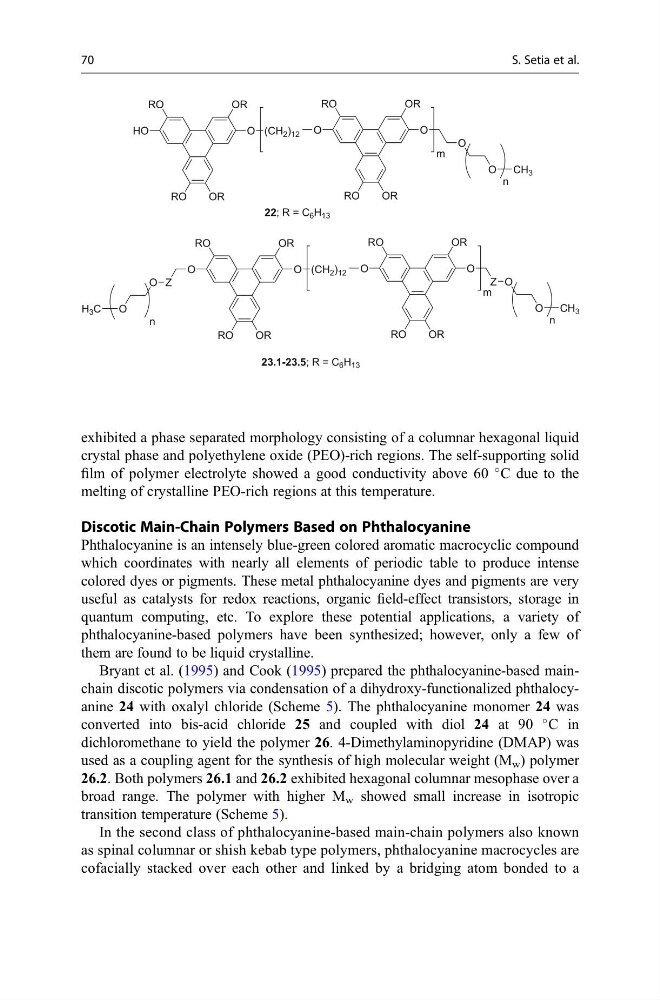
exhibited a phase separated morphology consisting of a columnar hexagonal liquid
crystal phase and polyethylene oxide (PEO)-rich regions. The self-supporting solid
film of polymer electrolyte showed a good conductivity above 60
C due to the
melting of crystalline PEO-rich regions at this temperature.
Discotic Main-Chain Polymers Based on Phthalocyanine
Phthalocyanine is an intensely blue-green colored aromatic macrocyclic compound
which coordinates with nearly all elements of periodic table to produce intense
colored dyes or pigments. These metal phthalocyanine dyes and pigments are very
useful as catalysts for redox reactions, organic field-effect transistors, storage in
quantum computing, etc. To explore these potential applications, a variety of
phthalocyanine-based polymers have been synthesized; however, only a few of
them are found to be liquid crystalline.
Bryant et al. (1995) and Cook (1995) prepared the phthalocyanine-based mainchain discotic polymers via condensation of a dihydroxy-functionalized phthalocyanine 24 with oxalyl chloride (Scheme 5). The phthalocyanine monomer 24 was
converted into bis-acid chloride 25 and coupled with diol 24 at 90
C in
dichloromethane to yield the polymer 26. 4-Dimethylaminopyridine (DMAP) was
used as a coupling agent for the synthesis of high molecular weight (M w ) polymer
26.2. Both polymers 26.1 and 26.2 exhibited hexagonal columnar mesophase over a
broad range. The polymer with higher M w showed small increase in isotropic
transition temperature (Scheme 5).
In the second class of phthalocyanine-based main-chain polymers also known
as spinal columnar or shish kebab type polymers, phthalocyanine macrocycles are
cofacially stacked over each other and linked by a bridging atom bonded to a
22; R = C 6 H 13
RO
HO
O
OR
OR
RO
(CH 2 ) 12 O
RO
OR
O
OR
RO
O
O
CH 3
m
n
RO
O
O
OR
OR
RO
(CH 2 ) 12 O
RO
OR
O
OR
RO
Z O
O
CH 3
m
n
Z
O
O
H 3 C
n
23.1-23.5; R = C 6 H 13
70
S. Setia et al.
crystal phase and polyethylene oxide (PEO)-rich regions. The self-supporting solid
film of polymer electrolyte showed a good conductivity above 60
C due to the
melting of crystalline PEO-rich regions at this temperature.
Discotic Main-Chain Polymers Based on Phthalocyanine
Phthalocyanine is an intensely blue-green colored aromatic macrocyclic compound
which coordinates with nearly all elements of periodic table to produce intense
colored dyes or pigments. These metal phthalocyanine dyes and pigments are very
useful as catalysts for redox reactions, organic field-effect transistors, storage in
quantum computing, etc. To explore these potential applications, a variety of
phthalocyanine-based polymers have been synthesized; however, only a few of
them are found to be liquid crystalline.
Bryant et al. (1995) and Cook (1995) prepared the phthalocyanine-based mainchain discotic polymers via condensation of a dihydroxy-functionalized phthalocyanine 24 with oxalyl chloride (Scheme 5). The phthalocyanine monomer 24 was
converted into bis-acid chloride 25 and coupled with diol 24 at 90
C in
dichloromethane to yield the polymer 26. 4-Dimethylaminopyridine (DMAP) was
used as a coupling agent for the synthesis of high molecular weight (M w ) polymer
26.2. Both polymers 26.1 and 26.2 exhibited hexagonal columnar mesophase over a
broad range. The polymer with higher M w showed small increase in isotropic
transition temperature (Scheme 5).
In the second class of phthalocyanine-based main-chain polymers also known
as spinal columnar or shish kebab type polymers, phthalocyanine macrocycles are
cofacially stacked over each other and linked by a bridging atom bonded to a
22; R = C 6 H 13
RO
HO
O
OR
OR
RO
(CH 2 ) 12 O
RO
OR
O
OR
RO
O
O
CH 3
m
n
RO
O
O
OR
OR
RO
(CH 2 ) 12 O
RO
OR
O
OR
RO
Z O
O
CH 3
m
n
Z
O
O
H 3 C
n
23.1-23.5; R = C 6 H 13
70
S. Setia et al.