

Benzene-based discotic polyamides 12.1–12.8 were prepared by reacting tetra
substituted 1,4-phenylenediamine 6 with terephthaloyl dichloride 8 in N-methyl-2pyrrolidone as solvent. Polyamides with four lateral alkyl chains 12.1 and 12.4
were found to be crystalline in nature, whereas polymers with six lateral chains
exhibited liquid crystalline behavior. This reverse behavior of these polymers as
compared to polyesters is due to the hydrogen bonding caused by amide linkage,
and thus polyamides 12.1 and 12.4 have a strong tendency to crystallize. Attachment of two more lateral substituents per repeating unit causes weaker
intermolecular interactions and hence favors the formation of mesomorphic
phase (Scheme 4).
Discotic Main-Chain Polymers Based on Triphenylene
Kreuder et al. (1985) prepared the very first triphenylene-based main-chain discotic
polymer. These polymers were prepared starting from the difunctional triphenylene
precursor monomer formed via partial hydrolysis/alkylation of triphenylene hexaacetate. But the main disadvantage of this method is that it provides a mixture of
diacetate isomers with two hydroxyl at 2,3-, 2,6-, 2,7-, or 2,11-positions. The
separation of these isomers requires extensive column chromatography.
Triphenylene-based main-chain polymers 13.1–13.10 were prepared via melt polycondensation with various α,ω-diacids (Hüser and Spiess 1988; Ringsdorf et al.
1989; Voigt-Martin et al. 1992; Green et al. 1990).
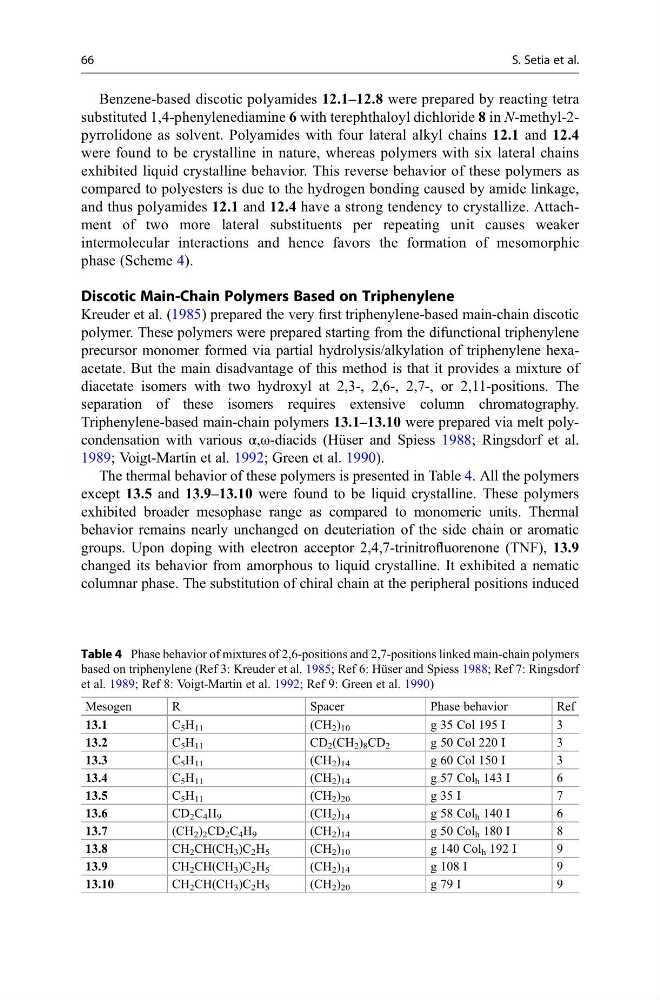
The thermal behavior of these polymers is presented in Table 4. All the polymers
except 13.5 and 13.9–13.10 were found to be liquid crystalline. These polymers
exhibited broader mesophase range as compared to monomeric units. Thermal
behavior remains nearly unchanged on deuteriation of the side chain or aromatic
groups. Upon doping with electron acceptor 2,4,7-trinitrofluorenone (TNF), 13.9
changed its behavior from amorphous to liquid crystalline. It exhibited a nematic
columnar phase. The substitution of chiral chain at the peripheral positions induced
Table 4 Phase behavior of mixtures of 2,6-positions and 2,7-positions linked main-chain polymers
based on triphenylene (Ref 3: Kreuder et al. 1985; Ref 6: Hüser and Spiess 1988; Ref 7: Ringsdorf
et al. 1989; Ref 8: Voigt-Martin et al. 1992; Ref 9: Green et al. 1990)
Mesogen
R
Spacer
Phase behavior
Ref
13.1
C 5 H 11
(CH 2 ) 10
g 35 Col 195 I
3
13.2
C 5 H 11
CD 2 (CH 2 ) 8 CD 2
g 50 Col 220 I
3
13.3
C 5 H 11
(CH 2 ) 14
g 60 Col 150 I
3
13.4
C 5 H 11
(CH 2 ) 14
g 57 Col h 143 I
6
13.5
C 5 H 11
(CH 2 ) 20
g 35 I
7
13.6
CD 2 C 4 H 9
(CH 2 ) 14
g 58 Col h 140 I
6
13.7
(CH 2 ) 2 CD 2 C 4 H 9
(CH 2 ) 14
g 50 Col h 180 I
8
13.8
CH 2 CH(CH 3 )C 2 H 5
(CH 2 ) 10
g 140 Col h 192 I
9
13.9
CH 2 CH(CH 3 )C 2 H 5
(CH 2 ) 14
g 108 I
9
13.10
CH 2 CH(CH 3 )C 2 H 5
(CH 2 ) 20
g 79 I
9
66
S. Setia et al.
substituted 1,4-phenylenediamine 6 with terephthaloyl dichloride 8 in N-methyl-2pyrrolidone as solvent. Polyamides with four lateral alkyl chains 12.1 and 12.4
were found to be crystalline in nature, whereas polymers with six lateral chains
exhibited liquid crystalline behavior. This reverse behavior of these polymers as
compared to polyesters is due to the hydrogen bonding caused by amide linkage,
and thus polyamides 12.1 and 12.4 have a strong tendency to crystallize. Attachment of two more lateral substituents per repeating unit causes weaker
intermolecular interactions and hence favors the formation of mesomorphic
phase (Scheme 4).
Discotic Main-Chain Polymers Based on Triphenylene
Kreuder et al. (1985) prepared the very first triphenylene-based main-chain discotic
polymer. These polymers were prepared starting from the difunctional triphenylene
precursor monomer formed via partial hydrolysis/alkylation of triphenylene hexaacetate. But the main disadvantage of this method is that it provides a mixture of
diacetate isomers with two hydroxyl at 2,3-, 2,6-, 2,7-, or 2,11-positions. The
separation of these isomers requires extensive column chromatography.
Triphenylene-based main-chain polymers 13.1–13.10 were prepared via melt polycondensation with various α,ω-diacids (Hüser and Spiess 1988; Ringsdorf et al.
1989; Voigt-Martin et al. 1992; Green et al. 1990).
The thermal behavior of these polymers is presented in Table 4. All the polymers
except 13.5 and 13.9–13.10 were found to be liquid crystalline. These polymers
exhibited broader mesophase range as compared to monomeric units. Thermal
behavior remains nearly unchanged on deuteriation of the side chain or aromatic
groups. Upon doping with electron acceptor 2,4,7-trinitrofluorenone (TNF), 13.9
changed its behavior from amorphous to liquid crystalline. It exhibited a nematic
columnar phase. The substitution of chiral chain at the peripheral positions induced
Table 4 Phase behavior of mixtures of 2,6-positions and 2,7-positions linked main-chain polymers
based on triphenylene (Ref 3: Kreuder et al. 1985; Ref 6: Hüser and Spiess 1988; Ref 7: Ringsdorf
et al. 1989; Ref 8: Voigt-Martin et al. 1992; Ref 9: Green et al. 1990)
Mesogen
R
Spacer
Phase behavior
Ref
13.1
C 5 H 11
(CH 2 ) 10
g 35 Col 195 I
3
13.2
C 5 H 11
CD 2 (CH 2 ) 8 CD 2
g 50 Col 220 I
3
13.3
C 5 H 11
(CH 2 ) 14
g 60 Col 150 I
3
13.4
C 5 H 11
(CH 2 ) 14
g 57 Col h 143 I
6
13.5
C 5 H 11
(CH 2 ) 20
g 35 I
7
13.6
CD 2 C 4 H 9
(CH 2 ) 14
g 58 Col h 140 I
6
13.7
(CH 2 ) 2 CD 2 C 4 H 9
(CH 2 ) 14
g 50 Col h 180 I
8
13.8
CH 2 CH(CH 3 )C 2 H 5
(CH 2 ) 10
g 140 Col h 192 I
9
13.9
CH 2 CH(CH 3 )C 2 H 5
(CH 2 ) 14
g 108 I
9
13.10
CH 2 CH(CH 3 )C 2 H 5
(CH 2 ) 20
g 79 I
9
66
S. Setia et al.