

mesogens with a well-defined supramolecular structure has opened up a new field of
DLCs known as the discotic liquid crystalline polymers. A range of synthetic
methods, including polymer homologous reactions, free radical polymerizations,
optical polymerizations, ring-opening metathesis polymerizations and condensation
polymerizations, have been used to prepare such polymers. However, polymeric
DLCs have been relatively little explored due to difficulties in synthesizing monodisperse polymerizable monomers containing the mesogenic moiety.
The very first polymeric discotic liquid crystal was prepared by Ringsdorf group
in 1983 (Kreuder and Ringsdorf 1983), and since then many other discotic polymers
have been prepared and studied for various physical properties. The discotic liquid
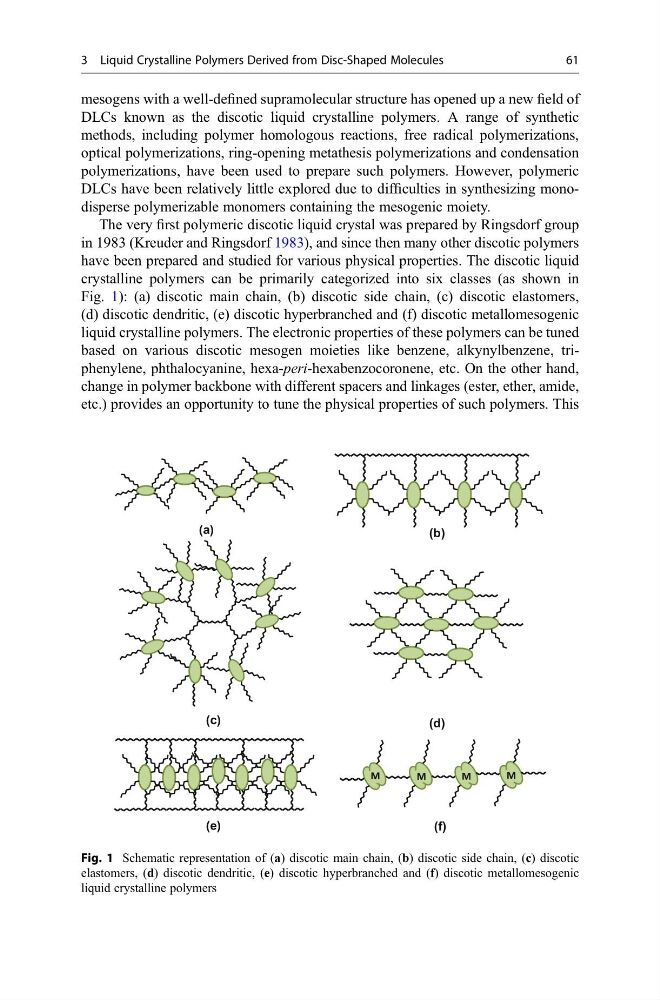
crystalline polymers can be primarily categorized into six classes (as shown in
Fig. 1): (a) discotic main chain, (b) discotic side chain, (c) discotic elastomers,
(d) discotic dendritic, (e) discotic hyperbranched and (f) discotic metallomesogenic
liquid crystalline polymers. The electronic properties of these polymers can be tuned
based on various discotic mesogen moieties like benzene, alkynylbenzene, triphenylene, phthalocyanine, hexa-peri-hexabenzocoronene, etc. On the other hand,
change in polymer backbone with different spacers and linkages (ester, ether, amide,
etc.) provides an opportunity to tune the physical properties of such polymers. This
M
M
M
M
(a)
(b)
(c)
(d)
(e)
(f)
Fig. 1 Schematic representation of (a) discotic main chain, (b) discotic side chain, (c) discotic
elastomers, (d) discotic dendritic, (e) discotic hyperbranched and (f) discotic metallomesogenic
liquid crystalline polymers
3 Liquid Crystalline Polymers Derived from Disc-Shaped Molecules
61
DLCs known as the discotic liquid crystalline polymers. A range of synthetic
methods, including polymer homologous reactions, free radical polymerizations,
optical polymerizations, ring-opening metathesis polymerizations and condensation
polymerizations, have been used to prepare such polymers. However, polymeric
DLCs have been relatively little explored due to difficulties in synthesizing monodisperse polymerizable monomers containing the mesogenic moiety.
The very first polymeric discotic liquid crystal was prepared by Ringsdorf group
in 1983 (Kreuder and Ringsdorf 1983), and since then many other discotic polymers
have been prepared and studied for various physical properties. The discotic liquid
crystalline polymers can be primarily categorized into six classes (as shown in
Fig. 1): (a) discotic main chain, (b) discotic side chain, (c) discotic elastomers,
(d) discotic dendritic, (e) discotic hyperbranched and (f) discotic metallomesogenic
liquid crystalline polymers. The electronic properties of these polymers can be tuned
based on various discotic mesogen moieties like benzene, alkynylbenzene, triphenylene, phthalocyanine, hexa-peri-hexabenzocoronene, etc. On the other hand,
change in polymer backbone with different spacers and linkages (ester, ether, amide,
etc.) provides an opportunity to tune the physical properties of such polymers. This
M
M
M
M
(a)
(b)
(c)
(d)
(e)
(f)
Fig. 1 Schematic representation of (a) discotic main chain, (b) discotic side chain, (c) discotic
elastomers, (d) discotic dendritic, (e) discotic hyperbranched and (f) discotic metallomesogenic
liquid crystalline polymers
3 Liquid Crystalline Polymers Derived from Disc-Shaped Molecules
61