

Ring-Opening Metathesis Polymerization (ROMP)
Yang and coworkers synthesized MJLCPs with a polynorbornene backbone using
the ROMP method (Yang et al. 2013). The mesogen was laterally attached directly to
the main chain without spacers. The polymerization was initiated by using a Grubbs
catalyst. The polymers are liquid crystalline and exhibit smectic phases when the
alkoxy tails of the mesogens are long enough. Recently, we also obtained
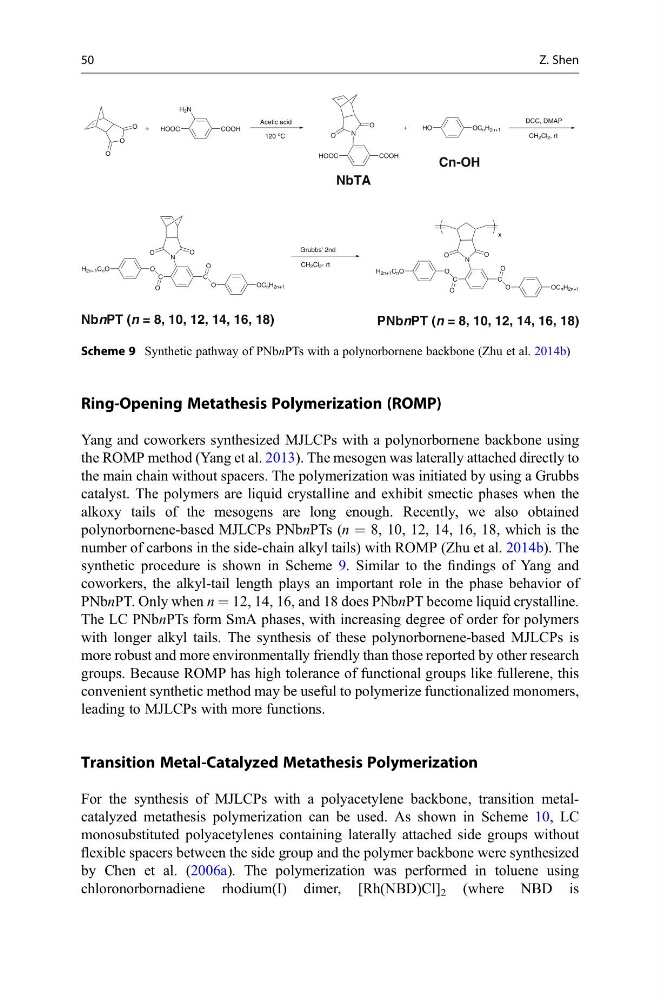
polynorbornene-based MJLCPs PNbnPTs (n = 8, 10, 12, 14, 16, 18, which is the
number of carbons in the side-chain alkyl tails) with ROMP (Zhu et al. 2014b). The
synthetic procedure is shown in Scheme 9. Similar to the findings of Yang and
coworkers, the alkyl-tail length plays an important role in the phase behavior of
PNbnPT. Only when n = 12, 14, 16, and 18 does PNbnPT become liquid crystalline.
The LC PNbnPTs form SmA phases, with increasing degree of order for polymers
with longer alkyl tails. The synthesis of these polynorbornene-based MJLCPs is
more robust and more environmentally friendly than those reported by other research
groups. Because ROMP has high tolerance of functional groups like fullerene, this
convenient synthetic method may be useful to polymerize functionalized monomers,
leading to MJLCPs with more functions.
Transition Metal-Catalyzed Metathesis Polymerization
For the synthesis of MJLCPs with a polyacetylene backbone, transition metalcatalyzed metathesis polymerization can be used. As shown in Scheme 10, LC
monosubstituted polyacetylenes containing laterally attached side groups without
flexible spacers between the side group and the polymer backbone were synthesized
by Chen et al. (2006a). The polymerization was performed in toluene using
chloronorbornadiene rhodium(I) dimer, [Rh(NBD)Cl] 2 (where NBD is
O
O
N
x
C
O
O
C
O
O
OCnH2n+1
H2n+1CnO
O
O
O
+
HOOC
COOH
H2N
Acetic acid
HOOC
COOH
N
O
O
+
HO
OCnH2n+1
DCC, DMAP
CH2Cl2, rt
O
O
N
C
O
O
C
O
O
OCnH2n+1
H2n+1CnO
Grubbs' 2nd
CH2Cl2- rt
120 o C
NbTA
Cn-OH
NbnPT (n = 8, 10, 12, 14, 16, 18)
PNbnPT (n = 8, 10, 12, 14, 16, 18)
Scheme 9 Synthetic pathway of PNbnPTs with a polynorbornene backbone (Zhu et al. 2014b)
50
Z. Shen
Yang and coworkers synthesized MJLCPs with a polynorbornene backbone using
the ROMP method (Yang et al. 2013). The mesogen was laterally attached directly to
the main chain without spacers. The polymerization was initiated by using a Grubbs
catalyst. The polymers are liquid crystalline and exhibit smectic phases when the
alkoxy tails of the mesogens are long enough. Recently, we also obtained
polynorbornene-based MJLCPs PNbnPTs (n = 8, 10, 12, 14, 16, 18, which is the
number of carbons in the side-chain alkyl tails) with ROMP (Zhu et al. 2014b). The
synthetic procedure is shown in Scheme 9. Similar to the findings of Yang and
coworkers, the alkyl-tail length plays an important role in the phase behavior of
PNbnPT. Only when n = 12, 14, 16, and 18 does PNbnPT become liquid crystalline.
The LC PNbnPTs form SmA phases, with increasing degree of order for polymers
with longer alkyl tails. The synthesis of these polynorbornene-based MJLCPs is
more robust and more environmentally friendly than those reported by other research
groups. Because ROMP has high tolerance of functional groups like fullerene, this
convenient synthetic method may be useful to polymerize functionalized monomers,
leading to MJLCPs with more functions.
Transition Metal-Catalyzed Metathesis Polymerization
For the synthesis of MJLCPs with a polyacetylene backbone, transition metalcatalyzed metathesis polymerization can be used. As shown in Scheme 10, LC
monosubstituted polyacetylenes containing laterally attached side groups without
flexible spacers between the side group and the polymer backbone were synthesized
by Chen et al. (2006a). The polymerization was performed in toluene using
chloronorbornadiene rhodium(I) dimer, [Rh(NBD)Cl] 2 (where NBD is
O
O
N
x
C
O
O
C
O
O
OCnH2n+1
H2n+1CnO
O
O
O
+
HOOC
COOH
H2N
Acetic acid
HOOC
COOH
N
O
O
+
HO
OCnH2n+1
DCC, DMAP
CH2Cl2, rt
O
O
N
C
O
O
C
O
O
OCnH2n+1
H2n+1CnO
Grubbs' 2nd
CH2Cl2- rt
120 o C
NbTA
Cn-OH
NbnPT (n = 8, 10, 12, 14, 16, 18)
PNbnPT (n = 8, 10, 12, 14, 16, 18)
Scheme 9 Synthetic pathway of PNbnPTs with a polynorbornene backbone (Zhu et al. 2014b)
50
Z. Shen