

C25A content. When the amount of organoclay in EHBT reached 6 wt%, a 1.6-fold
increase in the ultimate strength and a 2.0-fold increase in the initial modulus were
obtained, as compared to the strength and modulus of the pure polymer matrix.
Future Directions
Nanocomposites are a class of composites derived from ultrafine inorganic particles,
such as clays (with sizes in the nanometer range), that are homogeneously dispersed
in a polymer matrix. Because of the nanometer sizes of the particles, these materials
possess properties that are superior to those of conventional composites. In particular, the high interfacial adhesion in the nanocomposites resulting from their nanometer particle dimensions improves the physical material properties. Many works
demonstrated a potential fabrication technique for nanocomposites of a TLCP with
an organoclay that yields high-performance materials. Nanostructured materials
often possess a combination of physical and mechanical properties that are not
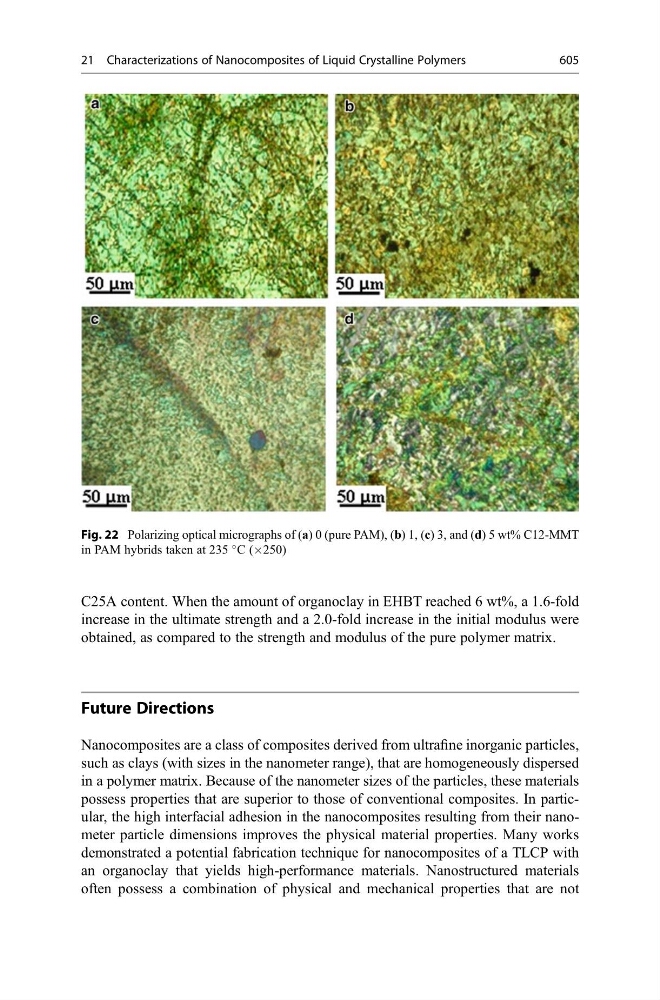
Fig. 22 Polarizing optical micrographs of (a) 0 (pure PAM), (b) 1, (c) 3, and (d) 5 wt% C12-MMT
in PAM hybrids taken at 235
C (Â250)
21 Characterizations of Nanocomposites of Liquid Crystalline Polymers
605