

thermal cross-linking (2π + 2π cycloaddition) between divanillylidene mesogenic
groups (Scheme 12), which was proved by the DSC heating scans of all testing
polymers. These phenomena may have the potential benefit on flame retardance that
the thermal cross-linking could play positive role on suppressing the melt dripping
during burning, accelerating aromatization, and carbonization, therefore enhancing the
flame retardance in the condensed phase (Zhao et al. 2012, 2014). Besides thermal
cross-linking, all the polymers showed photo dimerization behavior under UV irradiation, and the photolysis reaction completed within 30–40 min. Polymers with more
methylene spacers showed faster photolysis than the ones containing fewer methylene
spacers, and the pendent alkyloxy-containing polymers showed faster cross-linking
than those with pendent aryloxy groups. Same results were obtained for the similar
liquid crystalline polyphosphates derived from dibenzylidene cyclopentanone group
(Sakthivel and Kannan 2006) or stilbene-based derivatives (Ravikrishnan et al. 2008,
2010, 2012) as the cross-linkable mesogenic unit.
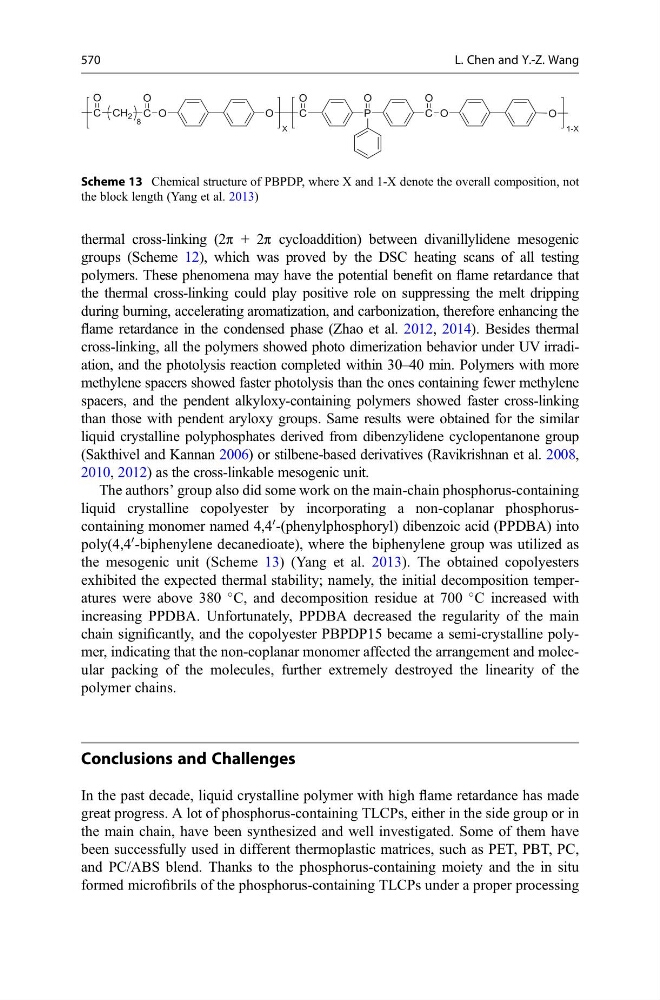
The authors’ group also did some work on the main-chain phosphorus-containing
liquid crystalline copolyester by incorporating a non-coplanar phosphoruscontaining monomer named 4,4
0 -(phenylphosphoryl) dibenzoic acid (PPDBA) into
poly(4,4
0 -biphenylene decanedioate), where the biphenylene group was utilized as
the mesogenic unit (Scheme 13) (Yang et al. 2013). The obtained copolyesters
exhibited the expected thermal stability; namely, the initial decomposition temperatures were above 380
C, and decomposition residue at 700
C increased with
increasing PPDBA. Unfortunately, PPDBA decreased the regularity of the main
chain significantly, and the copolyester PBPDP15 became a semi-crystalline polymer, indicating that the non-coplanar monomer affected the arrangement and molecular packing of the molecules, further extremely destroyed the linearity of the
polymer chains.
Conclusions and Challenges
In the past decade, liquid crystalline polymer with high flame retardance has made
great progress. A lot of phosphorus-containing TLCPs, either in the side group or in
the main chain, have been synthesized and well investigated. Some of them have
been successfully used in different thermoplastic matrices, such as PET, PBT, PC,
and PC/ABS blend. Thanks to the phosphorus-containing moiety and the in situ
formed microfibrils of the phosphorus-containing TLCPs under a proper processing
Scheme 13 Chemical structure of PBPDP, where X and 1-X denote the overall composition, not
the block length (Yang et al. 2013)
570
L. Chen and Y.-Z. Wang