

benzoquinone (aromatic C=C), aldehydes (C=O), etc. or epoxides, which is becoming
most of the researchers and manufacturers’ first choice (Chang and Chang 1999).
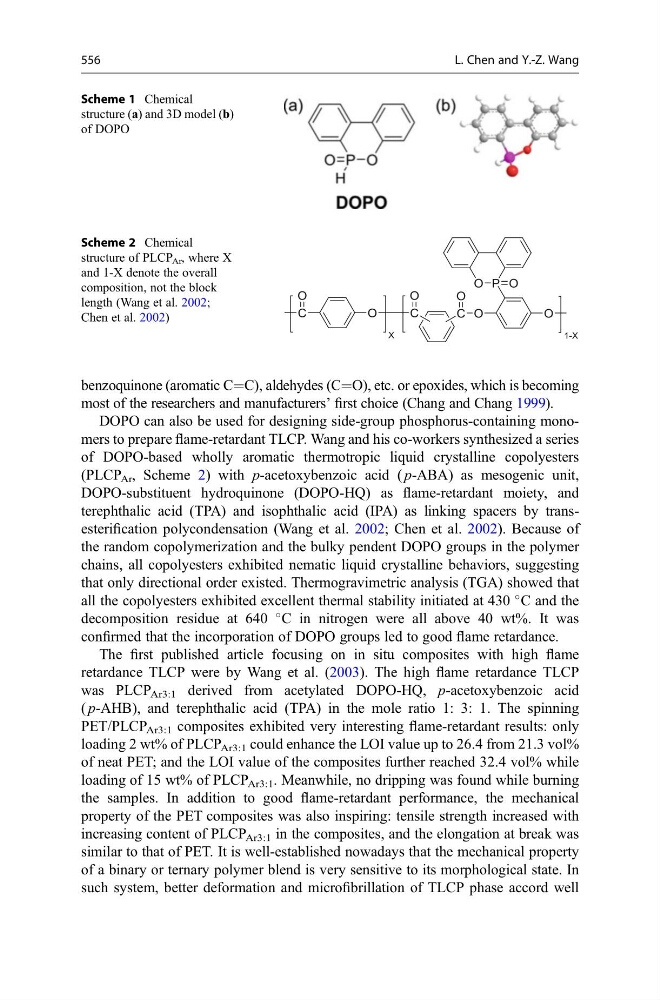
DOPO can also be used for designing side-group phosphorus-containing monomers to prepare flame-retardant TLCP. Wang and his co-workers synthesized a series
of DOPO-based wholly aromatic thermotropic liquid crystalline copolyesters
(PLCP Ar , Scheme 2) with p-acetoxybenzoic acid ( p-ABA) as mesogenic unit,
DOPO-substituent hydroquinone (DOPO-HQ) as flame-retardant moiety, and
terephthalic acid (TPA) and isophthalic acid (IPA) as linking spacers by transesterification polycondensation (Wang et al. 2002; Chen et al. 2002). Because of
the random copolymerization and the bulky pendent DOPO groups in the polymer
chains, all copolyesters exhibited nematic liquid crystalline behaviors, suggesting
that only directional order existed. Thermogravimetric analysis (TGA) showed that
all the copolyesters exhibited excellent thermal stability initiated at 430
C and the
decomposition residue at 640
C in nitrogen were all above 40 wt%. It was
confirmed that the incorporation of DOPO groups led to good flame retardance.
The first published article focusing on in situ composites with high flame
retardance TLCP were by Wang et al. (2003). The high flame retardance TLCP
was PLCP Ar3:1 derived from acetylated DOPO-HQ, p-acetoxybenzoic acid
( p-AHB), and terephthalic acid (TPA) in the mole ratio 1: 3: 1. The spinning
PET/PLCP Ar3:1 composites exhibited very interesting flame-retardant results: only
loading 2 wt% of PLCP Ar3:1 could enhance the LOI value up to 26.4 from 21.3 vol%
of neat PET; and the LOI value of the composites further reached 32.4 vol% while
loading of 15 wt% of PLCP Ar3:1 . Meanwhile, no dripping was found while burning
the samples. In addition to good flame-retardant performance, the mechanical
property of the PET composites was also inspiring: tensile strength increased with
increasing content of PLCP Ar3:1 in the composites, and the elongation at break was
similar to that of PET. It is well-established nowadays that the mechanical property
of a binary or ternary polymer blend is very sensitive to its morphological state. In
such system, better deformation and microfibrillation of TLCP phase accord well
Scheme 1 Chemical
structure (a) and 3D model (b)
of DOPO
Scheme 2 Chemical
structure of PLCP Ar , where X
and 1-X denote the overall
composition, not the block
length (Wang et al. 2002;
Chen et al. 2002)
556
L. Chen and Y.-Z. Wang
most of the researchers and manufacturers’ first choice (Chang and Chang 1999).
DOPO can also be used for designing side-group phosphorus-containing monomers to prepare flame-retardant TLCP. Wang and his co-workers synthesized a series
of DOPO-based wholly aromatic thermotropic liquid crystalline copolyesters
(PLCP Ar , Scheme 2) with p-acetoxybenzoic acid ( p-ABA) as mesogenic unit,
DOPO-substituent hydroquinone (DOPO-HQ) as flame-retardant moiety, and
terephthalic acid (TPA) and isophthalic acid (IPA) as linking spacers by transesterification polycondensation (Wang et al. 2002; Chen et al. 2002). Because of
the random copolymerization and the bulky pendent DOPO groups in the polymer
chains, all copolyesters exhibited nematic liquid crystalline behaviors, suggesting
that only directional order existed. Thermogravimetric analysis (TGA) showed that
all the copolyesters exhibited excellent thermal stability initiated at 430
C and the
decomposition residue at 640
C in nitrogen were all above 40 wt%. It was
confirmed that the incorporation of DOPO groups led to good flame retardance.
The first published article focusing on in situ composites with high flame
retardance TLCP were by Wang et al. (2003). The high flame retardance TLCP
was PLCP Ar3:1 derived from acetylated DOPO-HQ, p-acetoxybenzoic acid
( p-AHB), and terephthalic acid (TPA) in the mole ratio 1: 3: 1. The spinning
PET/PLCP Ar3:1 composites exhibited very interesting flame-retardant results: only
loading 2 wt% of PLCP Ar3:1 could enhance the LOI value up to 26.4 from 21.3 vol%
of neat PET; and the LOI value of the composites further reached 32.4 vol% while
loading of 15 wt% of PLCP Ar3:1 . Meanwhile, no dripping was found while burning
the samples. In addition to good flame-retardant performance, the mechanical
property of the PET composites was also inspiring: tensile strength increased with
increasing content of PLCP Ar3:1 in the composites, and the elongation at break was
similar to that of PET. It is well-established nowadays that the mechanical property
of a binary or ternary polymer blend is very sensitive to its morphological state. In
such system, better deformation and microfibrillation of TLCP phase accord well
Scheme 1 Chemical
structure (a) and 3D model (b)
of DOPO
Scheme 2 Chemical
structure of PLCP Ar , where X
and 1-X denote the overall
composition, not the block
length (Wang et al. 2002;
Chen et al. 2002)
556
L. Chen and Y.-Z. Wang