

(n = 6, 8, 10, 12) (Chen et al. 2009). And polymer 9 (Chart 1) having 1,3,4-oxadiazole
units in the side chains forms a Col hn phase for P-Ct and changes to a SmA phase for
P-OCn (Chai et al. 2007), confirming that the microphase separation between the flexible
tails and the rigid core is also important in the formation of smectic structures. In addition,
polymer 12 in Chart 1 with relatively short aliphatic tails forms a Col r phase, while that
with relatively long tails exhibits a Col h phase. And both Col h and Col r phases are
observed for polymer 12 with n = 12.
Non-covalent Interactions in Side Chain
Generally, the introduction of non-covalent interactions, such as hydrogen bonding,
π-π stacking, ionic interaction, and microphase separation, into the side chains of
MJLCPs favors the formation of smectic phases. For example, MJLCPs having sidechain amide linkages can develop SmA phases (Cheng et al. 2011a). Additionally,
smectic phases in these polymers are also favored because of the increased immiscibility between the longer tails and the aromatic core. Similar phenomena have been
observed in the two new series of polynorbornene-based MJLCPs (Yang et al. 2013;
Zhu et al. 2014b). Only polymers with long enough alkoxy tails in the side group are
liquid crystalline. MJLCPs having ionic groups in the side chains also display
smectic phases (Cheng et al. 2011b).
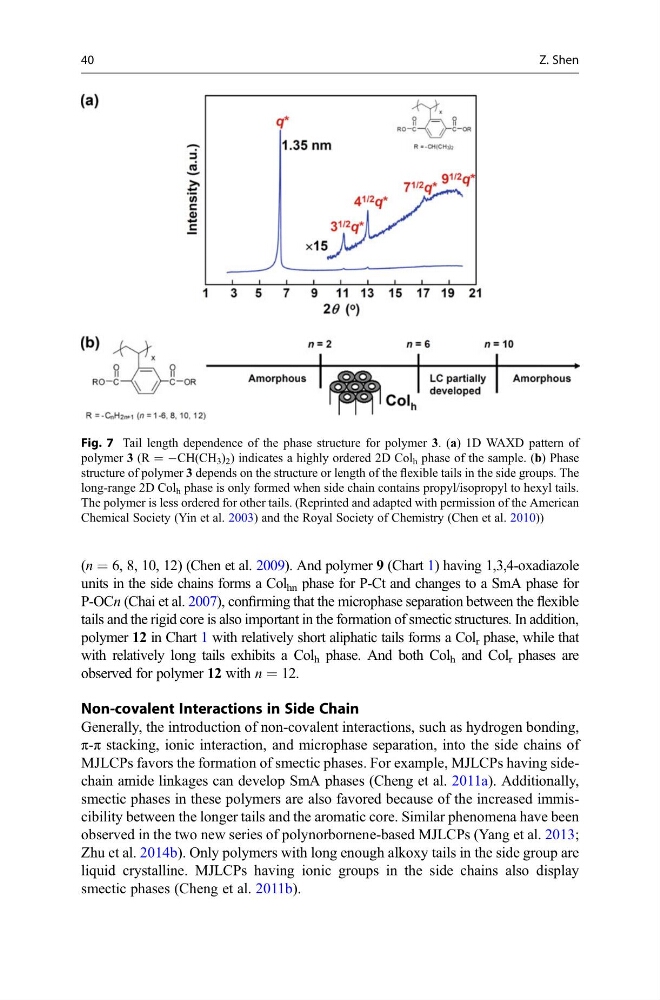
Fig. 7 Tail length dependence of the phase structure for polymer 3. (a) 1D WAXD pattern of
polymer 3 (R = ÀCH(CH 3 ) 2 ) indicates a highly ordered 2D Col h phase of the sample. (b) Phase
structure of polymer 3 depends on the structure or length of the flexible tails in the side groups. The
long-range 2D Col h phase is only formed when side chain contains propyl/isopropyl to hexyl tails.
The polymer is less ordered for other tails. (Reprinted and adapted with permission of the American
Chemical Society (Yin et al. 2003) and the Royal Society of Chemistry (Chen et al. 2010))
40
Z. Shen
units in the side chains forms a Col hn phase for P-Ct and changes to a SmA phase for
P-OCn (Chai et al. 2007), confirming that the microphase separation between the flexible
tails and the rigid core is also important in the formation of smectic structures. In addition,
polymer 12 in Chart 1 with relatively short aliphatic tails forms a Col r phase, while that
with relatively long tails exhibits a Col h phase. And both Col h and Col r phases are
observed for polymer 12 with n = 12.
Non-covalent Interactions in Side Chain
Generally, the introduction of non-covalent interactions, such as hydrogen bonding,
π-π stacking, ionic interaction, and microphase separation, into the side chains of
MJLCPs favors the formation of smectic phases. For example, MJLCPs having sidechain amide linkages can develop SmA phases (Cheng et al. 2011a). Additionally,
smectic phases in these polymers are also favored because of the increased immiscibility between the longer tails and the aromatic core. Similar phenomena have been
observed in the two new series of polynorbornene-based MJLCPs (Yang et al. 2013;
Zhu et al. 2014b). Only polymers with long enough alkoxy tails in the side group are
liquid crystalline. MJLCPs having ionic groups in the side chains also display
smectic phases (Cheng et al. 2011b).
Fig. 7 Tail length dependence of the phase structure for polymer 3. (a) 1D WAXD pattern of
polymer 3 (R = ÀCH(CH 3 ) 2 ) indicates a highly ordered 2D Col h phase of the sample. (b) Phase
structure of polymer 3 depends on the structure or length of the flexible tails in the side groups. The
long-range 2D Col h phase is only formed when side chain contains propyl/isopropyl to hexyl tails.
The polymer is less ordered for other tails. (Reprinted and adapted with permission of the American
Chemical Society (Yin et al. 2003) and the Royal Society of Chemistry (Chen et al. 2010))
40
Z. Shen