

of the aromatic polyimide that contains an alternating sequence of electron-rich
donor and electron-deficient acceptor molecules. Therefore, the CTC formation
and polymer cohesiveness can be determined via the emission peak intensity.
The maximum peak emission wavelength was approximately 470 nm. Figure 23
shows that the maximum peak emission intensities of all TeMPD-based polyimides
increased after LPUV irradiation. The LPUV irradiation depends on the chemical
structure and polymer cohesiveness. It is expected that the CT interaction between
polymer segments strongly depends on the photoreaction. The intermolecular crosslinked photoreaction derived from CT interaction occurred, as shown in our previous
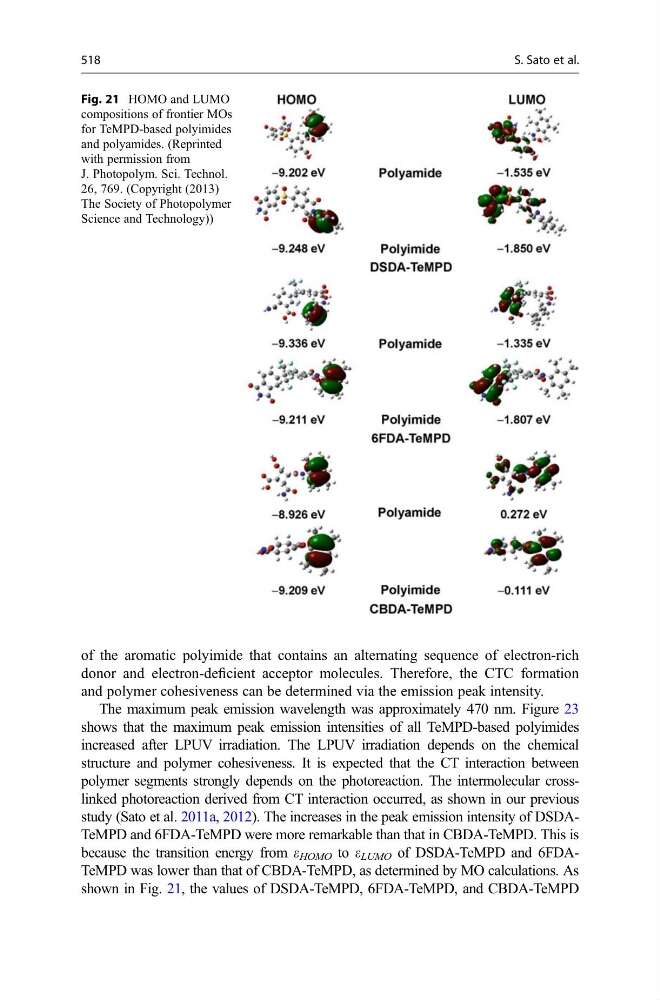
study (Sato et al. 2011a, 2012). The increases in the peak emission intensity of DSDATeMPD and 6FDA-TeMPD were more remarkable than that in CBDA-TeMPD. This is
because the transition energy from e HOMO to e LUMO of DSDA-TeMPD and 6FDATeMPD was lower than that of CBDA-TeMPD, as determined by MO calculations. As
shown in Fig. 21, the values of DSDA-TeMPD, 6FDA-TeMPD, and CBDA-TeMPD
Fig. 21 HOMO and LUMO
compositions of frontier MOs
for TeMPD-based polyimides
and polyamides. (Reprinted
with permission from
J. Photopolym. Sci. Technol.
26, 769. (Copyright (2013)
The Society of Photopolymer
Science and Technology))
518
S. Sato et al.
donor and electron-deficient acceptor molecules. Therefore, the CTC formation
and polymer cohesiveness can be determined via the emission peak intensity.
The maximum peak emission wavelength was approximately 470 nm. Figure 23
shows that the maximum peak emission intensities of all TeMPD-based polyimides
increased after LPUV irradiation. The LPUV irradiation depends on the chemical
structure and polymer cohesiveness. It is expected that the CT interaction between
polymer segments strongly depends on the photoreaction. The intermolecular crosslinked photoreaction derived from CT interaction occurred, as shown in our previous
study (Sato et al. 2011a, 2012). The increases in the peak emission intensity of DSDATeMPD and 6FDA-TeMPD were more remarkable than that in CBDA-TeMPD. This is
because the transition energy from e HOMO to e LUMO of DSDA-TeMPD and 6FDATeMPD was lower than that of CBDA-TeMPD, as determined by MO calculations. As
shown in Fig. 21, the values of DSDA-TeMPD, 6FDA-TeMPD, and CBDA-TeMPD
Fig. 21 HOMO and LUMO
compositions of frontier MOs
for TeMPD-based polyimides
and polyamides. (Reprinted
with permission from
J. Photopolym. Sci. Technol.
26, 769. (Copyright (2013)
The Society of Photopolymer
Science and Technology))
518
S. Sato et al.