

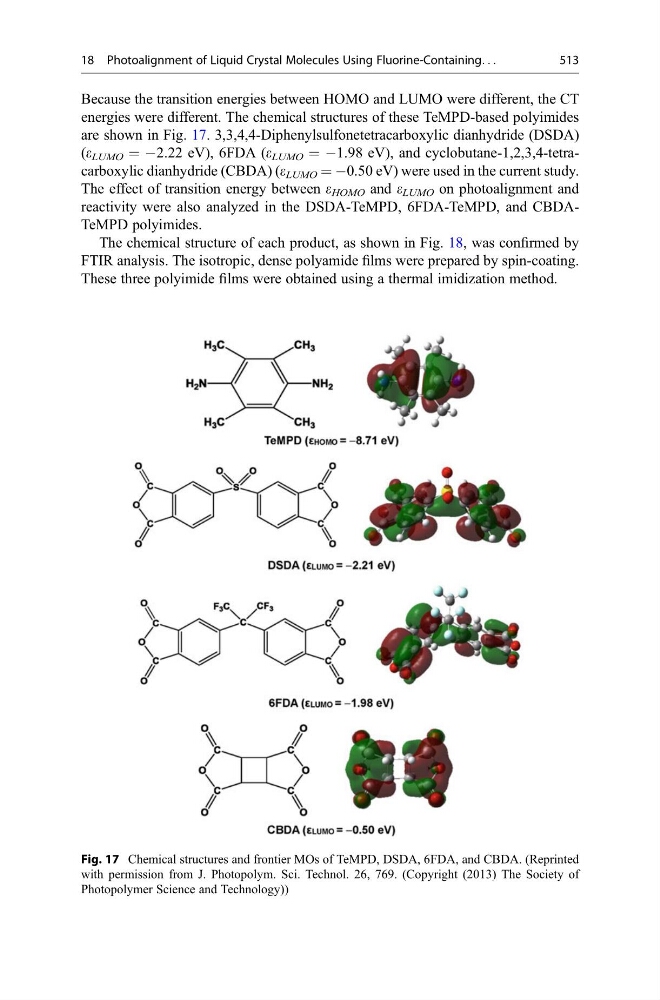
Because the transition energies between HOMO and LUMO were different, the CT
energies were different. The chemical structures of these TeMPD-based polyimides
are shown in Fig. 17. 3,3,4,4-Diphenylsulfonetetracarboxylic dianhydride (DSDA)
(e LUMO = À2.22 eV), 6FDA (e LUMO = À1.98 eV), and cyclobutane-1,2,3,4-tetracarboxylic dianhydride (CBDA) (e LUMO = À0.50 eV) were used in the current study.
The effect of transition energy between e HOMO and e LUMO on photoalignment and
reactivity were also analyzed in the DSDA-TeMPD, 6FDA-TeMPD, and CBDATeMPD polyimides.
The chemical structure of each product, as shown in Fig. 18, was confirmed by
FTIR analysis. The isotropic, dense polyamide films were prepared by spin-coating.
These three polyimide films were obtained using a thermal imidization method.
Fig. 17 Chemical structures and frontier MOs of TeMPD, DSDA, 6FDA, and CBDA. (Reprinted
with permission from J. Photopolym. Sci. Technol. 26, 769. (Copyright (2013) The Society of
Photopolymer Science and Technology))
18 Photoalignment of Liquid Crystal Molecules Using Fluorine-Containing. . .
513
energies were different. The chemical structures of these TeMPD-based polyimides
are shown in Fig. 17. 3,3,4,4-Diphenylsulfonetetracarboxylic dianhydride (DSDA)
(e LUMO = À2.22 eV), 6FDA (e LUMO = À1.98 eV), and cyclobutane-1,2,3,4-tetracarboxylic dianhydride (CBDA) (e LUMO = À0.50 eV) were used in the current study.
The effect of transition energy between e HOMO and e LUMO on photoalignment and
reactivity were also analyzed in the DSDA-TeMPD, 6FDA-TeMPD, and CBDATeMPD polyimides.
The chemical structure of each product, as shown in Fig. 18, was confirmed by
FTIR analysis. The isotropic, dense polyamide films were prepared by spin-coating.
These three polyimide films were obtained using a thermal imidization method.
Fig. 17 Chemical structures and frontier MOs of TeMPD, DSDA, 6FDA, and CBDA. (Reprinted
with permission from J. Photopolym. Sci. Technol. 26, 769. (Copyright (2013) The Society of
Photopolymer Science and Technology))
18 Photoalignment of Liquid Crystal Molecules Using Fluorine-Containing. . .
513