

Nos. 1 and 2 peak intensities of 6FDA-TeMPD clearly decreased upon LPUV
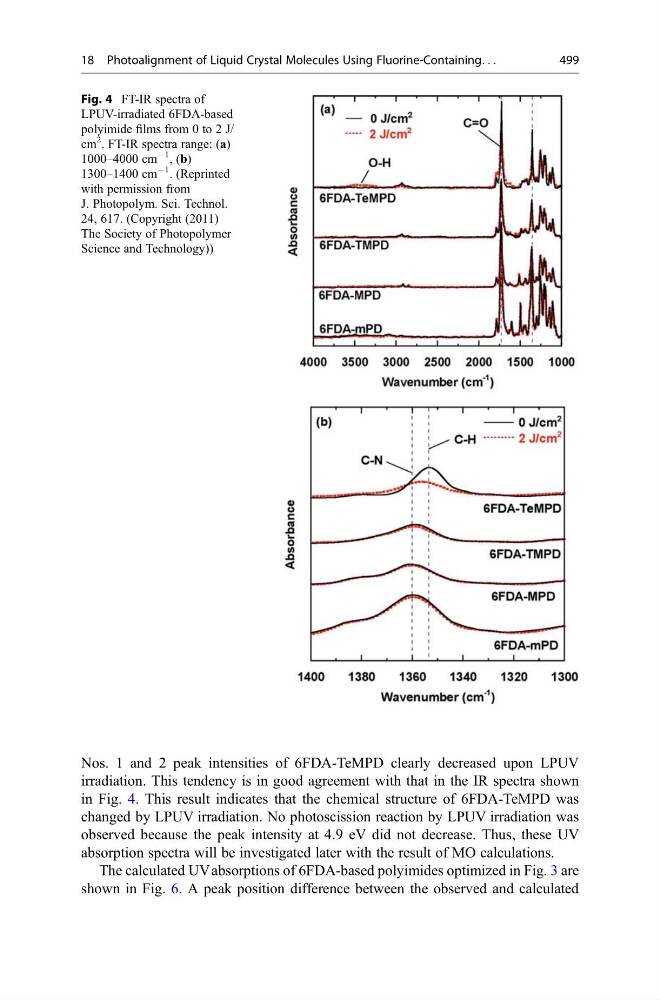
irradiation. This tendency is in good agreement with that in the IR spectra shown
in Fig. 4. This result indicates that the chemical structure of 6FDA-TeMPD was
changed by LPUV irradiation. No photoscission reaction by LPUV irradiation was
observed because the peak intensity at 4.9 eV did not decrease. Thus, these UV
absorption spectra will be investigated later with the result of MO calculations.
The calculated UV absorptions of 6FDA-based polyimides optimized in Fig. 3 are
shown in Fig. 6. A peak position difference between the observed and calculated
Fig. 4 FT-IR spectra of
LPUV-irradiated 6FDA-based
polyimide films from 0 to 2 J/
cm
2
. FT-IR spectra range: (a)
1000–4000 cm
À1
, (b)
1300–1400 cm
À1
. (Reprinted
with permission from
J. Photopolym. Sci. Technol.
24, 617. (Copyright (2011)
The Society of Photopolymer
Science and Technology))
18 Photoalignment of Liquid Crystal Molecules Using Fluorine-Containing. . .
499
irradiation. This tendency is in good agreement with that in the IR spectra shown
in Fig. 4. This result indicates that the chemical structure of 6FDA-TeMPD was
changed by LPUV irradiation. No photoscission reaction by LPUV irradiation was
observed because the peak intensity at 4.9 eV did not decrease. Thus, these UV
absorption spectra will be investigated later with the result of MO calculations.
The calculated UV absorptions of 6FDA-based polyimides optimized in Fig. 3 are
shown in Fig. 6. A peak position difference between the observed and calculated
Fig. 4 FT-IR spectra of
LPUV-irradiated 6FDA-based
polyimide films from 0 to 2 J/
cm
2
. FT-IR spectra range: (a)
1000–4000 cm
À1
, (b)
1300–1400 cm
À1
. (Reprinted
with permission from
J. Photopolym. Sci. Technol.
24, 617. (Copyright (2011)
The Society of Photopolymer
Science and Technology))
18 Photoalignment of Liquid Crystal Molecules Using Fluorine-Containing. . .
499