

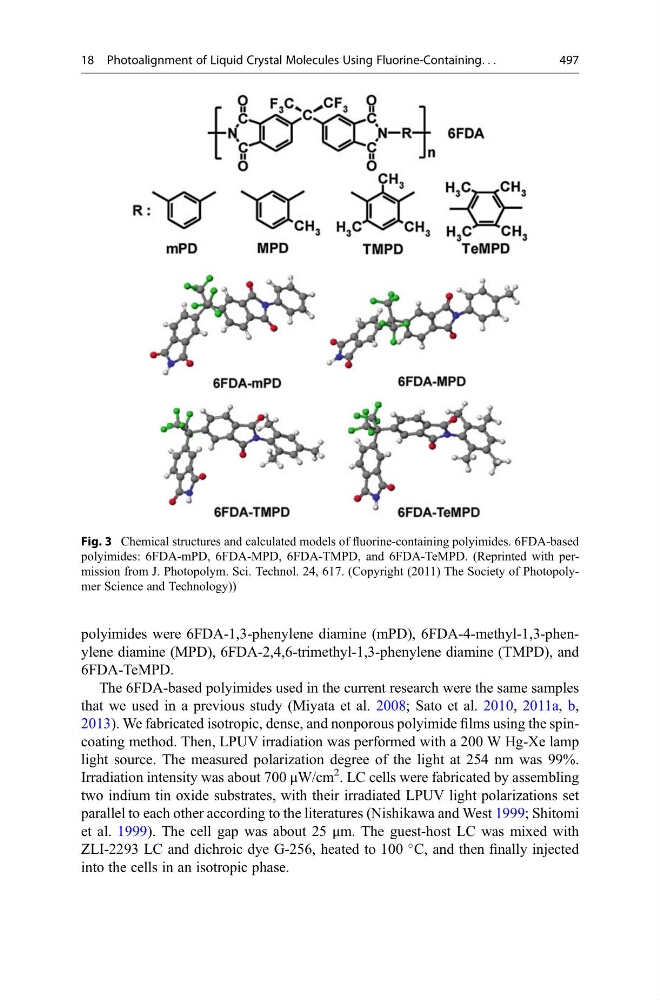
polyimides were 6FDA-1,3-phenylene diamine (mPD), 6FDA-4-methyl-1,3-phenylene diamine (MPD), 6FDA-2,4,6-trimethyl-1,3-phenylene diamine (TMPD), and
6FDA-TeMPD.
The 6FDA-based polyimides used in the current research were the same samples
that we used in a previous study (Miyata et al. 2008; Sato et al. 2010, 2011a, b,
2013). We fabricated isotropic, dense, and nonporous polyimide films using the spincoating method. Then, LPUV irradiation was performed with a 200 W Hg-Xe lamp
light source. The measured polarization degree of the light at 254 nm was 99%.
Irradiation intensity was about 700 μW/cm
2 . LC cells were fabricated by assembling
two indium tin oxide substrates, with their irradiated LPUV light polarizations set
parallel to each other according to the literatures (Nishikawa and West 1999; Shitomi
et al. 1999). The cell gap was about 25 μm. The guest-host LC was mixed with
ZLI-2293 LC and dichroic dye G-256, heated to 100
C, and then finally injected
into the cells in an isotropic phase.
Fig. 3 Chemical structures and calculated models of fluorine-containing polyimides. 6FDA-based
polyimides: 6FDA-mPD, 6FDA-MPD, 6FDA-TMPD, and 6FDA-TeMPD. (Reprinted with permission from J. Photopolym. Sci. Technol. 24, 617. (Copyright (2011) The Society of Photopolymer Science and Technology))
18 Photoalignment of Liquid Crystal Molecules Using Fluorine-Containing. . .
497
6FDA-TeMPD.
The 6FDA-based polyimides used in the current research were the same samples
that we used in a previous study (Miyata et al. 2008; Sato et al. 2010, 2011a, b,
2013). We fabricated isotropic, dense, and nonporous polyimide films using the spincoating method. Then, LPUV irradiation was performed with a 200 W Hg-Xe lamp
light source. The measured polarization degree of the light at 254 nm was 99%.
Irradiation intensity was about 700 μW/cm
2 . LC cells were fabricated by assembling
two indium tin oxide substrates, with their irradiated LPUV light polarizations set
parallel to each other according to the literatures (Nishikawa and West 1999; Shitomi
et al. 1999). The cell gap was about 25 μm. The guest-host LC was mixed with
ZLI-2293 LC and dichroic dye G-256, heated to 100
C, and then finally injected
into the cells in an isotropic phase.
Fig. 3 Chemical structures and calculated models of fluorine-containing polyimides. 6FDA-based
polyimides: 6FDA-mPD, 6FDA-MPD, 6FDA-TMPD, and 6FDA-TeMPD. (Reprinted with permission from J. Photopolym. Sci. Technol. 24, 617. (Copyright (2011) The Society of Photopolymer Science and Technology))
18 Photoalignment of Liquid Crystal Molecules Using Fluorine-Containing. . .
497