

provides efficient means to obtain highly aligned vertical nanostructures in thin film
geometries on large area films. Magnetic fields were used to produce vertically
aligned Li + conducting cylindrical domains made of linear block PEG in a block
copolymer film over millimeter length scales. The architecture used in this particular
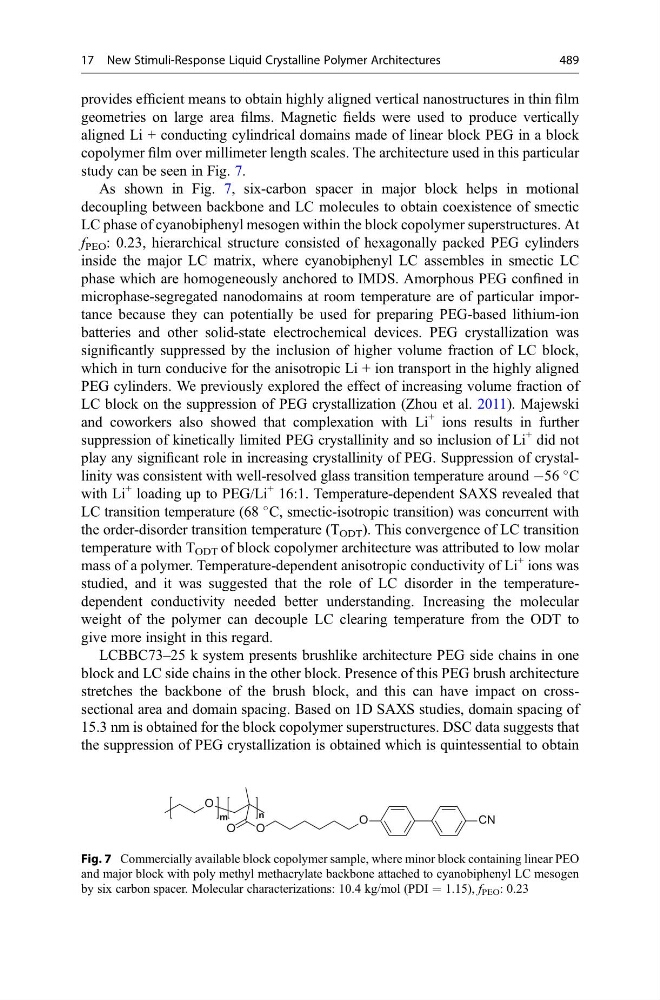
study can be seen in Fig. 7.
As shown in Fig. 7, six-carbon spacer in major block helps in motional
decoupling between backbone and LC molecules to obtain coexistence of smectic
LC phase of cyanobiphenyl mesogen within the block copolymer superstructures. At
f PEO : 0.23, hierarchical structure consisted of hexagonally packed PEG cylinders
inside the major LC matrix, where cyanobiphenyl LC assembles in smectic LC
phase which are homogeneously anchored to IMDS. Amorphous PEG confined in
microphase-segregated nanodomains at room temperature are of particular importance because they can potentially be used for preparing PEG-based lithium-ion
batteries and other solid-state electrochemical devices. PEG crystallization was
significantly suppressed by the inclusion of higher volume fraction of LC block,
which in turn conducive for the anisotropic Li + ion transport in the highly aligned
PEG cylinders. We previously explored the effect of increasing volume fraction of
LC block on the suppression of PEG crystallization (Zhou et al. 2011). Majewski
and coworkers also showed that complexation with Li
+ ions results in further
suppression of kinetically limited PEG crystallinity and so inclusion of Li
+ did not
play any significant role in increasing crystallinity of PEG. Suppression of crystallinity was consistent with well-resolved glass transition temperature around À56
C
with Li
+ loading up to PEG/Li
+ 16:1. Temperature-dependent SAXS revealed that
LC transition temperature (68
C, smectic-isotropic transition) was concurrent with
the order-disorder transition temperature (T ODT ). This convergence of LC transition
temperature with T ODT of block copolymer architecture was attributed to low molar
mass of a polymer. Temperature-dependent anisotropic conductivity of Li
+ ions was
studied, and it was suggested that the role of LC disorder in the temperaturedependent conductivity needed better understanding. Increasing the molecular
weight of the polymer can decouple LC clearing temperature from the ODT to
give more insight in this regard.
LCBBC73–25 k system presents brushlike architecture PEG side chains in one
block and LC side chains in the other block. Presence of this PEG brush architecture
stretches the backbone of the brush block, and this can have impact on crosssectional area and domain spacing. Based on 1D SAXS studies, domain spacing of
15.3 nm is obtained for the block copolymer superstructures. DSC data suggests that
the suppression of PEG crystallization is obtained which is quintessential to obtain
O
O
O
O
CN
m
n
Fig. 7 Commercially available block copolymer sample, where minor block containing linear PEO
and major block with poly methyl methacrylate backbone attached to cyanobiphenyl LC mesogen
by six carbon spacer. Molecular characterizations: 10.4 kg/mol (PDI = 1.15), f PEO : 0.23
17 New Stimuli-Response Liquid Crystalline Polymer Architectures
489
geometries on large area films. Magnetic fields were used to produce vertically
aligned Li + conducting cylindrical domains made of linear block PEG in a block
copolymer film over millimeter length scales. The architecture used in this particular
study can be seen in Fig. 7.
As shown in Fig. 7, six-carbon spacer in major block helps in motional
decoupling between backbone and LC molecules to obtain coexistence of smectic
LC phase of cyanobiphenyl mesogen within the block copolymer superstructures. At
f PEO : 0.23, hierarchical structure consisted of hexagonally packed PEG cylinders
inside the major LC matrix, where cyanobiphenyl LC assembles in smectic LC
phase which are homogeneously anchored to IMDS. Amorphous PEG confined in
microphase-segregated nanodomains at room temperature are of particular importance because they can potentially be used for preparing PEG-based lithium-ion
batteries and other solid-state electrochemical devices. PEG crystallization was
significantly suppressed by the inclusion of higher volume fraction of LC block,
which in turn conducive for the anisotropic Li + ion transport in the highly aligned
PEG cylinders. We previously explored the effect of increasing volume fraction of
LC block on the suppression of PEG crystallization (Zhou et al. 2011). Majewski
and coworkers also showed that complexation with Li
+ ions results in further
suppression of kinetically limited PEG crystallinity and so inclusion of Li
+ did not
play any significant role in increasing crystallinity of PEG. Suppression of crystallinity was consistent with well-resolved glass transition temperature around À56
C
with Li
+ loading up to PEG/Li
+ 16:1. Temperature-dependent SAXS revealed that
LC transition temperature (68
C, smectic-isotropic transition) was concurrent with
the order-disorder transition temperature (T ODT ). This convergence of LC transition
temperature with T ODT of block copolymer architecture was attributed to low molar
mass of a polymer. Temperature-dependent anisotropic conductivity of Li
+ ions was
studied, and it was suggested that the role of LC disorder in the temperaturedependent conductivity needed better understanding. Increasing the molecular
weight of the polymer can decouple LC clearing temperature from the ODT to
give more insight in this regard.
LCBBC73–25 k system presents brushlike architecture PEG side chains in one
block and LC side chains in the other block. Presence of this PEG brush architecture
stretches the backbone of the brush block, and this can have impact on crosssectional area and domain spacing. Based on 1D SAXS studies, domain spacing of
15.3 nm is obtained for the block copolymer superstructures. DSC data suggests that
the suppression of PEG crystallization is obtained which is quintessential to obtain
O
O
O
O
CN
m
n
Fig. 7 Commercially available block copolymer sample, where minor block containing linear PEO
and major block with poly methyl methacrylate backbone attached to cyanobiphenyl LC mesogen
by six carbon spacer. Molecular characterizations: 10.4 kg/mol (PDI = 1.15), f PEO : 0.23
17 New Stimuli-Response Liquid Crystalline Polymer Architectures
489