

features a stable liquid crystalline phase as confirmed by q LC peak appeared in SAXS
profile. Twelve carbon spacers attaching norbornene backbone with LC domains
allow sufficient freedom for LC domain arrangement and avoid entanglements with
the backbone. Formation of smectic LC phase in LCBBC73–25 k suggests that
12 methylene spacer is long enough to permit sufficient motional decoupling
between backbone and cyanobiphenyl LC mesogens.
In summary, LCBBC73–25 k polymer having brush architecture with overall
MW of 25 k shows (i) hierarchical structure consisting of microphase segregation
suggesting hexagonally packed cylinders of PEG enclosed in LC domains with
d-spacing of 15.31 nm and inter-cylinder distance of 17.7 nm and (ii) smectic
ordering of LC domains due to 12 carbon spacer on the length scale of 5.42 nm.
While we didn’t explore 2D SAXS and WAXS on this particular library, previous
work using the same LC monomer but PLA as the other brushlike unit showed that
the LC orients parallel to the intermaterial dividing surface (Deshmukh et al. 2014).
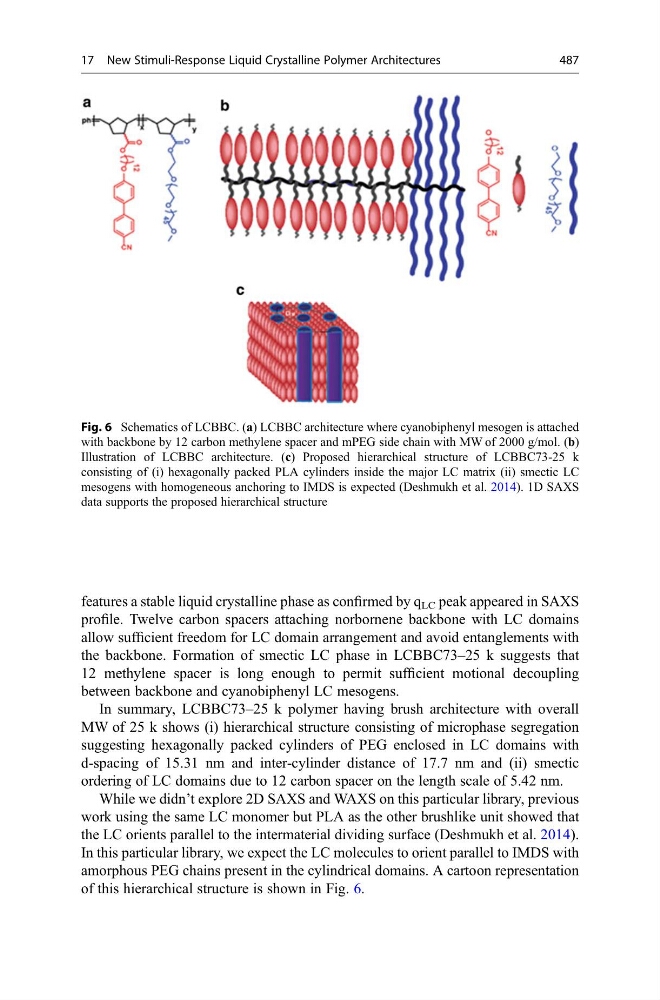
In this particular library, we expect the LC molecules to orient parallel to IMDS with
amorphous PEG chains present in the cylindrical domains. A cartoon representation
of this hierarchical structure is shown in Fig. 6.
Fig. 6 Schematics of LCBBC. (a) LCBBC architecture where cyanobiphenyl mesogen is attached
with backbone by 12 carbon methylene spacer and mPEG side chain with MW of 2000 g/mol. (b)
Illustration of LCBBC architecture. (c) Proposed hierarchical structure of LCBBC73-25 k
consisting of (i) hexagonally packed PLA cylinders inside the major LC matrix (ii) smectic LC
mesogens with homogeneous anchoring to IMDS is expected (Deshmukh et al. 2014). 1D SAXS
data supports the proposed hierarchical structure
17 New Stimuli-Response Liquid Crystalline Polymer Architectures
487
profile. Twelve carbon spacers attaching norbornene backbone with LC domains
allow sufficient freedom for LC domain arrangement and avoid entanglements with
the backbone. Formation of smectic LC phase in LCBBC73–25 k suggests that
12 methylene spacer is long enough to permit sufficient motional decoupling
between backbone and cyanobiphenyl LC mesogens.
In summary, LCBBC73–25 k polymer having brush architecture with overall
MW of 25 k shows (i) hierarchical structure consisting of microphase segregation
suggesting hexagonally packed cylinders of PEG enclosed in LC domains with
d-spacing of 15.31 nm and inter-cylinder distance of 17.7 nm and (ii) smectic
ordering of LC domains due to 12 carbon spacer on the length scale of 5.42 nm.
While we didn’t explore 2D SAXS and WAXS on this particular library, previous
work using the same LC monomer but PLA as the other brushlike unit showed that
the LC orients parallel to the intermaterial dividing surface (Deshmukh et al. 2014).
In this particular library, we expect the LC molecules to orient parallel to IMDS with
amorphous PEG chains present in the cylindrical domains. A cartoon representation
of this hierarchical structure is shown in Fig. 6.
Fig. 6 Schematics of LCBBC. (a) LCBBC architecture where cyanobiphenyl mesogen is attached
with backbone by 12 carbon methylene spacer and mPEG side chain with MW of 2000 g/mol. (b)
Illustration of LCBBC architecture. (c) Proposed hierarchical structure of LCBBC73-25 k
consisting of (i) hexagonally packed PLA cylinders inside the major LC matrix (ii) smectic LC
mesogens with homogeneous anchoring to IMDS is expected (Deshmukh et al. 2014). 1D SAXS
data supports the proposed hierarchical structure
17 New Stimuli-Response Liquid Crystalline Polymer Architectures
487