

the light-induced orientation achieved in azobenzene materials can be erased by
thermal or optical means that makes the optical storage media rewritable. Early work
in the field of azobenzene polymers was done using azo chromophores dispersed in
amorphous polymeric matrices; however, the stability of the photoinduced anisotropy were low due to the rotational diffusion of chromophores in the polymeric
matrix. To improve the stability of the recorded anisotropy, chromophores were
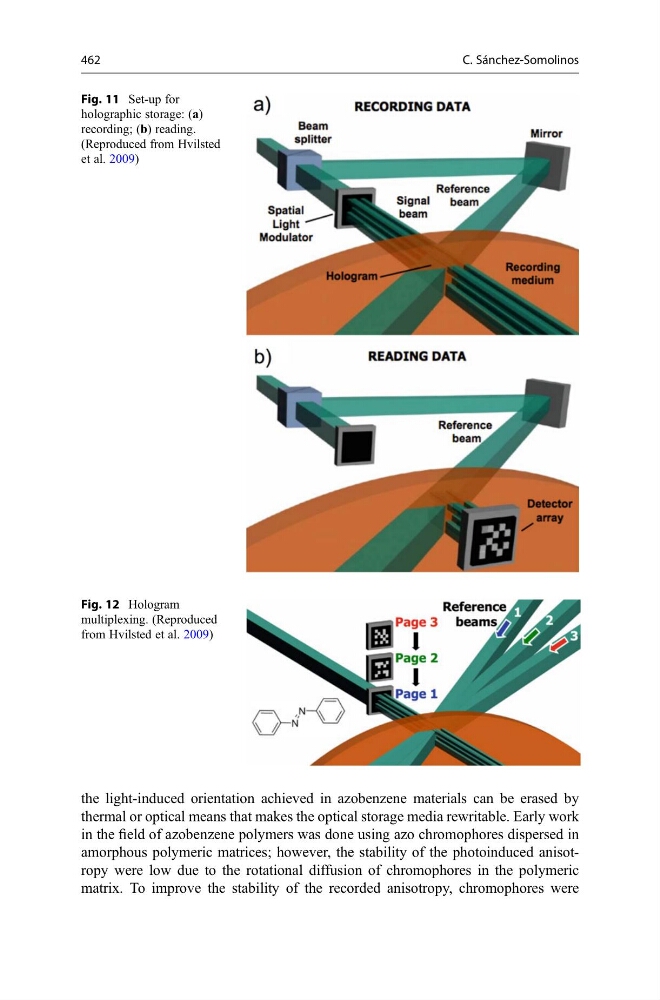
Fig. 11 Set-up for
holographic storage: (a)
recording; (b) reading.
(Reproduced from Hvilsted
et al. 2009)
Fig. 12 Hologram
multiplexing. (Reproduced
from Hvilsted et al. 2009)
462
C. Sánchez-Somolinos
thermal or optical means that makes the optical storage media rewritable. Early work
in the field of azobenzene polymers was done using azo chromophores dispersed in
amorphous polymeric matrices; however, the stability of the photoinduced anisotropy were low due to the rotational diffusion of chromophores in the polymeric
matrix. To improve the stability of the recorded anisotropy, chromophores were
Fig. 11 Set-up for
holographic storage: (a)
recording; (b) reading.
(Reproduced from Hvilsted
et al. 2009)
Fig. 12 Hologram
multiplexing. (Reproduced
from Hvilsted et al. 2009)
462
C. Sánchez-Somolinos