

Introduction
Generally, a liquid crystalline polymer (LCP) is categorized as main-chain liquid
crystalline polymer (MCLCP), side-chain liquid crystalline polymer (SCLCP), or
main-chain/side-chain liquid crystalline polymer (MCSCLCP) combined one if the
mesogenic unit is incorporated into the backbone, the side chain, or both of
the polymer, respectively (Wang and Zhou 2004). For SCLCPs and MCLCPs, the
mesogen can be introduced into the polymer either longitudinally (end-on) or
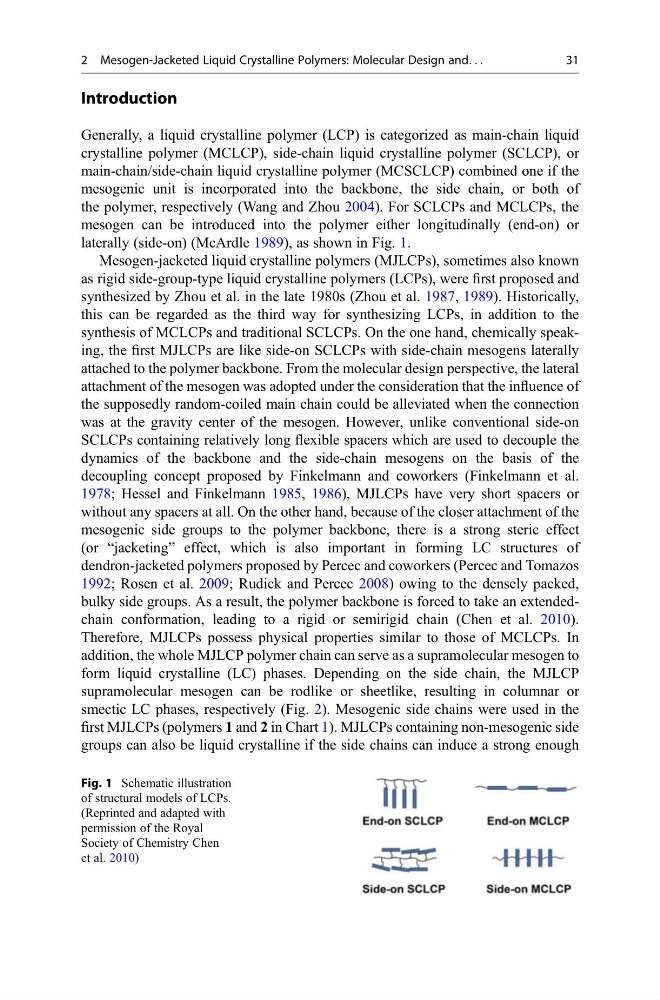
laterally (side-on) (McArdle 1989), as shown in Fig. 1.
Mesogen-jacketed liquid crystalline polymers (MJLCPs), sometimes also known
as rigid side-group-type liquid crystalline polymers (LCPs), were first proposed and
synthesized by Zhou et al. in the late 1980s (Zhou et al. 1987, 1989). Historically,
this can be regarded as the third way for synthesizing LCPs, in addition to the
synthesis of MCLCPs and traditional SCLCPs. On the one hand, chemically speaking, the first MJLCPs are like side-on SCLCPs with side-chain mesogens laterally
attached to the polymer backbone. From the molecular design perspective, the lateral
attachment of the mesogen was adopted under the consideration that the influence of
the supposedly random-coiled main chain could be alleviated when the connection
was at the gravity center of the mesogen. However, unlike conventional side-on
SCLCPs containing relatively long flexible spacers which are used to decouple the
dynamics of the backbone and the side-chain mesogens on the basis of the
decoupling concept proposed by Finkelmann and coworkers (Finkelmann et al.
1978; Hessel and Finkelmann 1985, 1986), MJLCPs have very short spacers or
without any spacers at all. On the other hand, because of the closer attachment of the
mesogenic side groups to the polymer backbone, there is a strong steric effect
(or “jacketing” effect, which is also important in forming LC structures of
dendron-jacketed polymers proposed by Percec and coworkers (Percec and Tomazos
1992; Rosen et al. 2009; Rudick and Percec 2008) owing to the densely packed,
bulky side groups. As a result, the polymer backbone is forced to take an extendedchain conformation, leading to a rigid or semirigid chain (Chen et al. 2010).
Therefore, MJLCPs possess physical properties similar to those of MCLCPs. In
addition, the whole MJLCP polymer chain can serve as a supramolecular mesogen to
form liquid crystalline (LC) phases. Depending on the side chain, the MJLCP
supramolecular mesogen can be rodlike or sheetlike, resulting in columnar or
smectic LC phases, respectively (Fig. 2). Mesogenic side chains were used in the
first MJLCPs (polymers 1 and 2 in Chart 1). MJLCPs containing non-mesogenic side
groups can also be liquid crystalline if the side chains can induce a strong enough
Fig. 1 Schematic illustration
of structural models of LCPs.
(Reprinted and adapted with
permission of the Royal
Society of Chemistry Chen
et al. 2010)
2 Mesogen-Jacketed Liquid Crystalline Polymers: Molecular Design and. . .
31
Generally, a liquid crystalline polymer (LCP) is categorized as main-chain liquid
crystalline polymer (MCLCP), side-chain liquid crystalline polymer (SCLCP), or
main-chain/side-chain liquid crystalline polymer (MCSCLCP) combined one if the
mesogenic unit is incorporated into the backbone, the side chain, or both of
the polymer, respectively (Wang and Zhou 2004). For SCLCPs and MCLCPs, the
mesogen can be introduced into the polymer either longitudinally (end-on) or
laterally (side-on) (McArdle 1989), as shown in Fig. 1.
Mesogen-jacketed liquid crystalline polymers (MJLCPs), sometimes also known
as rigid side-group-type liquid crystalline polymers (LCPs), were first proposed and
synthesized by Zhou et al. in the late 1980s (Zhou et al. 1987, 1989). Historically,
this can be regarded as the third way for synthesizing LCPs, in addition to the
synthesis of MCLCPs and traditional SCLCPs. On the one hand, chemically speaking, the first MJLCPs are like side-on SCLCPs with side-chain mesogens laterally
attached to the polymer backbone. From the molecular design perspective, the lateral
attachment of the mesogen was adopted under the consideration that the influence of
the supposedly random-coiled main chain could be alleviated when the connection
was at the gravity center of the mesogen. However, unlike conventional side-on
SCLCPs containing relatively long flexible spacers which are used to decouple the
dynamics of the backbone and the side-chain mesogens on the basis of the
decoupling concept proposed by Finkelmann and coworkers (Finkelmann et al.
1978; Hessel and Finkelmann 1985, 1986), MJLCPs have very short spacers or
without any spacers at all. On the other hand, because of the closer attachment of the
mesogenic side groups to the polymer backbone, there is a strong steric effect
(or “jacketing” effect, which is also important in forming LC structures of
dendron-jacketed polymers proposed by Percec and coworkers (Percec and Tomazos
1992; Rosen et al. 2009; Rudick and Percec 2008) owing to the densely packed,
bulky side groups. As a result, the polymer backbone is forced to take an extendedchain conformation, leading to a rigid or semirigid chain (Chen et al. 2010).
Therefore, MJLCPs possess physical properties similar to those of MCLCPs. In
addition, the whole MJLCP polymer chain can serve as a supramolecular mesogen to
form liquid crystalline (LC) phases. Depending on the side chain, the MJLCP
supramolecular mesogen can be rodlike or sheetlike, resulting in columnar or
smectic LC phases, respectively (Fig. 2). Mesogenic side chains were used in the
first MJLCPs (polymers 1 and 2 in Chart 1). MJLCPs containing non-mesogenic side
groups can also be liquid crystalline if the side chains can induce a strong enough
Fig. 1 Schematic illustration
of structural models of LCPs.
(Reprinted and adapted with
permission of the Royal
Society of Chemistry Chen
et al. 2010)
2 Mesogen-Jacketed Liquid Crystalline Polymers: Molecular Design and. . .
31