

photoactive molecules. Furthermore, this photochemical transition could be magnified by the supramolecular cooperative motions into a nanoscale motion of the
LCBCs. 2D and 3D photomechanical motions of LC elastomers and LCP composites are induced by light irradiation, which directly transfers light energy into
mechanical energy. In SLCP systems, microparticles and nanofibers are fabricated
by noncovalent interactions; besides, as an infant noncovalent interaction, halogenbonded LCs may have quite huge space for research. All these properties of
photoresponsive LCPs indicate their possible applications in energy conversion,
optical devices, nanotechnology and biomaterials.
References
Ahir SV, Terentjev EM (2005) Photomechanical actuation in polymer-nanotube composites. Nat
Mater 4:491–495
Bates FS, Fredrickson GH (1990) Block copolymer thermodynamics: theory and experiment. Annu
Rev Phys Chem 41:525–557
Behl M, Lendlein A (2010) Triple-shape polymers. J Mater Chem 20:3335–3345
Bruce DW, Metrangolo P, Meyer F, Pilati T, Präsang C, Resnati G, Whitwood AC (2010) Structurefunction relationships in liquid-crystalline halogen-bonded complexes. Chem-A Eur J
16:9511–9524
Chen D, Liu H, Kobayashi T, Yu HF (2010) Multiresponsive reversible gels based on a carboxylic
azo polymer. J Mater Chem 20:3610–3614
Chen HM, Zhen ZP, Todd T, Chu PK, Xie J (2013) Nanoparticles for improving cancer diagnosis.
Mater Sci Eng 74:35–35
Chen Y, Yu HF, Zhang L, Yang H, Lu Y (2014) Photoresponsive liquid crystals based on halogen
bonding of azopyridines. Chem Commun 50:9647–9649
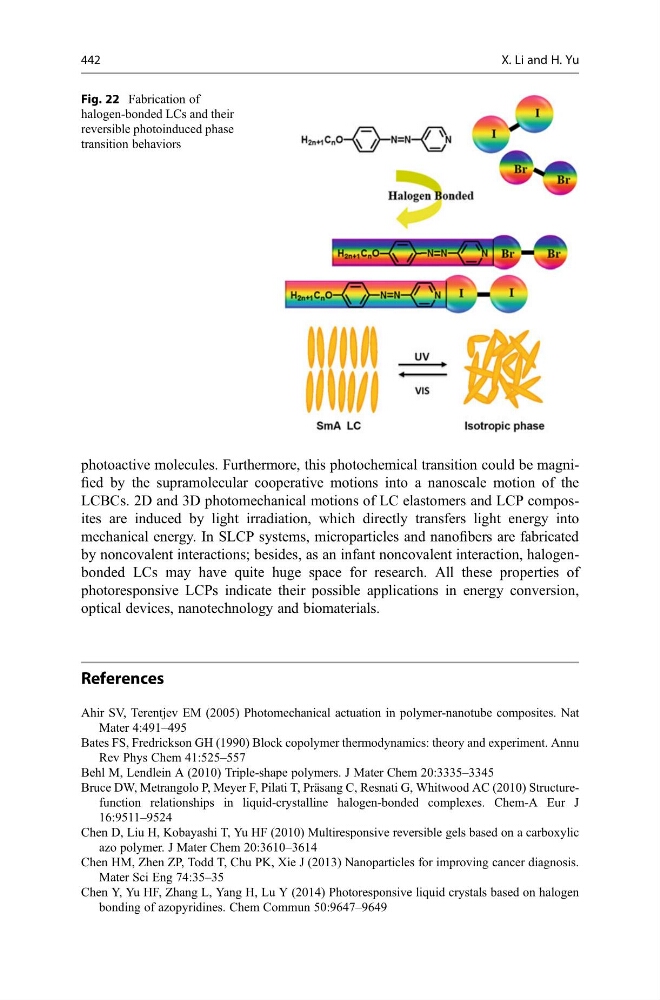
Fig. 22 Fabrication of
halogen-bonded LCs and their
reversible photoinduced phase
transition behaviors
442
X. Li and H. Yu
LCBCs. 2D and 3D photomechanical motions of LC elastomers and LCP composites are induced by light irradiation, which directly transfers light energy into
mechanical energy. In SLCP systems, microparticles and nanofibers are fabricated
by noncovalent interactions; besides, as an infant noncovalent interaction, halogenbonded LCs may have quite huge space for research. All these properties of
photoresponsive LCPs indicate their possible applications in energy conversion,
optical devices, nanotechnology and biomaterials.
References
Ahir SV, Terentjev EM (2005) Photomechanical actuation in polymer-nanotube composites. Nat
Mater 4:491–495
Bates FS, Fredrickson GH (1990) Block copolymer thermodynamics: theory and experiment. Annu
Rev Phys Chem 41:525–557
Behl M, Lendlein A (2010) Triple-shape polymers. J Mater Chem 20:3335–3345
Bruce DW, Metrangolo P, Meyer F, Pilati T, Präsang C, Resnati G, Whitwood AC (2010) Structurefunction relationships in liquid-crystalline halogen-bonded complexes. Chem-A Eur J
16:9511–9524
Chen D, Liu H, Kobayashi T, Yu HF (2010) Multiresponsive reversible gels based on a carboxylic
azo polymer. J Mater Chem 20:3610–3614
Chen HM, Zhen ZP, Todd T, Chu PK, Xie J (2013) Nanoparticles for improving cancer diagnosis.
Mater Sci Eng 74:35–35
Chen Y, Yu HF, Zhang L, Yang H, Lu Y (2014) Photoresponsive liquid crystals based on halogen
bonding of azopyridines. Chem Commun 50:9647–9649
Fig. 22 Fabrication of
halogen-bonded LCs and their
reversible photoinduced phase
transition behaviors
442
X. Li and H. Yu