

the azobenzene group based on the reversibility of hydrogen bond after the grating
formation (Zettsu et al. 2008).
As we have mentioned above, hydrogen-bonding could be used to introduce LC
property from amorphous molecules. Parallel to hydrogen-bonding, halogen-bonding, which is the noncovalent interaction between halogen atoms and neutral or
anionic Lewis bases, could achieve the same purpose (Metrangolo et al. 2005).
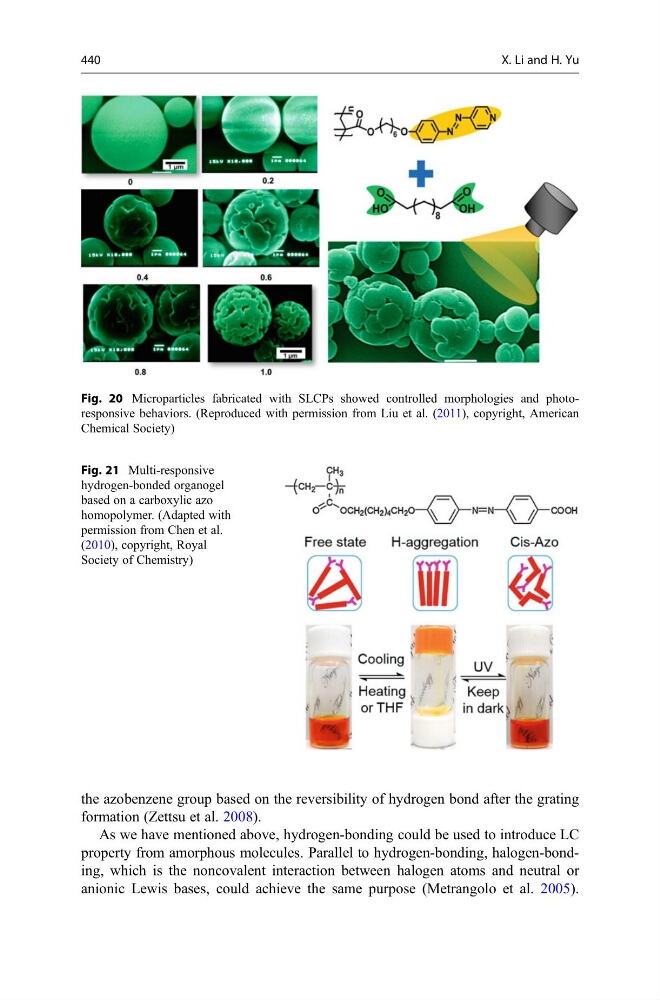
Fig. 20 Microparticles fabricated with SLCPs showed controlled morphologies and photoresponsive behaviors. (Reproduced with permission from Liu et al. (2011), copyright, American
Chemical Society)
Fig. 21 Multi-responsive
hydrogen-bonded organogel
based on a carboxylic azo
homopolymer. (Adapted with
permission from Chen et al.
(2010), copyright, Royal
Society of Chemistry)
440
X. Li and H. Yu
formation (Zettsu et al. 2008).
As we have mentioned above, hydrogen-bonding could be used to introduce LC
property from amorphous molecules. Parallel to hydrogen-bonding, halogen-bonding, which is the noncovalent interaction between halogen atoms and neutral or
anionic Lewis bases, could achieve the same purpose (Metrangolo et al. 2005).
Fig. 20 Microparticles fabricated with SLCPs showed controlled morphologies and photoresponsive behaviors. (Reproduced with permission from Liu et al. (2011), copyright, American
Chemical Society)
Fig. 21 Multi-responsive
hydrogen-bonded organogel
based on a carboxylic azo
homopolymer. (Adapted with
permission from Chen et al.
(2010), copyright, Royal
Society of Chemistry)
440
X. Li and H. Yu