

Opto-mechanical Effect in Liquid Single Crystal Elastomers
When UV light falls on LSCEs, besides maximum stress that the system can
generate, the time required by the network to produce its maximum mechanical
response and that necessary to recover the initial state thermally are the parameters
concerned as these parameters are vital for complete performance evaluation of
LSCEs for artificial muscle-like photo-actuation.
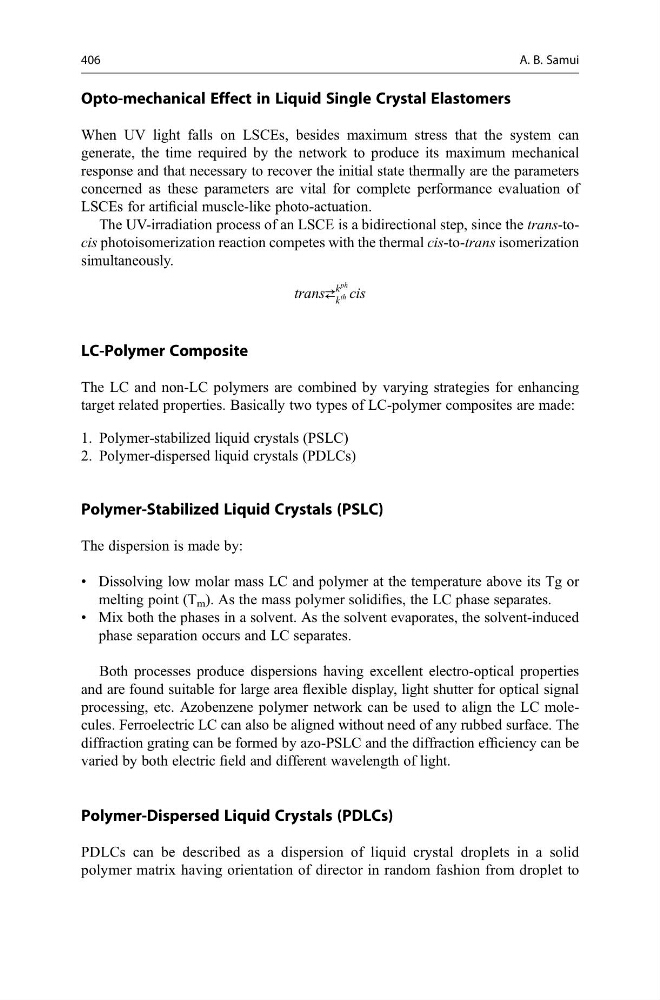
The UV-irradiation process of an LSCE is a bidirectional step, since the trans-tocis photoisomerization reaction competes with the thermal cis-to-trans isomerization
simultaneously.
trans⇄
k
ph
k
th cis
LC-Polymer Composite
The LC and non-LC polymers are combined by varying strategies for enhancing
target related properties. Basically two types of LC-polymer composites are made:
1. Polymer-stabilized liquid crystals (PSLC)
2. Polymer-dispersed liquid crystals (PDLCs)
Polymer-Stabilized Liquid Crystals (PSLC)
The dispersion is made by:
• Dissolving low molar mass LC and polymer at the temperature above its Tg or
melting point (T m ). As the mass polymer solidifies, the LC phase separates.
• Mix both the phases in a solvent. As the solvent evaporates, the solvent-induced
phase separation occurs and LC separates.
Both processes produce dispersions having excellent electro-optical properties
and are found suitable for large area flexible display, light shutter for optical signal
processing, etc. Azobenzene polymer network can be used to align the LC molecules. Ferroelectric LC can also be aligned without need of any rubbed surface. The
diffraction grating can be formed by azo-PSLC and the diffraction efficiency can be
varied by both electric field and different wavelength of light.
Polymer-Dispersed Liquid Crystals (PDLCs)
PDLCs can be described as a dispersion of liquid crystal droplets in a solid
polymer matrix having orientation of director in random fashion from droplet to
406
A. B. Samui
When UV light falls on LSCEs, besides maximum stress that the system can
generate, the time required by the network to produce its maximum mechanical
response and that necessary to recover the initial state thermally are the parameters
concerned as these parameters are vital for complete performance evaluation of
LSCEs for artificial muscle-like photo-actuation.
The UV-irradiation process of an LSCE is a bidirectional step, since the trans-tocis photoisomerization reaction competes with the thermal cis-to-trans isomerization
simultaneously.
trans⇄
k
ph
k
th cis
LC-Polymer Composite
The LC and non-LC polymers are combined by varying strategies for enhancing
target related properties. Basically two types of LC-polymer composites are made:
1. Polymer-stabilized liquid crystals (PSLC)
2. Polymer-dispersed liquid crystals (PDLCs)
Polymer-Stabilized Liquid Crystals (PSLC)
The dispersion is made by:
• Dissolving low molar mass LC and polymer at the temperature above its Tg or
melting point (T m ). As the mass polymer solidifies, the LC phase separates.
• Mix both the phases in a solvent. As the solvent evaporates, the solvent-induced
phase separation occurs and LC separates.
Both processes produce dispersions having excellent electro-optical properties
and are found suitable for large area flexible display, light shutter for optical signal
processing, etc. Azobenzene polymer network can be used to align the LC molecules. Ferroelectric LC can also be aligned without need of any rubbed surface. The
diffraction grating can be formed by azo-PSLC and the diffraction efficiency can be
varied by both electric field and different wavelength of light.
Polymer-Dispersed Liquid Crystals (PDLCs)
PDLCs can be described as a dispersion of liquid crystal droplets in a solid
polymer matrix having orientation of director in random fashion from droplet to
406
A. B. Samui