

photoisomerization, the cis-isomer with lower molar absorption coefficient does
not allow much light to penetrate inside.
• If the polymer film is fixed on one side in vertical direction, and the incident beam
polarization is decided to be in vertical plane, shrinking of the input surface in
vertical direction results in bending of the film toward the laser.
• If the beam polarization is in the horizontal plane, the input surface expands in the
vertical direction resulting in bending of the film backward, away from the laser.
• The photo-mechanical response of azopolymers depends on spacer length and the
rigidity of the polymer backbone. Mostly it happens conveniently in elastomers.
The photomechanical effect can be understood in terms of bilayer effect. The
trigger of mechanical motion and the photoisomerization of azobenzene moieties
occur only in the surface region of the films receiving the incident light. The
isomerization does not occur in bulk due to two reasons:
• Light does not penetrate much inside the polymer.
• The surface cis-isomer has very low molar absorption coefficient which does not
relay the isomerization further.
The phenomenon is akin to a bilayer structure: First layer in the surface region of
the film contracts by photoirradiation, while the second layer (bulk) does not
undergo any photochemical reaction. As in bilayer, first layer contracts, other layer
do not, and the result is bending of the film (Fig. 5).
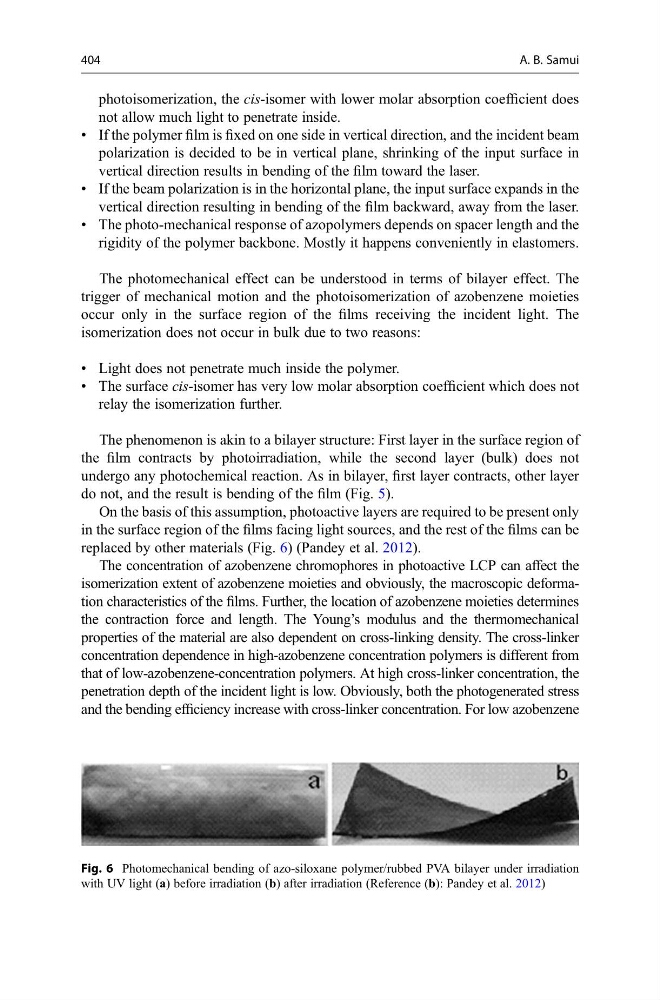
On the basis of this assumption, photoactive layers are required to be present only
in the surface region of the films facing light sources, and the rest of the films can be
replaced by other materials (Fig. 6) (Pandey et al. 2012).
The concentration of azobenzene chromophores in photoactive LCP can affect the
isomerization extent of azobenzene moieties and obviously, the macroscopic deformation characteristics of the films. Further, the location of azobenzene moieties determines
the contraction force and length. The Young’s modulus and the thermomechanical
properties of the material are also dependent on cross-linking density. The cross-linker
concentration dependence in high-azobenzene concentration polymers is different from
that of low-azobenzene-concentration polymers. At high cross-linker concentration, the
penetration depth of the incident light is low. Obviously, both the photogenerated stress
and the bending efficiency increase with cross-linker concentration. For low azobenzene
Fig. 6 Photomechanical bending of azo-siloxane polymer/rubbed PVA bilayer under irradiation
with UV light (a) before irradiation (b) after irradiation (Reference (b): Pandey et al. 2012)
404
A. B. Samui
not allow much light to penetrate inside.
• If the polymer film is fixed on one side in vertical direction, and the incident beam
polarization is decided to be in vertical plane, shrinking of the input surface in
vertical direction results in bending of the film toward the laser.
• If the beam polarization is in the horizontal plane, the input surface expands in the
vertical direction resulting in bending of the film backward, away from the laser.
• The photo-mechanical response of azopolymers depends on spacer length and the
rigidity of the polymer backbone. Mostly it happens conveniently in elastomers.
The photomechanical effect can be understood in terms of bilayer effect. The
trigger of mechanical motion and the photoisomerization of azobenzene moieties
occur only in the surface region of the films receiving the incident light. The
isomerization does not occur in bulk due to two reasons:
• Light does not penetrate much inside the polymer.
• The surface cis-isomer has very low molar absorption coefficient which does not
relay the isomerization further.
The phenomenon is akin to a bilayer structure: First layer in the surface region of
the film contracts by photoirradiation, while the second layer (bulk) does not
undergo any photochemical reaction. As in bilayer, first layer contracts, other layer
do not, and the result is bending of the film (Fig. 5).
On the basis of this assumption, photoactive layers are required to be present only
in the surface region of the films facing light sources, and the rest of the films can be
replaced by other materials (Fig. 6) (Pandey et al. 2012).
The concentration of azobenzene chromophores in photoactive LCP can affect the
isomerization extent of azobenzene moieties and obviously, the macroscopic deformation characteristics of the films. Further, the location of azobenzene moieties determines
the contraction force and length. The Young’s modulus and the thermomechanical
properties of the material are also dependent on cross-linking density. The cross-linker
concentration dependence in high-azobenzene concentration polymers is different from
that of low-azobenzene-concentration polymers. At high cross-linker concentration, the
penetration depth of the incident light is low. Obviously, both the photogenerated stress
and the bending efficiency increase with cross-linker concentration. For low azobenzene
Fig. 6 Photomechanical bending of azo-siloxane polymer/rubbed PVA bilayer under irradiation
with UV light (a) before irradiation (b) after irradiation (Reference (b): Pandey et al. 2012)
404
A. B. Samui