

phase leading to destabilization. This phenomenon can be used to record volume
holographic gratings and to carry out optical switching when combined with the
thermally or visible-light-induced cis-trans back isomerization.
• The display of thermochromic behavior which may be noticed if an amorphous state
develops in spin-cast films or quenching rapidly from the isotropic state. The reason
is that as the temperature increases, disordered azobenzene chromophores will form
ordered phases, leading to different aggregations that absorb different wavelengths.
Representative Architectures of Photoactive LCP
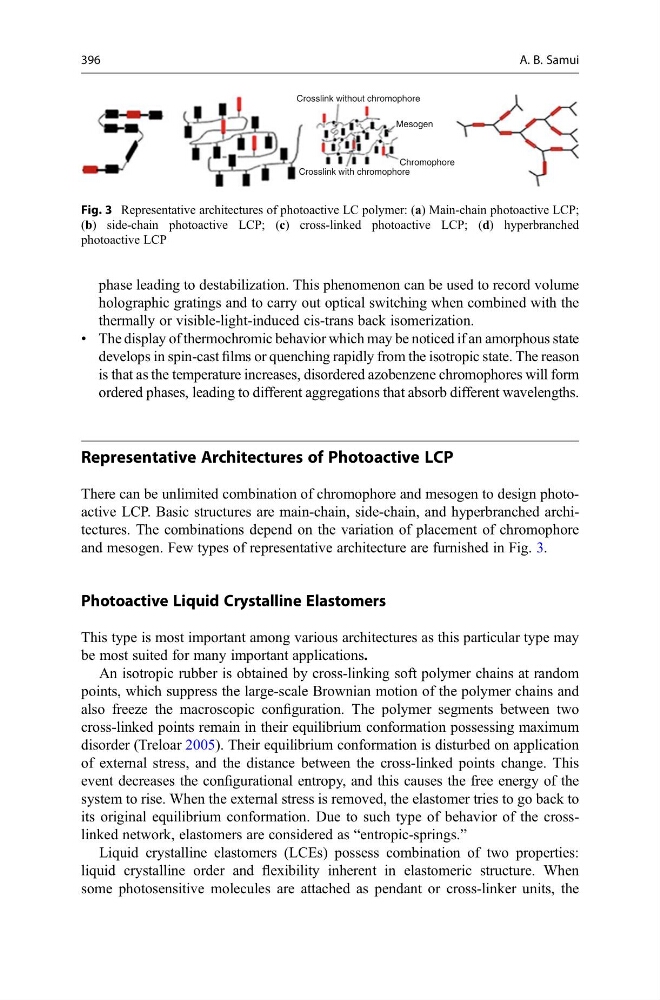
There can be unlimited combination of chromophore and mesogen to design photoactive LCP. Basic structures are main-chain, side-chain, and hyperbranched architectures. The combinations depend on the variation of placement of chromophore
and mesogen. Few types of representative architecture are furnished in Fig. 3.
Photoactive Liquid Crystalline Elastomers
This type is most important among various architectures as this particular type may
be most suited for many important applications.
An isotropic rubber is obtained by cross-linking soft polymer chains at random
points, which suppress the large-scale Brownian motion of the polymer chains and
also freeze the macroscopic configuration. The polymer segments between two
cross-linked points remain in their equilibrium conformation possessing maximum
disorder (Treloar 2005). Their equilibrium conformation is disturbed on application
of external stress, and the distance between the cross-linked points change. This
event decreases the configurational entropy, and this causes the free energy of the
system to rise. When the external stress is removed, the elastomer tries to go back to
its original equilibrium conformation. Due to such type of behavior of the crosslinked network, elastomers are considered as “entropic-springs.”
Liquid crystalline elastomers (LCEs) possess combination of two properties:
liquid crystalline order and flexibility inherent in elastomeric structure. When
some photosensitive molecules are attached as pendant or cross-linker units, the
Crosslink without chromophore
Crosslink with chromophore
Mesogen
Chromophore
Fig. 3 Representative architectures of photoactive LC polymer: (a) Main-chain photoactive LCP;
(b) side-chain photoactive LCP; (c) cross-linked photoactive LCP; (d) hyperbranched
photoactive LCP
396
A. B. Samui
holographic gratings and to carry out optical switching when combined with the
thermally or visible-light-induced cis-trans back isomerization.
• The display of thermochromic behavior which may be noticed if an amorphous state
develops in spin-cast films or quenching rapidly from the isotropic state. The reason
is that as the temperature increases, disordered azobenzene chromophores will form
ordered phases, leading to different aggregations that absorb different wavelengths.
Representative Architectures of Photoactive LCP
There can be unlimited combination of chromophore and mesogen to design photoactive LCP. Basic structures are main-chain, side-chain, and hyperbranched architectures. The combinations depend on the variation of placement of chromophore
and mesogen. Few types of representative architecture are furnished in Fig. 3.
Photoactive Liquid Crystalline Elastomers
This type is most important among various architectures as this particular type may
be most suited for many important applications.
An isotropic rubber is obtained by cross-linking soft polymer chains at random
points, which suppress the large-scale Brownian motion of the polymer chains and
also freeze the macroscopic configuration. The polymer segments between two
cross-linked points remain in their equilibrium conformation possessing maximum
disorder (Treloar 2005). Their equilibrium conformation is disturbed on application
of external stress, and the distance between the cross-linked points change. This
event decreases the configurational entropy, and this causes the free energy of the
system to rise. When the external stress is removed, the elastomer tries to go back to
its original equilibrium conformation. Due to such type of behavior of the crosslinked network, elastomers are considered as “entropic-springs.”
Liquid crystalline elastomers (LCEs) possess combination of two properties:
liquid crystalline order and flexibility inherent in elastomeric structure. When
some photosensitive molecules are attached as pendant or cross-linker units, the
Crosslink without chromophore
Crosslink with chromophore
Mesogen
Chromophore
Fig. 3 Representative architectures of photoactive LC polymer: (a) Main-chain photoactive LCP;
(b) side-chain photoactive LCP; (c) cross-linked photoactive LCP; (d) hyperbranched
photoactive LCP
396
A. B. Samui