

because the double mesogenic core is highly responsive to the external perturbation
than the single mesogenic one, giving an alignment with substantially notable linear
dichroism.
Summary
In this entry, a broad overview of the recent developments in LC polyacetylene
derivatives and their linearly polarized functionalities was discussed. The structures
and liquid crystallinity of mono-LCPA derivatives were briefly reviewed. The
synthesis of di-LCPA derivatives using metathesis catalyst that exhibit
enantiotropically thermotropic or lyotropic liquid crystallinity was discussed. The
origin of the emission of substituted PAs was elucidated, and fluorescent trends
including emission color were investigated. It was found that the macroscopically
aligned films of the di-LCPAs emit LPL by virtue of the functionalities associated
with liquid crystallinity and fluorescence. The aligned structures of the di-LCPAs
were characterized in terms of main chain and side chain type alignments through
XRD measurements of the macroscopically aligned polymer films. The mechanism
of the LPL of the di-LCPAs with respect to the polymer structure, alignment type,
and emission color was elucidated.
Over the past few years, research focused on LC polyacetylenes has been
overlooked in favor of LC aromatic conjugated polymers. However, recent developments with the LC polyacetylenes described in this entry may encourage further
development of di-LCPAs with advanced LC functionalities. The synergistic incorporation of functional di-LCPAs with other advanced polymer functionalities, such
as ferroelectric liquid crystallinity as well as temperature- and photo-switching,
might lead to the emergence of novel next-generation LC conjugated polymers.
Cross-References
▶ Anisotropic Liquid Crystal Networks from Reactive Mesogens
▶ Characterizations of Nanocomposites of Liquid Crystalline Polymers
▶ Columnar Phase-Forming Polymers
▶ Liquid Crystalline Conjugated Polymers
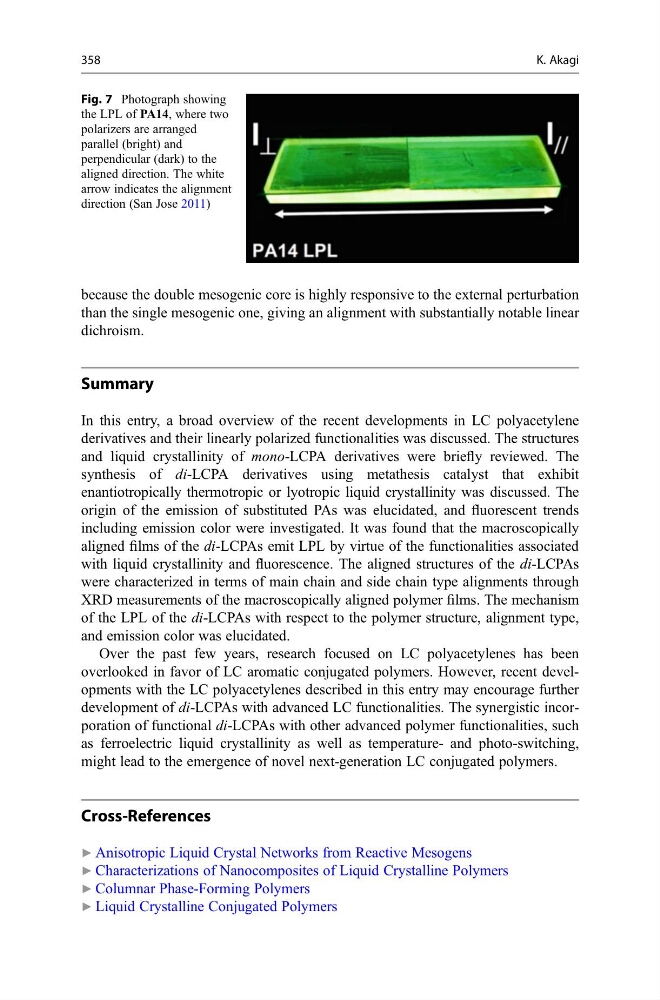
Fig. 7 Photograph showing
the LPL of PA14, where two
polarizers are arranged
parallel (bright) and
perpendicular (dark) to the
aligned direction. The white
arrow indicates the alignment
direction (San Jose 2011)
358
K. Akagi
than the single mesogenic one, giving an alignment with substantially notable linear
dichroism.
Summary
In this entry, a broad overview of the recent developments in LC polyacetylene
derivatives and their linearly polarized functionalities was discussed. The structures
and liquid crystallinity of mono-LCPA derivatives were briefly reviewed. The
synthesis of di-LCPA derivatives using metathesis catalyst that exhibit
enantiotropically thermotropic or lyotropic liquid crystallinity was discussed. The
origin of the emission of substituted PAs was elucidated, and fluorescent trends
including emission color were investigated. It was found that the macroscopically
aligned films of the di-LCPAs emit LPL by virtue of the functionalities associated
with liquid crystallinity and fluorescence. The aligned structures of the di-LCPAs
were characterized in terms of main chain and side chain type alignments through
XRD measurements of the macroscopically aligned polymer films. The mechanism
of the LPL of the di-LCPAs with respect to the polymer structure, alignment type,
and emission color was elucidated.
Over the past few years, research focused on LC polyacetylenes has been
overlooked in favor of LC aromatic conjugated polymers. However, recent developments with the LC polyacetylenes described in this entry may encourage further
development of di-LCPAs with advanced LC functionalities. The synergistic incorporation of functional di-LCPAs with other advanced polymer functionalities, such
as ferroelectric liquid crystallinity as well as temperature- and photo-switching,
might lead to the emergence of novel next-generation LC conjugated polymers.
Cross-References
▶ Anisotropic Liquid Crystal Networks from Reactive Mesogens
▶ Characterizations of Nanocomposites of Liquid Crystalline Polymers
▶ Columnar Phase-Forming Polymers
▶ Liquid Crystalline Conjugated Polymers
Fig. 7 Photograph showing
the LPL of PA14, where two
polarizers are arranged
parallel (bright) and
perpendicular (dark) to the
aligned direction. The white
arrow indicates the alignment
direction (San Jose 2011)
358
K. Akagi