

the material. In general, rod-like LCPs form nematic, cholesteric, and smectic
phases, while disk-like molecules show columnar and nematic mesophases. Nematic
remains the most common and least organized liquid crystalline phase. This phase
results when the molecules are ordered in one dimension only, and the ordered
phases remain parallel to each other. Smectic is another well-known liquid crystalline phase formed when the molecules are arranged in the long-range. In this
particular case, the molecules remain parallel and ordered in layered arrangement
one over the other in the form of stacks. When an LCP contains both phases, the
smectic phase arises at a lower temperature. In the other phase, the columnar phase is
made during the heating or cooling process of the molecules that are disk-shaped in
nature and capable to be packed together in the form of cylinders or columns similar
to the way to stacking of coins. The individual molecules within these layers of
stacks may be ordered or disordered. The columns can again be combined together in
the form of hexagonal or orthogonal lattice forms (De Gennes and Prost 1993). LCPs
may form twisted or chiral nematic phases named as cholesteric liquid crystalline
phase. Cholesteric phases are formed when nematic phases orient themselves in the
form of layers and each layer is again twisted with respect to one and another. The
director “n” is considered to be variable in space and twisted periodically in an axis
normal to the vector “n” leading to the formation of helical form. The pitch of the
helical form is defined as the distance, over which the vector goes 360
. This
particular arrangement of phases may result in unique optical properties. This
cholesteric phase owns orientational order; however, long-range or positional orders
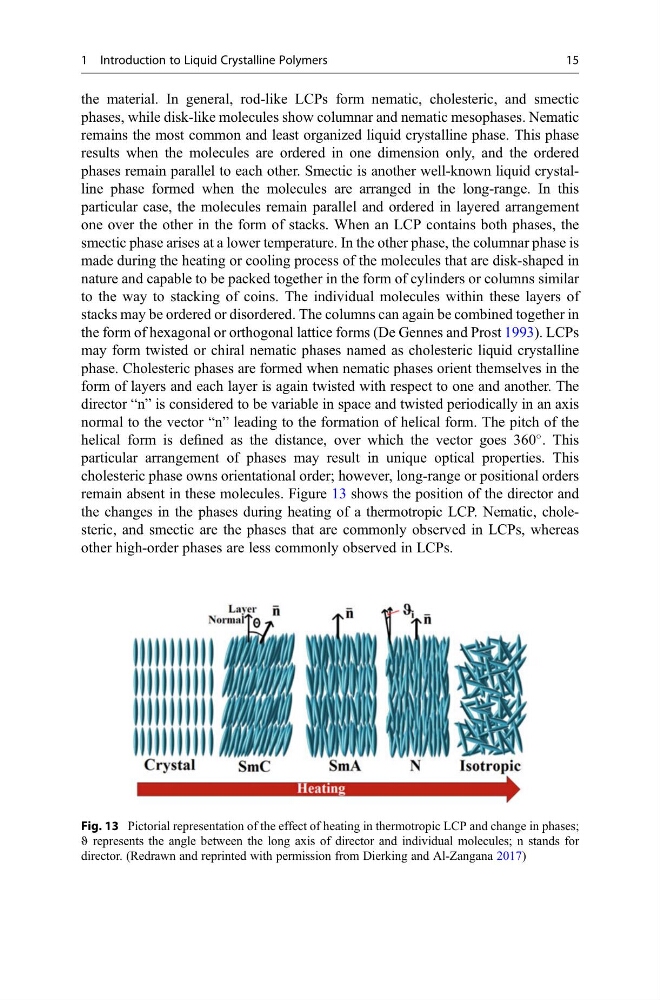
remain absent in these molecules. Figure 13 shows the position of the director and
the changes in the phases during heating of a thermotropic LCP. Nematic, cholesteric, and smectic are the phases that are commonly observed in LCPs, whereas
other high-order phases are less commonly observed in LCPs.
Fig. 13 Pictorial representation of the effect of heating in thermotropic LCP and change in phases;
ϑ represents the angle between the long axis of director and individual molecules; n stands for
director. (Redrawn and reprinted with permission from Dierking and Al-Zangana 2017)
1 Introduction to Liquid Crystalline Polymers
15
phases, while disk-like molecules show columnar and nematic mesophases. Nematic
remains the most common and least organized liquid crystalline phase. This phase
results when the molecules are ordered in one dimension only, and the ordered
phases remain parallel to each other. Smectic is another well-known liquid crystalline phase formed when the molecules are arranged in the long-range. In this
particular case, the molecules remain parallel and ordered in layered arrangement
one over the other in the form of stacks. When an LCP contains both phases, the
smectic phase arises at a lower temperature. In the other phase, the columnar phase is
made during the heating or cooling process of the molecules that are disk-shaped in
nature and capable to be packed together in the form of cylinders or columns similar
to the way to stacking of coins. The individual molecules within these layers of
stacks may be ordered or disordered. The columns can again be combined together in
the form of hexagonal or orthogonal lattice forms (De Gennes and Prost 1993). LCPs
may form twisted or chiral nematic phases named as cholesteric liquid crystalline
phase. Cholesteric phases are formed when nematic phases orient themselves in the
form of layers and each layer is again twisted with respect to one and another. The
director “n” is considered to be variable in space and twisted periodically in an axis
normal to the vector “n” leading to the formation of helical form. The pitch of the
helical form is defined as the distance, over which the vector goes 360
. This
particular arrangement of phases may result in unique optical properties. This
cholesteric phase owns orientational order; however, long-range or positional orders
remain absent in these molecules. Figure 13 shows the position of the director and
the changes in the phases during heating of a thermotropic LCP. Nematic, cholesteric, and smectic are the phases that are commonly observed in LCPs, whereas
other high-order phases are less commonly observed in LCPs.
Fig. 13 Pictorial representation of the effect of heating in thermotropic LCP and change in phases;
ϑ represents the angle between the long axis of director and individual molecules; n stands for
director. (Redrawn and reprinted with permission from Dierking and Al-Zangana 2017)
1 Introduction to Liquid Crystalline Polymers
15