

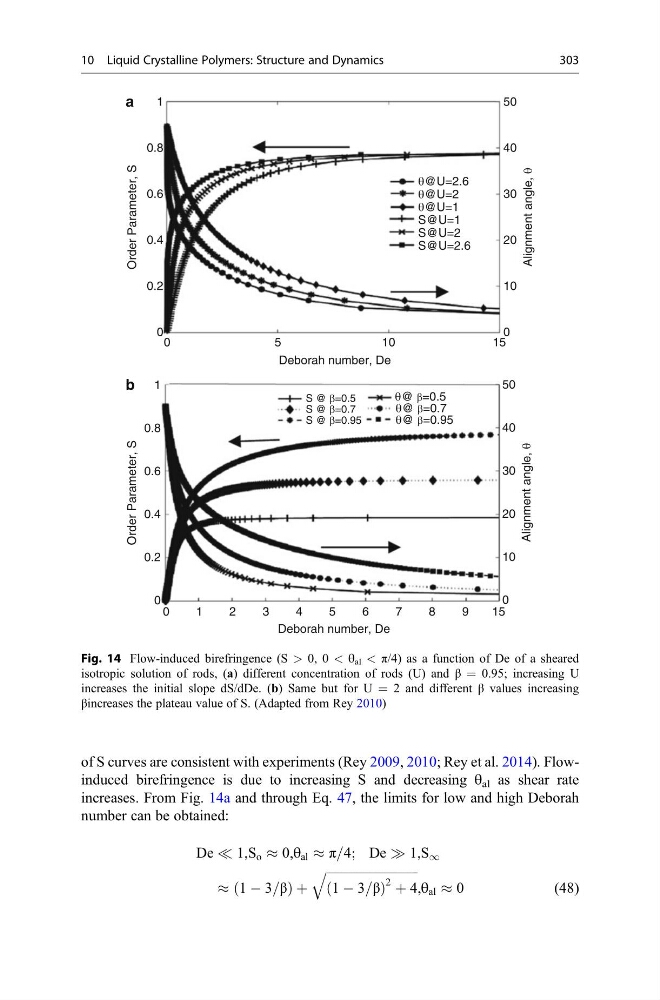
of S curves are consistent with experiments (Rey 2009, 2010; Rey et al. 2014). Flowinduced birefringence is due to increasing S and decreasing θ al as shear rate
increases. From Fig. 14a and through Eq. 47, the limits for low and high Deborah
number can be obtained:
De ( 1,S o % 0,θ al % π=4; De ) 1,S 1
% 1 À 3=β
ð
Þþ
ffiffiffiffiffiffiffiffiffiffiffiffiffiffiffiffiffiffiffiffiffiffiffiffiffiffiffiffiffi ffi
1 À 3=β
ð
Þ
2 þ 4
q
,θ al % 0
(48)
1
a
b
0.8
0.6
0.4
0.2
0
Deborah number, De
θ@U=2.6
θ@U=2
θ@ β=0.5
θ@ β=0.7
θ@ β=0.95
θ@U=1
S@U=1
S@U=2
S@U=2.6
S @ β=0.5
S @ β=0.7
S @ β=0.95
0
5
10
15
Alignment angle,
θ
Order Parameter, S
0
10
20
30
40
50
1
0.8
0.6
0.4
0.2
0
Deborah number, De
0
1
2
3
4
5
6
7
8
9
15
Alignment angle,
θ
Order Parameter, S
0
10
20
30
40
50
Fig. 14 Flow-induced birefringence (S > 0, 0 < θ al < π/4) as a function of De of a sheared
isotropic solution of rods, (a) different concentration of rods (U) and β = 0.95; increasing U
increases the initial slope dS/dDe. (b) Same but for U = 2 and different β values increasing
βincreases the plateau value of S. (Adapted from Rey 2010)
10 Liquid Crystalline Polymers: Structure and Dynamics
303
increases. From Fig. 14a and through Eq. 47, the limits for low and high Deborah
number can be obtained:
De ( 1,S o % 0,θ al % π=4; De ) 1,S 1
% 1 À 3=β
ð
Þþ
ffiffiffiffiffiffiffiffiffiffiffiffiffiffiffiffiffiffiffiffiffiffiffiffiffiffiffiffiffi ffi
1 À 3=β
ð
Þ
2 þ 4
q
,θ al % 0
(48)
1
a
b
0.8
0.6
0.4
0.2
0
Deborah number, De
θ@U=2.6
θ@U=2
θ@ β=0.5
θ@ β=0.7
θ@ β=0.95
θ@U=1
S@U=1
S@U=2
S@U=2.6
S @ β=0.5
S @ β=0.7
S @ β=0.95
0
5
10
15
Alignment angle,
θ
Order Parameter, S
0
10
20
30
40
50
1
0.8
0.6
0.4
0.2
0
Deborah number, De
0
1
2
3
4
5
6
7
8
9
15
Alignment angle,
θ
Order Parameter, S
0
10
20
30
40
50
Fig. 14 Flow-induced birefringence (S > 0, 0 < θ al < π/4) as a function of De of a sheared
isotropic solution of rods, (a) different concentration of rods (U) and β = 0.95; increasing U
increases the initial slope dS/dDe. (b) Same but for U = 2 and different β values increasing
βincreases the plateau value of S. (Adapted from Rey 2010)
10 Liquid Crystalline Polymers: Structure and Dynamics
303