

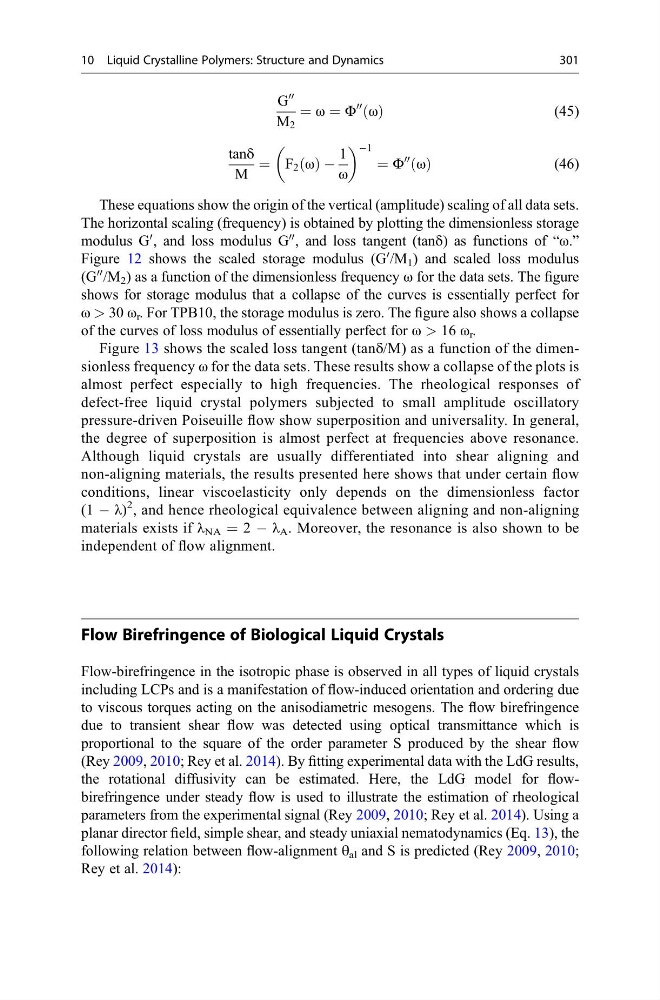
G
00
M 2
¼ ω ¼ Φ
00
ω
ð Þ
(45)
tanδ
M
¼ F 2 ω
ð Þ À
1
ω
À1
¼ Φ
00
ω
ð Þ
(46)
These equations show the origin of the vertical (amplitude) scaling of all data sets.
The horizontal scaling (frequency) is obtained by plotting the dimensionless storage
modulus G
0 , and loss modulus G
00 , and loss tangent (tanδ) as functions of “ω.”
Figure 12 shows the scaled storage modulus (G
0 /M 1 ) and scaled loss modulus
(G
00 /M 2 ) as a function of the dimensionless frequency ω for the data sets. The figure
shows for storage modulus that a collapse of the curves is essentially perfect for
ω > 30 ω r . For TPB10, the storage modulus is zero. The figure also shows a collapse
of the curves of loss modulus of essentially perfect for ω > 16 ω r .
Figure 13 shows the scaled loss tangent (tanδ/M) as a function of the dimensionless frequency ω for the data sets. These results show a collapse of the plots is
almost perfect especially to high frequencies. The rheological responses of
defect-free liquid crystal polymers subjected to small amplitude oscillatory
pressure-driven Poiseuille flow show superposition and universality. In general,
the degree of superposition is almost perfect at frequencies above resonance.
Although liquid crystals are usually differentiated into shear aligning and
non-aligning materials, the results presented here shows that under certain flow
conditions, linear viscoelasticity only depends on the dimensionless factor
(1 À λ)
2 , and hence rheological equivalence between aligning and non-aligning
materials exists if λ NA = 2 À λ A . Moreover, the resonance is also shown to be
independent of flow alignment.
Flow Birefringence of Biological Liquid Crystals
Flow-birefringence in the isotropic phase is observed in all types of liquid crystals
including LCPs and is a manifestation of flow-induced orientation and ordering due
to viscous torques acting on the anisodiametric mesogens. The flow birefringence
due to transient shear flow was detected using optical transmittance which is
proportional to the square of the order parameter S produced by the shear flow
(Rey 2009, 2010; Rey et al. 2014). By fitting experimental data with the LdG results,
the rotational diffusivity can be estimated. Here, the LdG model for flowbirefringence under steady flow is used to illustrate the estimation of rheological
parameters from the experimental signal (Rey 2009, 2010; Rey et al. 2014). Using a
planar director field, simple shear, and steady uniaxial nematodynamics (Eq. 13), the
following relation between flow-alignment θ al and S is predicted (Rey 2009, 2010;
Rey et al. 2014):
10 Liquid Crystalline Polymers: Structure and Dynamics
301
00
M 2
¼ ω ¼ Φ
00
ω
ð Þ
(45)
tanδ
M
¼ F 2 ω
ð Þ À
1
ω
À1
¼ Φ
00
ω
ð Þ
(46)
These equations show the origin of the vertical (amplitude) scaling of all data sets.
The horizontal scaling (frequency) is obtained by plotting the dimensionless storage
modulus G
0 , and loss modulus G
00 , and loss tangent (tanδ) as functions of “ω.”
Figure 12 shows the scaled storage modulus (G
0 /M 1 ) and scaled loss modulus
(G
00 /M 2 ) as a function of the dimensionless frequency ω for the data sets. The figure
shows for storage modulus that a collapse of the curves is essentially perfect for
ω > 30 ω r . For TPB10, the storage modulus is zero. The figure also shows a collapse
of the curves of loss modulus of essentially perfect for ω > 16 ω r .
Figure 13 shows the scaled loss tangent (tanδ/M) as a function of the dimensionless frequency ω for the data sets. These results show a collapse of the plots is
almost perfect especially to high frequencies. The rheological responses of
defect-free liquid crystal polymers subjected to small amplitude oscillatory
pressure-driven Poiseuille flow show superposition and universality. In general,
the degree of superposition is almost perfect at frequencies above resonance.
Although liquid crystals are usually differentiated into shear aligning and
non-aligning materials, the results presented here shows that under certain flow
conditions, linear viscoelasticity only depends on the dimensionless factor
(1 À λ)
2 , and hence rheological equivalence between aligning and non-aligning
materials exists if λ NA = 2 À λ A . Moreover, the resonance is also shown to be
independent of flow alignment.
Flow Birefringence of Biological Liquid Crystals
Flow-birefringence in the isotropic phase is observed in all types of liquid crystals
including LCPs and is a manifestation of flow-induced orientation and ordering due
to viscous torques acting on the anisodiametric mesogens. The flow birefringence
due to transient shear flow was detected using optical transmittance which is
proportional to the square of the order parameter S produced by the shear flow
(Rey 2009, 2010; Rey et al. 2014). By fitting experimental data with the LdG results,
the rotational diffusivity can be estimated. Here, the LdG model for flowbirefringence under steady flow is used to illustrate the estimation of rheological
parameters from the experimental signal (Rey 2009, 2010; Rey et al. 2014). Using a
planar director field, simple shear, and steady uniaxial nematodynamics (Eq. 13), the
following relation between flow-alignment θ al and S is predicted (Rey 2009, 2010;
Rey et al. 2014):
10 Liquid Crystalline Polymers: Structure and Dynamics
301