

1. Defect loop emission by the Frank-Reed surface mechanism (Grecov and Rey
2003a, b)
2. Stretching and pinching of existing loops in the bulk (Gupta and Rey 2005a, b)
3. Heterogeneous reorientation upon flow start-up
Direct numerical simulation of all these three coexisting nucleation processes for
flow-aligning LCs is not easily achieved and motivates the use of simplified models
and theoretical frameworks that provide insights to texture transformations. For
instance, the loop emission process and its impact on rheology were investigated
(Rey 1993a). Numerical simulations based on heterogeneous reorientation (Yan and
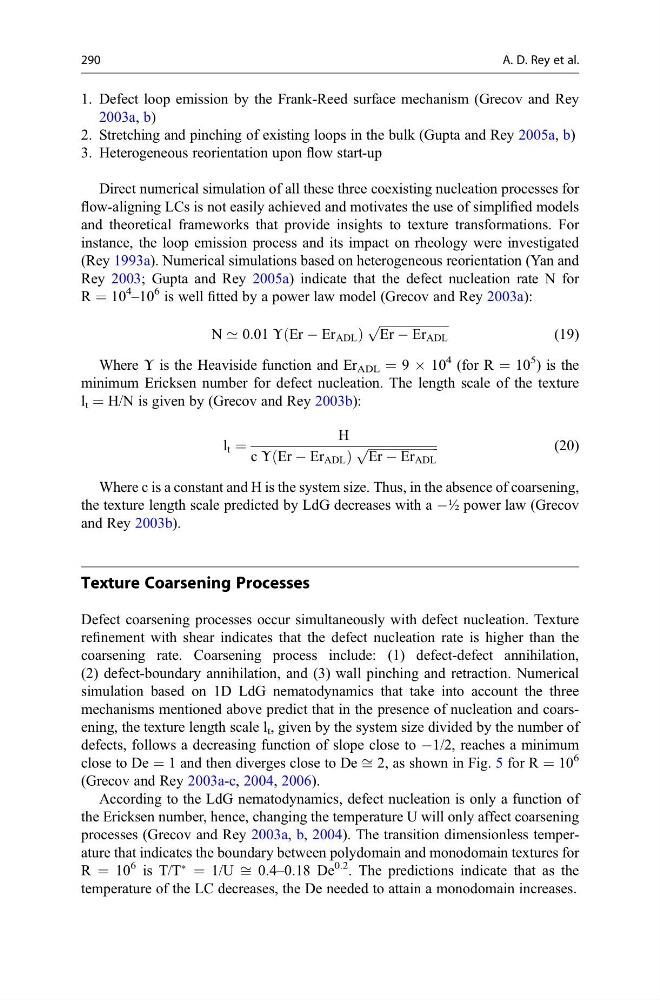
Rey 2003; Gupta and Rey 2005a) indicate that the defect nucleation rate N for
R = 10
4
–10
6 is well fitted by a power law model (Grecov and Rey 2003a):
N ’ 0:01 Υ Er À Er ADL
ð
Þ
ffiffiffiffiffiffiffiffiffiffiffiffiffiffiffiffiffiffiffiffiffiffi ffi
Er À Er ADL
p
(19)
Where Υ is the Heaviside function and Er ADL = 9 Â 10
4 (for R = 10
5 ) is the
minimum Ericksen number for defect nucleation. The length scale of the texture
l t = H/N is given by (Grecov and Rey 2003b):
l t ¼
H
c Υ Er À Er ADL
ð
Þ
ffiffiffiffiffiffiffiffiffiffiffiffiffiffiffiffiffiffiffiffiffiffi ffi
Er À Er ADL
p
(20)
Where c is a constant and H is the system size. Thus, in the absence of coarsening,
the texture length scale predicted by LdG decreases with a À½ power law (Grecov
and Rey 2003b).
Texture Coarsening Processes
Defect coarsening processes occur simultaneously with defect nucleation. Texture
refinement with shear indicates that the defect nucleation rate is higher than the
coarsening rate. Coarsening process include: (1) defect-defect annihilation,
(2) defect-boundary annihilation, and (3) wall pinching and retraction. Numerical
simulation based on 1D LdG nematodynamics that take into account the three
mechanisms mentioned above predict that in the presence of nucleation and coarsening, the texture length scale l t , given by the system size divided by the number of
defects, follows a decreasing function of slope close to À1/2, reaches a minimum
close to De = 1 and then diverges close to De ffi 2, as shown in Fig. 5 for R = 10
6
(Grecov and Rey 2003a-c, 2004, 2006).
According to the LdG nematodynamics, defect nucleation is only a function of
the Ericksen number, hence, changing the temperature U will only affect coarsening
processes (Grecov and Rey 2003a, b, 2004). The transition dimensionless temperature that indicates the boundary between polydomain and monodomain textures for
R = 10
6 is T/T
Ã
= 1/U ffi 0.4–0.18 De
0.2 . The predictions indicate that as the
temperature of the LC decreases, the De needed to attain a monodomain increases.
290
A. D. Rey et al.
2003a, b)
2. Stretching and pinching of existing loops in the bulk (Gupta and Rey 2005a, b)
3. Heterogeneous reorientation upon flow start-up
Direct numerical simulation of all these three coexisting nucleation processes for
flow-aligning LCs is not easily achieved and motivates the use of simplified models
and theoretical frameworks that provide insights to texture transformations. For
instance, the loop emission process and its impact on rheology were investigated
(Rey 1993a). Numerical simulations based on heterogeneous reorientation (Yan and
Rey 2003; Gupta and Rey 2005a) indicate that the defect nucleation rate N for
R = 10
4
–10
6 is well fitted by a power law model (Grecov and Rey 2003a):
N ’ 0:01 Υ Er À Er ADL
ð
Þ
ffiffiffiffiffiffiffiffiffiffiffiffiffiffiffiffiffiffiffiffiffiffi ffi
Er À Er ADL
p
(19)
Where Υ is the Heaviside function and Er ADL = 9 Â 10
4 (for R = 10
5 ) is the
minimum Ericksen number for defect nucleation. The length scale of the texture
l t = H/N is given by (Grecov and Rey 2003b):
l t ¼
H
c Υ Er À Er ADL
ð
Þ
ffiffiffiffiffiffiffiffiffiffiffiffiffiffiffiffiffiffiffiffiffiffi ffi
Er À Er ADL
p
(20)
Where c is a constant and H is the system size. Thus, in the absence of coarsening,
the texture length scale predicted by LdG decreases with a À½ power law (Grecov
and Rey 2003b).
Texture Coarsening Processes
Defect coarsening processes occur simultaneously with defect nucleation. Texture
refinement with shear indicates that the defect nucleation rate is higher than the
coarsening rate. Coarsening process include: (1) defect-defect annihilation,
(2) defect-boundary annihilation, and (3) wall pinching and retraction. Numerical
simulation based on 1D LdG nematodynamics that take into account the three
mechanisms mentioned above predict that in the presence of nucleation and coarsening, the texture length scale l t , given by the system size divided by the number of
defects, follows a decreasing function of slope close to À1/2, reaches a minimum
close to De = 1 and then diverges close to De ffi 2, as shown in Fig. 5 for R = 10
6
(Grecov and Rey 2003a-c, 2004, 2006).
According to the LdG nematodynamics, defect nucleation is only a function of
the Ericksen number, hence, changing the temperature U will only affect coarsening
processes (Grecov and Rey 2003a, b, 2004). The transition dimensionless temperature that indicates the boundary between polydomain and monodomain textures for
R = 10
6 is T/T
Ã
= 1/U ffi 0.4–0.18 De
0.2 . The predictions indicate that as the
temperature of the LC decreases, the De needed to attain a monodomain increases.
290
A. D. Rey et al.