

high-melting polyester of poly(4-hydroxybenzoic acid) has been formed by condensation of p-HBA monomers, while copolymers are formed by the reaction of p-HBA
with terephthalic acid and bisphenol A. Figure 12 represents the chemical structures
of some industrial-grade LCPs.
Physics Behind Liquid Crystalline Polymer Structure
The orientational properties of LCPs are an important aspect to determine the
utility of this particular class of material. The molecules in LCP arrange and align
themselves in the longitudinal direction more or less in a transverse direction.
This fundamental property of LCPs decides many important properties such as
mechanical strength (Hamley et al. 1996). The degree of orientation is usually
described by a unit vector, “n” (Allen et al. 1996). This vector “n” is commonly
defined as the director or optical axis (Marrucci 1996). The director “n” is
determined by the action of the flow of the molecules or some weak forces
such as magnetic and electric forces, and it is not related to the individual
orientation of the molecules; rather it is dependent on the average molecular
orientation inside the LCP. This vector is further quantified and characterized by
scalar quantity “S” also known as the order parameter or Herman’s orientation
function and calculated using Eq. 1 (Pavel et al. 2005):
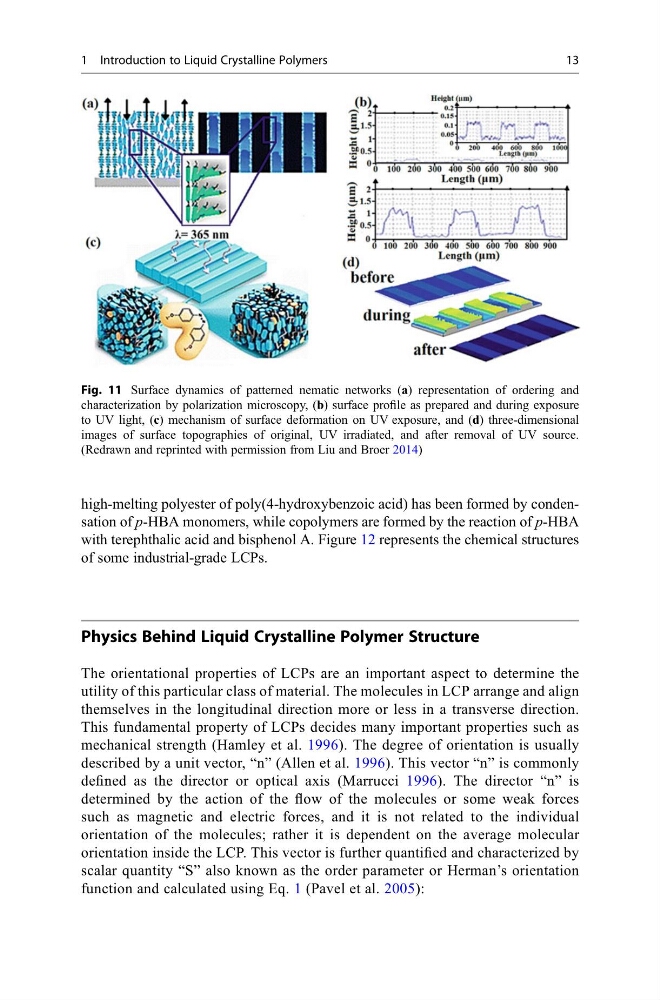
Fig. 11 Surface dynamics of patterned nematic networks (a) representation of ordering and
characterization by polarization microscopy, (b) surface profile as prepared and during exposure
to UV light, (c) mechanism of surface deformation on UV exposure, and (d) three-dimensional
images of surface topographies of original, UV irradiated, and after removal of UV source.
(Redrawn and reprinted with permission from Liu and Broer 2014)
1 Introduction to Liquid Crystalline Polymers
13
with terephthalic acid and bisphenol A. Figure 12 represents the chemical structures
of some industrial-grade LCPs.
Physics Behind Liquid Crystalline Polymer Structure
The orientational properties of LCPs are an important aspect to determine the
utility of this particular class of material. The molecules in LCP arrange and align
themselves in the longitudinal direction more or less in a transverse direction.
This fundamental property of LCPs decides many important properties such as
mechanical strength (Hamley et al. 1996). The degree of orientation is usually
described by a unit vector, “n” (Allen et al. 1996). This vector “n” is commonly
defined as the director or optical axis (Marrucci 1996). The director “n” is
determined by the action of the flow of the molecules or some weak forces
such as magnetic and electric forces, and it is not related to the individual
orientation of the molecules; rather it is dependent on the average molecular
orientation inside the LCP. This vector is further quantified and characterized by
scalar quantity “S” also known as the order parameter or Herman’s orientation
function and calculated using Eq. 1 (Pavel et al. 2005):
Fig. 11 Surface dynamics of patterned nematic networks (a) representation of ordering and
characterization by polarization microscopy, (b) surface profile as prepared and during exposure
to UV light, (c) mechanism of surface deformation on UV exposure, and (d) three-dimensional
images of surface topographies of original, UV irradiated, and after removal of UV source.
(Redrawn and reprinted with permission from Liu and Broer 2014)
1 Introduction to Liquid Crystalline Polymers
13