

Theory and Simulation
Multi-scale thermodynamic, interfacial, textural, and rheological modelling have
been used together with experimental measurements and observations, to optimize
information extraction from experimental signals, and has also been used to propose
experiments and computational discoveries and has contributed extensively in the
development of liquid crystals in general; such tools are applicable to LCPs (Rey
2007, 2008a, b, 2009; Rey and Herrera-Valencia 2012). The Landau – de Gennes
model (LdG), based on the order parameters of the mesophase (orientation, molecular order, and chirality) is able to describe equilibrium phase transitions, surface
wetting and anchoring, flow birefringence and flow-induced orientation, defect and
pattern formation, electro-magnetic effects, and optical responses, among others
(Rey 2007, 2008a, b, 2009; Rey and Herrera-Valencia 2012; Rey et al. 2014). Recent
work has demonstrated the applicability of the LdG approach to describe equilibrium
and nonequilibrium phenomena in biological liquid crystals (Rey 2007, 2008a, b,
2009; Rey and Herrera-Valencia 2012).
In this chapter, we present key details of the LdG model and how it has been
used to elucidate elastic, viscoelastic, interfacial, and anchoring processes in
liquid crystalline polymers and its extension to biological processes such as
silk spinning, collagen self-assembly, and plywood formation (Donald et al.
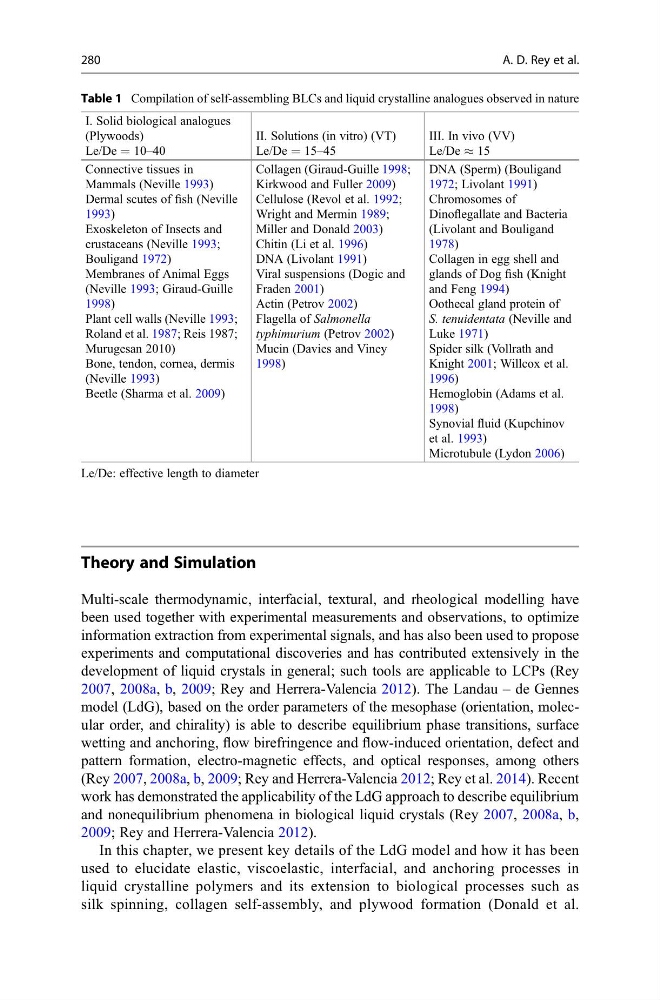
Table 1 Compilation of self-assembling BLCs and liquid crystalline analogues observed in nature
I. Solid biological analogues
(Plywoods)
Le/De = 10–40
II. Solutions (in vitro) (VT)
Le/De = 15–45
III. In vivo (VV)
Le/De % 15
Connective tissues in
Mammals (Neville 1993)
Dermal scutes of fish (Neville
1993)
Exoskeleton of Insects and
crustaceans (Neville 1993;
Bouligand 1972)
Membranes of Animal Eggs
(Neville 1993; Giraud-Guille
1998)
Plant cell walls (Neville 1993;
Roland et al. 1987; Reis 1987;
Murugesan 2010)
Bone, tendon, cornea, dermis
(Neville 1993)
Beetle (Sharma et al. 2009)
Collagen (Giraud-Guille 1998;
Kirkwood and Fuller 2009)
Cellulose (Revol et al. 1992;
Wright and Mermin 1989;
Miller and Donald 2003)
Chitin (Li et al. 1996)
DNA (Livolant 1991)
Viral suspensions (Dogic and
Fraden 2001)
Actin (Petrov 2002)
Flagella of Salmonella
typhimurium (Petrov 2002)
Mucin (Davies and Viney
1998)
DNA (Sperm) (Bouligand
1972; Livolant 1991)
Chromosomes of
Dinoflegallate and Bacteria
(Livolant and Bouligand
1978)
Collagen in egg shell and
glands of Dog fish (Knight
and Feng 1994)
Oothecal gland protein of
S. tenuidentata (Neville and
Luke 1971)
Spider silk (Vollrath and
Knight 2001; Willcox et al.
1996)
Hemoglobin (Adams et al.
1998)
Synovial fluid (Kupchinov
et al. 1993)
Microtubule (Lydon 2006)
Le/De: effective length to diameter
280
A. D. Rey et al.
Multi-scale thermodynamic, interfacial, textural, and rheological modelling have
been used together with experimental measurements and observations, to optimize
information extraction from experimental signals, and has also been used to propose
experiments and computational discoveries and has contributed extensively in the
development of liquid crystals in general; such tools are applicable to LCPs (Rey
2007, 2008a, b, 2009; Rey and Herrera-Valencia 2012). The Landau – de Gennes
model (LdG), based on the order parameters of the mesophase (orientation, molecular order, and chirality) is able to describe equilibrium phase transitions, surface
wetting and anchoring, flow birefringence and flow-induced orientation, defect and
pattern formation, electro-magnetic effects, and optical responses, among others
(Rey 2007, 2008a, b, 2009; Rey and Herrera-Valencia 2012; Rey et al. 2014). Recent
work has demonstrated the applicability of the LdG approach to describe equilibrium
and nonequilibrium phenomena in biological liquid crystals (Rey 2007, 2008a, b,
2009; Rey and Herrera-Valencia 2012).
In this chapter, we present key details of the LdG model and how it has been
used to elucidate elastic, viscoelastic, interfacial, and anchoring processes in
liquid crystalline polymers and its extension to biological processes such as
silk spinning, collagen self-assembly, and plywood formation (Donald et al.
Table 1 Compilation of self-assembling BLCs and liquid crystalline analogues observed in nature
I. Solid biological analogues
(Plywoods)
Le/De = 10–40
II. Solutions (in vitro) (VT)
Le/De = 15–45
III. In vivo (VV)
Le/De % 15
Connective tissues in
Mammals (Neville 1993)
Dermal scutes of fish (Neville
1993)
Exoskeleton of Insects and
crustaceans (Neville 1993;
Bouligand 1972)
Membranes of Animal Eggs
(Neville 1993; Giraud-Guille
1998)
Plant cell walls (Neville 1993;
Roland et al. 1987; Reis 1987;
Murugesan 2010)
Bone, tendon, cornea, dermis
(Neville 1993)
Beetle (Sharma et al. 2009)
Collagen (Giraud-Guille 1998;
Kirkwood and Fuller 2009)
Cellulose (Revol et al. 1992;
Wright and Mermin 1989;
Miller and Donald 2003)
Chitin (Li et al. 1996)
DNA (Livolant 1991)
Viral suspensions (Dogic and
Fraden 2001)
Actin (Petrov 2002)
Flagella of Salmonella
typhimurium (Petrov 2002)
Mucin (Davies and Viney
1998)
DNA (Sperm) (Bouligand
1972; Livolant 1991)
Chromosomes of
Dinoflegallate and Bacteria
(Livolant and Bouligand
1978)
Collagen in egg shell and
glands of Dog fish (Knight
and Feng 1994)
Oothecal gland protein of
S. tenuidentata (Neville and
Luke 1971)
Spider silk (Vollrath and
Knight 2001; Willcox et al.
1996)
Hemoglobin (Adams et al.
1998)
Synovial fluid (Kupchinov
et al. 1993)
Microtubule (Lydon 2006)
Le/De: effective length to diameter
280
A. D. Rey et al.