

Generalization of the Submillimeter Shear Elasticity to Fluids
and Liquids
The low-frequency shear elastic regime is observed away from the glass transition
(above a hundred degrees), on typically 0.025–0.500 mm sample thicknesses,
thus in a liquid state where G e is supposed to be zero. Using improved liquid/
substrate boundary conditions (i.e. high energy surfaces like the alumina
to provide total wetting), the observation of a terminal elastic response has
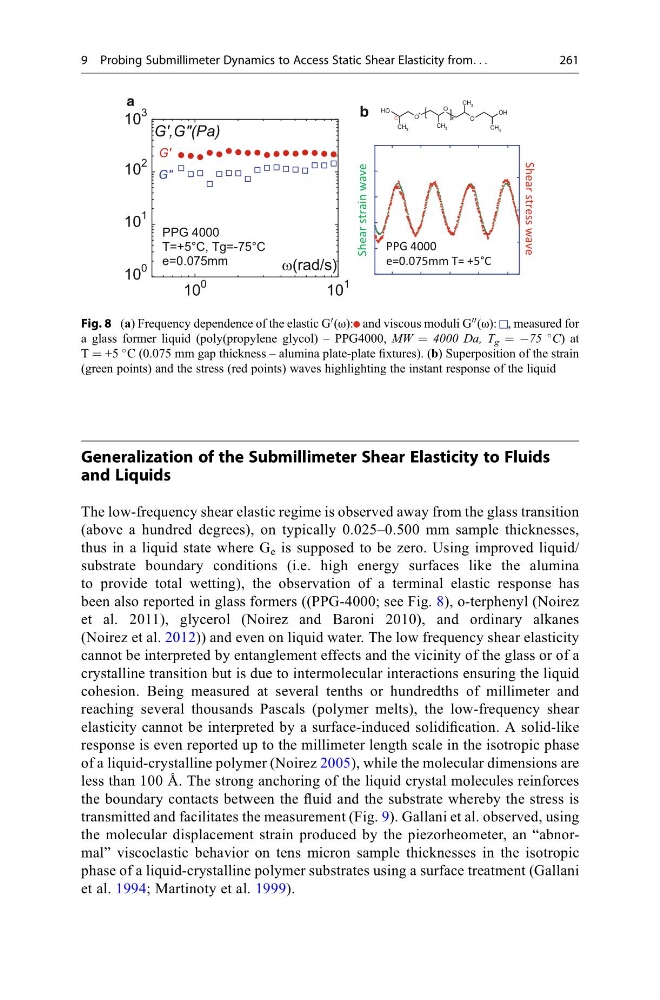
been also reported in glass formers ((PPG-4000; see Fig. 8), o-terphenyl (Noirez
et al. 2011), glycerol (Noirez and Baroni 2010), and ordinary alkanes
(Noirez et al. 2012)) and even on liquid water. The low frequency shear elasticity
cannot be interpreted by entanglement effects and the vicinity of the glass or of a
crystalline transition but is due to intermolecular interactions ensuring the liquid
cohesion. Being measured at several tenths or hundredths of millimeter and
reaching several thousands Pascals (polymer melts), the low-frequency shear
elasticity cannot be interpreted by a surface-induced solidification. A solid-like
response is even reported up to the millimeter length scale in the isotropic phase
of a liquid-crystalline polymer (Noirez 2005), while the molecular dimensions are
less than 100 Å. The strong anchoring of the liquid crystal molecules reinforces
the boundary contacts between the fluid and the substrate whereby the stress is
transmitted and facilitates the measurement (Fig. 9). Gallani et al. observed, using
the molecular displacement strain produced by the piezorheometer, an “abnormal” viscoelastic behavior on tens micron sample thicknesses in the isotropic
phase of a liquid-crystalline polymer substrates using a surface treatment (Gallani
et al. 1994; Martinoty et al. 1999).
10
0
10
1
10
2
10
3
10
0
10
1
G',G"(Pa)
w(rad/s)
PPG 4000
T=+5°C, Tg=-75°C
e=0.075mm
G'
G"
C
HO
O
CH 3
*
O
CH 3
O
CH 3
n
OH
CH 3
a
b
Shear strain wave
Shear stress wave
PPG 4000
e=0.075mm T= +5°C
Fig. 8 (a) Frequency dependence of the elastic G
0 (ω): and viscous moduli G
00 (ω): , measured for
a glass former liquid (poly(propylene glycol) – PPG4000, MW = 4000 Da, T g = À75
C) at
T = +5
C (0.075 mm gap thickness – alumina plate-plate fixtures). (b) Superposition of the strain
(green points) and the stress (red points) waves highlighting the instant response of the liquid
9 Probing Submillimeter Dynamics to Access Static Shear Elasticity from. . .
261
and Liquids
The low-frequency shear elastic regime is observed away from the glass transition
(above a hundred degrees), on typically 0.025–0.500 mm sample thicknesses,
thus in a liquid state where G e is supposed to be zero. Using improved liquid/
substrate boundary conditions (i.e. high energy surfaces like the alumina
to provide total wetting), the observation of a terminal elastic response has
been also reported in glass formers ((PPG-4000; see Fig. 8), o-terphenyl (Noirez
et al. 2011), glycerol (Noirez and Baroni 2010), and ordinary alkanes
(Noirez et al. 2012)) and even on liquid water. The low frequency shear elasticity
cannot be interpreted by entanglement effects and the vicinity of the glass or of a
crystalline transition but is due to intermolecular interactions ensuring the liquid
cohesion. Being measured at several tenths or hundredths of millimeter and
reaching several thousands Pascals (polymer melts), the low-frequency shear
elasticity cannot be interpreted by a surface-induced solidification. A solid-like
response is even reported up to the millimeter length scale in the isotropic phase
of a liquid-crystalline polymer (Noirez 2005), while the molecular dimensions are
less than 100 Å. The strong anchoring of the liquid crystal molecules reinforces
the boundary contacts between the fluid and the substrate whereby the stress is
transmitted and facilitates the measurement (Fig. 9). Gallani et al. observed, using
the molecular displacement strain produced by the piezorheometer, an “abnormal” viscoelastic behavior on tens micron sample thicknesses in the isotropic
phase of a liquid-crystalline polymer substrates using a surface treatment (Gallani
et al. 1994; Martinoty et al. 1999).
10
0
10
1
10
2
10
3
10
0
10
1
G',G"(Pa)
w(rad/s)
PPG 4000
T=+5°C, Tg=-75°C
e=0.075mm
G'
G"
C
HO
O
CH 3
*
O
CH 3
O
CH 3
n
OH
CH 3
a
b
Shear strain wave
Shear stress wave
PPG 4000
e=0.075mm T= +5°C
Fig. 8 (a) Frequency dependence of the elastic G
0 (ω): and viscous moduli G
00 (ω): , measured for
a glass former liquid (poly(propylene glycol) – PPG4000, MW = 4000 Da, T g = À75
C) at
T = +5
C (0.075 mm gap thickness – alumina plate-plate fixtures). (b) Superposition of the strain
(green points) and the stress (red points) waves highlighting the instant response of the liquid
9 Probing Submillimeter Dynamics to Access Static Shear Elasticity from. . .
261