

Thermotropic LCPs are anisotropic melts by nature and possess comparatively low
viscosity that has grabbed the attention of researchers due to the excellent
chemical resistance, outstanding mechanical properties, low permeation of liquid and
gases, dimensionally stable with low coefficient of thermal expansion, etc. They can be
processed easily by injection molding and extrusion (Kar and Hodzic 2011; Kar 2011).
Thermotropic LCPs can again be oriented to form fibrous structures due to the extraordinary strength and stiffness originated from the presence of rigid rod-like molecules
ensuing in self-reinforcing nature (He and Bu 1994). Hence, thermotropic LCPs are of
great technological importance both in neat form and also in thermoplastic composites
in applications especially related to high-performance engineering fibers (Kim and
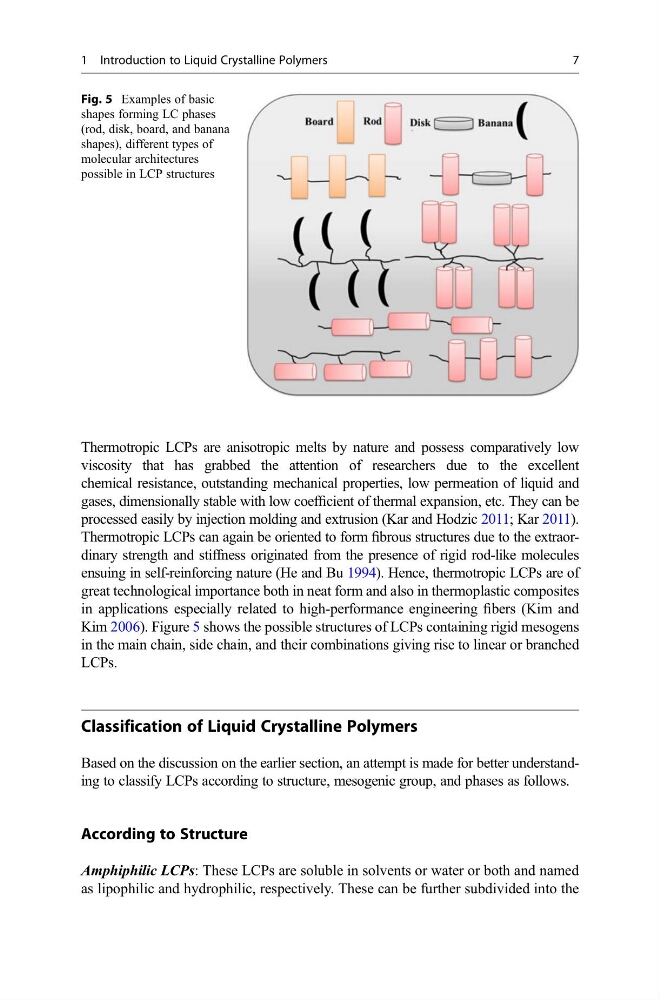
Kim 2006). Figure 5 shows the possible structures of LCPs containing rigid mesogens
in the main chain, side chain, and their combinations giving rise to linear or branched
LCPs.
Classification of Liquid Crystalline Polymers
Based on the discussion on the earlier section, an attempt is made for better understanding to classify LCPs according to structure, mesogenic group, and phases as follows.
According to Structure
Amphiphilic LCPs: These LCPs are soluble in solvents or water or both and named
as lipophilic and hydrophilic, respectively. These can be further subdivided into the
Fig. 5 Examples of basic
shapes forming LC phases
(rod, disk, board, and banana
shapes), different types of
molecular architectures
possible in LCP structures
1 Introduction to Liquid Crystalline Polymers
7
viscosity that has grabbed the attention of researchers due to the excellent
chemical resistance, outstanding mechanical properties, low permeation of liquid and
gases, dimensionally stable with low coefficient of thermal expansion, etc. They can be
processed easily by injection molding and extrusion (Kar and Hodzic 2011; Kar 2011).
Thermotropic LCPs can again be oriented to form fibrous structures due to the extraordinary strength and stiffness originated from the presence of rigid rod-like molecules
ensuing in self-reinforcing nature (He and Bu 1994). Hence, thermotropic LCPs are of
great technological importance both in neat form and also in thermoplastic composites
in applications especially related to high-performance engineering fibers (Kim and
Kim 2006). Figure 5 shows the possible structures of LCPs containing rigid mesogens
in the main chain, side chain, and their combinations giving rise to linear or branched
LCPs.
Classification of Liquid Crystalline Polymers
Based on the discussion on the earlier section, an attempt is made for better understanding to classify LCPs according to structure, mesogenic group, and phases as follows.
According to Structure
Amphiphilic LCPs: These LCPs are soluble in solvents or water or both and named
as lipophilic and hydrophilic, respectively. These can be further subdivided into the
Fig. 5 Examples of basic
shapes forming LC phases
(rod, disk, board, and banana
shapes), different types of
molecular architectures
possible in LCP structures
1 Introduction to Liquid Crystalline Polymers
7