

are capable to assemble to generate LCPs in a similar way liquid crystal does with a
single mesogen molecule. They have a fine combination of physicomechanical
properties and extraordinary optical properties similar to liquid crystals. The LCPs
have great potential and a matter of interest to the modern research field due to the
tunable ordered supramolecular structures. The structural organization plays a major
role in deciding the physicomechanical properties of these polymers since these can
be easily altered by external mechanical and electromagnetic fields, thermal effects,
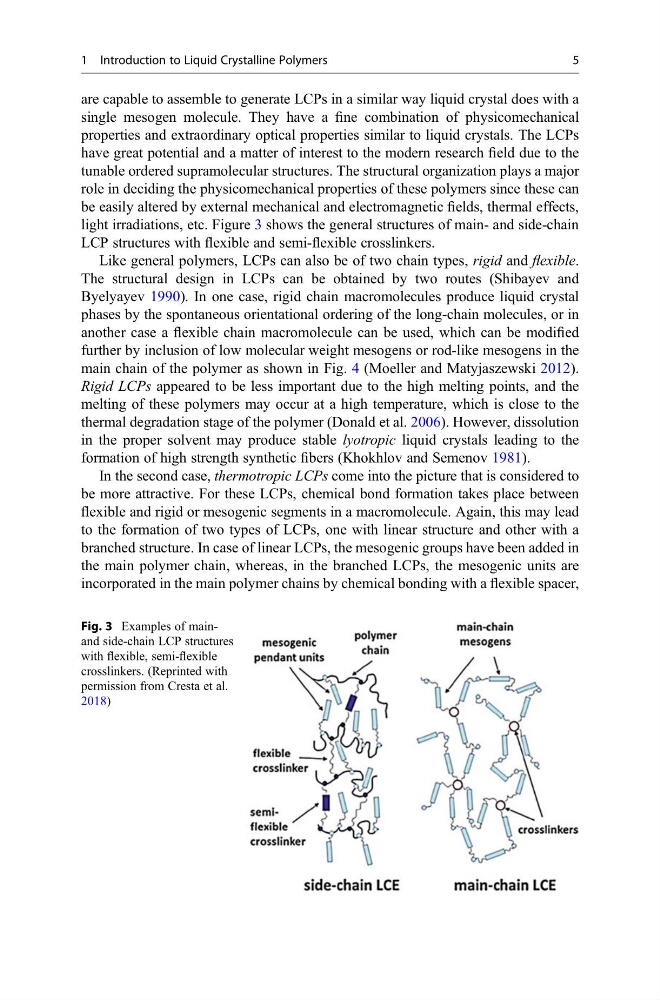
light irradiations, etc. Figure 3 shows the general structures of main- and side-chain
LCP structures with flexible and semi-flexible crosslinkers.
Like general polymers, LCPs can also be of two chain types, rigid and flexible.
The structural design in LCPs can be obtained by two routes (Shibayev and
Byelyayev 1990). In one case, rigid chain macromolecules produce liquid crystal
phases by the spontaneous orientational ordering of the long-chain molecules, or in
another case a flexible chain macromolecule can be used, which can be modified
further by inclusion of low molecular weight mesogens or rod-like mesogens in the
main chain of the polymer as shown in Fig. 4 (Moeller and Matyjaszewski 2012).
Rigid LCPs appeared to be less important due to the high melting points, and the
melting of these polymers may occur at a high temperature, which is close to the
thermal degradation stage of the polymer (Donald et al. 2006). However, dissolution
in the proper solvent may produce stable lyotropic liquid crystals leading to the
formation of high strength synthetic fibers (Khokhlov and Semenov 1981).
In the second case, thermotropic LCPs come into the picture that is considered to
be more attractive. For these LCPs, chemical bond formation takes place between
flexible and rigid or mesogenic segments in a macromolecule. Again, this may lead
to the formation of two types of LCPs, one with linear structure and other with a
branched structure. In case of linear LCPs, the mesogenic groups have been added in
the main polymer chain, whereas, in the branched LCPs, the mesogenic units are
incorporated in the main polymer chains by chemical bonding with a flexible spacer,
Fig. 3 Examples of mainand side-chain LCP structures
with flexible, semi-flexible
crosslinkers. (Reprinted with
permission from Cresta et al.
2018)
1 Introduction to Liquid Crystalline Polymers
5
single mesogen molecule. They have a fine combination of physicomechanical
properties and extraordinary optical properties similar to liquid crystals. The LCPs
have great potential and a matter of interest to the modern research field due to the
tunable ordered supramolecular structures. The structural organization plays a major
role in deciding the physicomechanical properties of these polymers since these can
be easily altered by external mechanical and electromagnetic fields, thermal effects,
light irradiations, etc. Figure 3 shows the general structures of main- and side-chain
LCP structures with flexible and semi-flexible crosslinkers.
Like general polymers, LCPs can also be of two chain types, rigid and flexible.
The structural design in LCPs can be obtained by two routes (Shibayev and
Byelyayev 1990). In one case, rigid chain macromolecules produce liquid crystal
phases by the spontaneous orientational ordering of the long-chain molecules, or in
another case a flexible chain macromolecule can be used, which can be modified
further by inclusion of low molecular weight mesogens or rod-like mesogens in the
main chain of the polymer as shown in Fig. 4 (Moeller and Matyjaszewski 2012).
Rigid LCPs appeared to be less important due to the high melting points, and the
melting of these polymers may occur at a high temperature, which is close to the
thermal degradation stage of the polymer (Donald et al. 2006). However, dissolution
in the proper solvent may produce stable lyotropic liquid crystals leading to the
formation of high strength synthetic fibers (Khokhlov and Semenov 1981).
In the second case, thermotropic LCPs come into the picture that is considered to
be more attractive. For these LCPs, chemical bond formation takes place between
flexible and rigid or mesogenic segments in a macromolecule. Again, this may lead
to the formation of two types of LCPs, one with linear structure and other with a
branched structure. In case of linear LCPs, the mesogenic groups have been added in
the main polymer chain, whereas, in the branched LCPs, the mesogenic units are
incorporated in the main polymer chains by chemical bonding with a flexible spacer,
Fig. 3 Examples of mainand side-chain LCP structures
with flexible, semi-flexible
crosslinkers. (Reprinted with
permission from Cresta et al.
2018)
1 Introduction to Liquid Crystalline Polymers
5