

Poser 1996; Fischer et al. 1994; Gallot 1996; Walther and Finkelmann 1996).
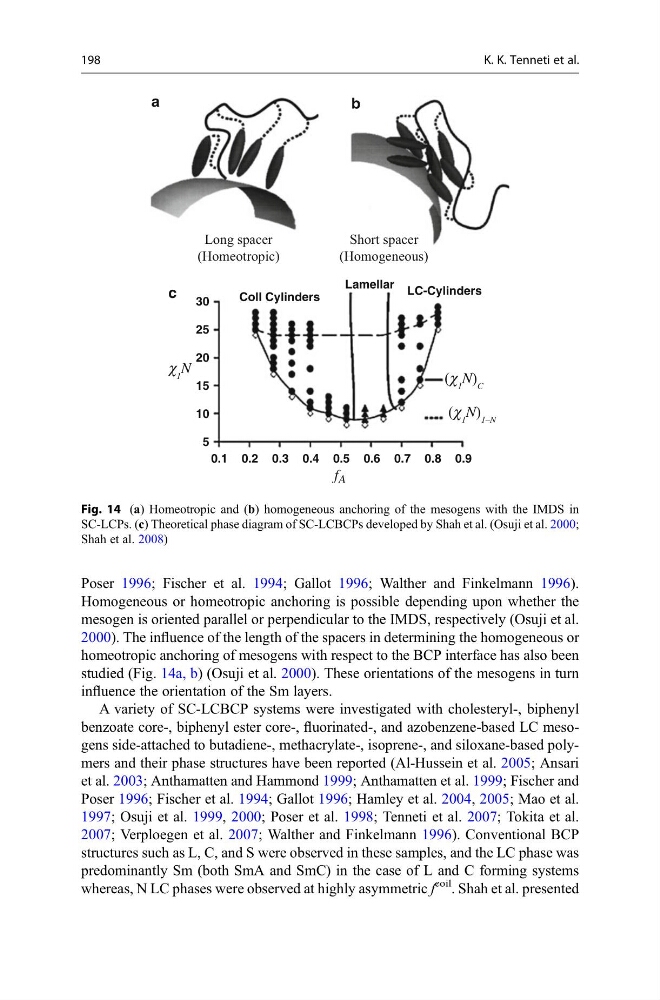
Homogeneous or homeotropic anchoring is possible depending upon whether the
mesogen is oriented parallel or perpendicular to the IMDS, respectively (Osuji et al.
2000). The influence of the length of the spacers in determining the homogeneous or
homeotropic anchoring of mesogens with respect to the BCP interface has also been
studied (Fig. 14a, b) (Osuji et al. 2000). These orientations of the mesogens in turn
influence the orientation of the Sm layers.
A variety of SC-LCBCP systems were investigated with cholesteryl-, biphenyl
benzoate core-, biphenyl ester core-, fluorinated-, and azobenzene-based LC mesogens side-attached to butadiene-, methacrylate-, isoprene-, and siloxane-based polymers and their phase structures have been reported (Al-Hussein et al. 2005; Ansari
et al. 2003; Anthamatten and Hammond 1999; Anthamatten et al. 1999; Fischer and
Poser 1996; Fischer et al. 1994; Gallot 1996; Hamley et al. 2004, 2005; Mao et al.
1997; Osuji et al. 1999, 2000; Poser et al. 1998; Tenneti et al. 2007; Tokita et al.
2007; Verploegen et al. 2007; Walther and Finkelmann 1996). Conventional BCP
structures such as L, C, and S were observed in these samples, and the LC phase was
predominantly Sm (both SmA and SmC) in the case of L and C forming systems
whereas, N LC phases were observed at highly asymmetric f
coil . Shah et al. presented
a
b
Long spacer
(Homeotropic)
Short spacer
(Homogeneous)
c
0.1
5
10
15
20
25
30
0.2 0.3 0.4 0.5
f A
c 1 N
(c 1 N) C
(c 1 N) 1–N
0.6
Coll Cylinders
Lamellar LC-Cylinders
0.7 0.8 0.9
Fig. 14 (a) Homeotropic and (b) homogeneous anchoring of the mesogens with the IMDS in
SC-LCPs. (c) Theoretical phase diagram of SC-LCBCPs developed by Shah et al. (Osuji et al. 2000;
Shah et al. 2008)
198
K. K. Tenneti et al.
Homogeneous or homeotropic anchoring is possible depending upon whether the
mesogen is oriented parallel or perpendicular to the IMDS, respectively (Osuji et al.
2000). The influence of the length of the spacers in determining the homogeneous or
homeotropic anchoring of mesogens with respect to the BCP interface has also been
studied (Fig. 14a, b) (Osuji et al. 2000). These orientations of the mesogens in turn
influence the orientation of the Sm layers.
A variety of SC-LCBCP systems were investigated with cholesteryl-, biphenyl
benzoate core-, biphenyl ester core-, fluorinated-, and azobenzene-based LC mesogens side-attached to butadiene-, methacrylate-, isoprene-, and siloxane-based polymers and their phase structures have been reported (Al-Hussein et al. 2005; Ansari
et al. 2003; Anthamatten and Hammond 1999; Anthamatten et al. 1999; Fischer and
Poser 1996; Fischer et al. 1994; Gallot 1996; Hamley et al. 2004, 2005; Mao et al.
1997; Osuji et al. 1999, 2000; Poser et al. 1998; Tenneti et al. 2007; Tokita et al.
2007; Verploegen et al. 2007; Walther and Finkelmann 1996). Conventional BCP
structures such as L, C, and S were observed in these samples, and the LC phase was
predominantly Sm (both SmA and SmC) in the case of L and C forming systems
whereas, N LC phases were observed at highly asymmetric f
coil . Shah et al. presented
a
b
Long spacer
(Homeotropic)
Short spacer
(Homogeneous)
c
0.1
5
10
15
20
25
30
0.2 0.3 0.4 0.5
f A
c 1 N
(c 1 N) C
(c 1 N) 1–N
0.6
Coll Cylinders
Lamellar LC-Cylinders
0.7 0.8 0.9
Fig. 14 (a) Homeotropic and (b) homogeneous anchoring of the mesogens with the IMDS in
SC-LCPs. (c) Theoretical phase diagram of SC-LCBCPs developed by Shah et al. (Osuji et al. 2000;
Shah et al. 2008)
198
K. K. Tenneti et al.